Duration and degree of excess body mass index were linked to cancer risk
Excess weight by degree and duration and cancer risk (ABACus2 consortium): a cohort study and individual participant data meta-analysis
Cohort study and individual participant data meta-analysisKey finding
Are adulthood overweight-years and single body mass index associated with cancer incidence?
Who
720210
720,210 participants including 312,132 men and 408,078 women · Four US cohorts and one European cohort
Compared
Men per 1 standard deviation overweight-years: hazard ratio 1.15 (95% CI: 1.14, 1.16)
Men per 1 standard deviation single BMI: hazard ratio 1.17 (95% CI: 1.16, 1.18)
Women per 1 standard deviation overweight-years: hazard ratio 1.08 (95% CI: 1.04, 1.13)
Women per 1 standard deviation single BMI: hazard ratio 1.10 (95% CI: 1.07, 1.14)
Main outcome
obesity-related cancer incidence
Bottom line: Adulthood degree and duration of excess body mass index are associated with increased cancer risk.
Funded by: Cancer Research UK, National Cancer Institute, and others
eClinicalMedicine · 2024-11-19 · Save PNG
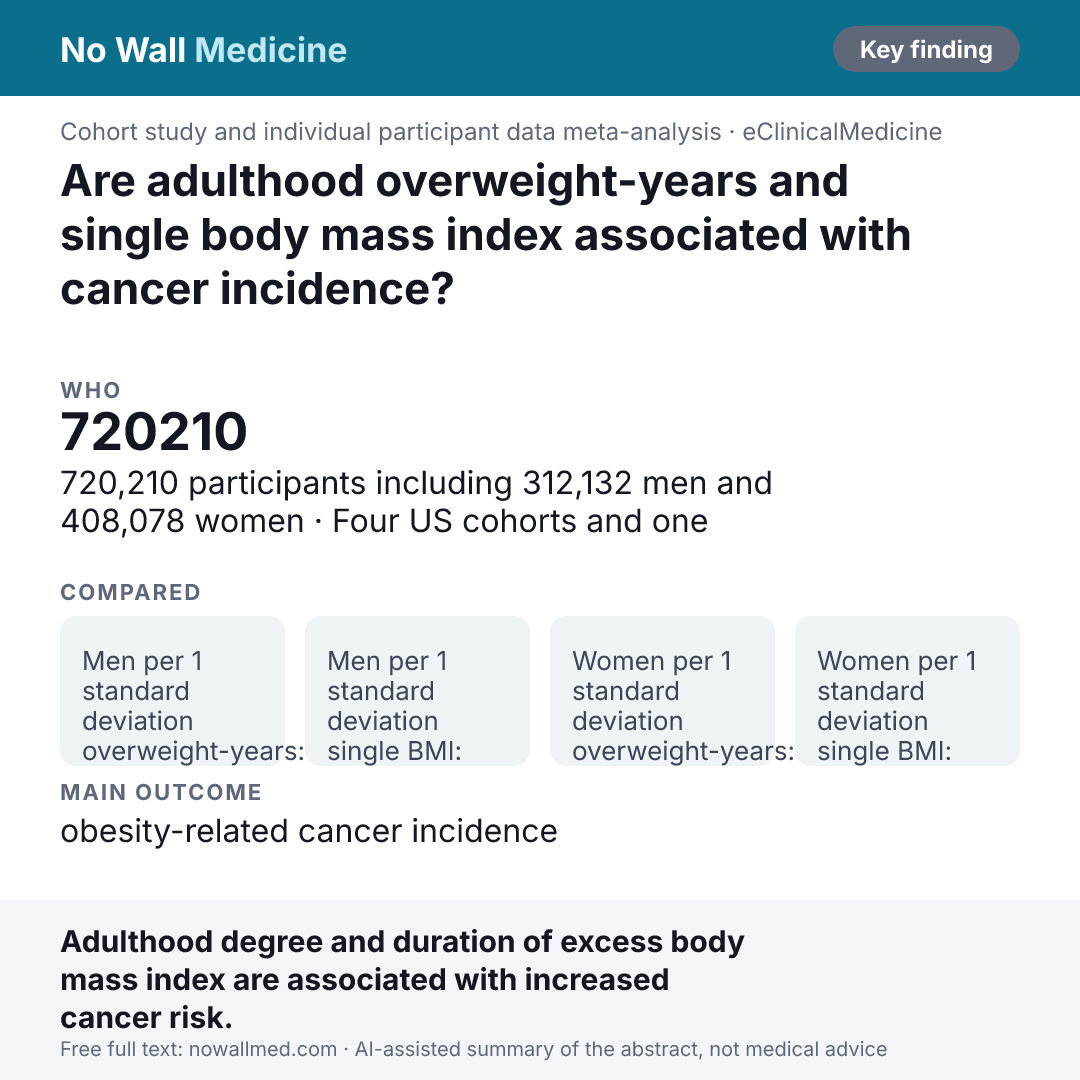
Clinical question: Are adulthood overweight-years and single body mass index associated with cancer incidence?
Why it matters: A single body mass index measurement does not capture how much excess weight a person carries or how long they have carried it.
Key points
- Researchers analyzed 720,210 participants, including 312,132 men and 408,078 women, to compare single body mass index (BMI) against overweight-years, which measures the degree and duration of excess weight.
- In men, each 1 standard deviation increase in overweight-years was associated with a hazard ratio of 1.15 for obesity-related cancers, while single BMI was associated with a hazard ratio of 1.17.
- In women, each 1 standard deviation increase in overweight-years was associated with a hazard ratio of 1.08, while single BMI was associated with a hazard ratio of 1.10 or 1.11.
Headline and key points written with AI from the paper’s abstract, with every number checked against it. Read the paper before relying on them.
Was this summary helpful?
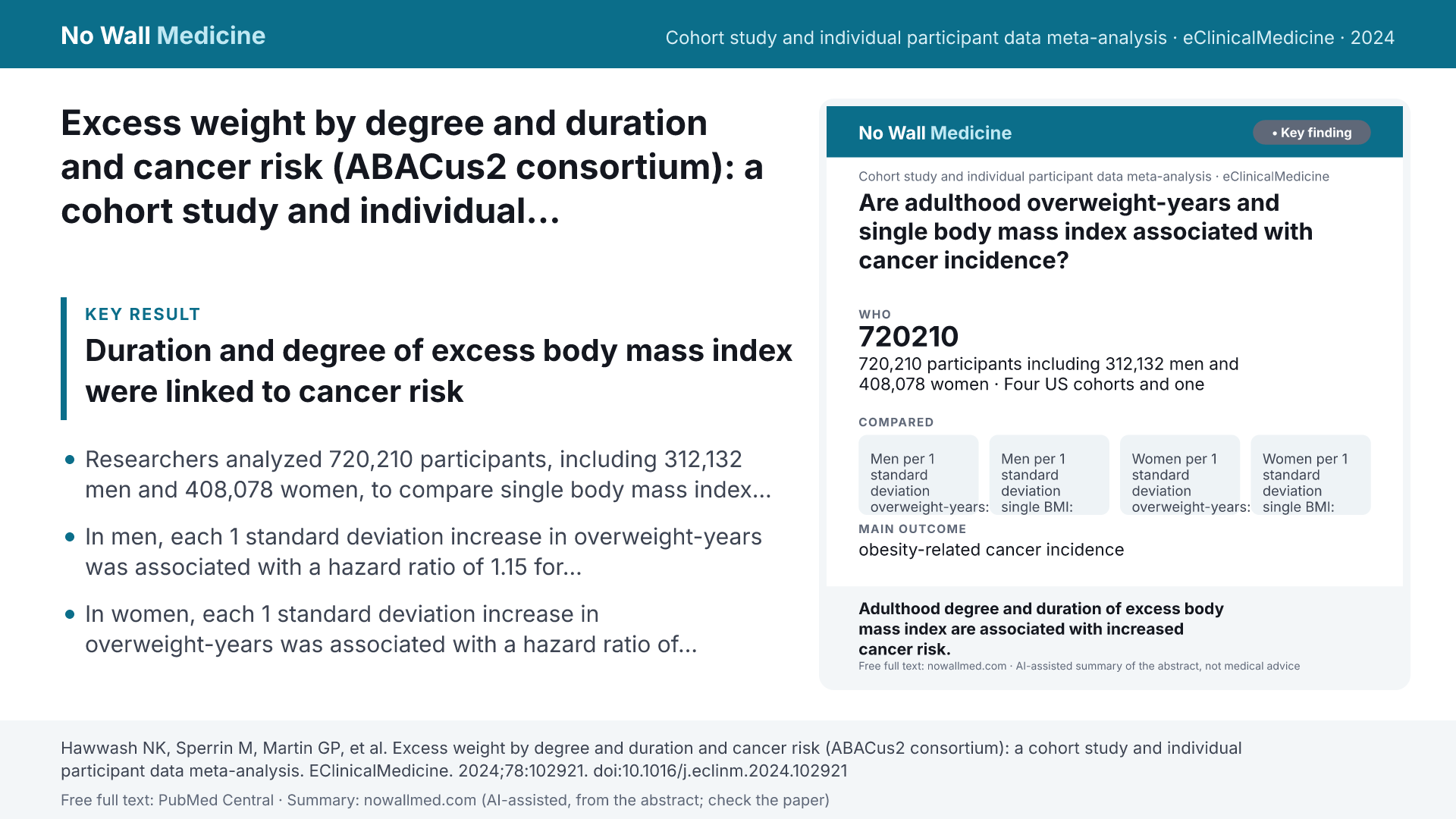
Headline, design, result, key points, caveat and citation as plain text.
Cite this article
Hawwash NK, Sperrin M, Martin GP, et al. Excess weight by degree and duration and cancer risk (ABACus2 consortium): a cohort study and individual participant data meta-analysis. EClinicalMedicine. 2024;78:102921. doi:10.1016/j.eclinm.2024.102921
Spotted a mistake? Suggest a correction