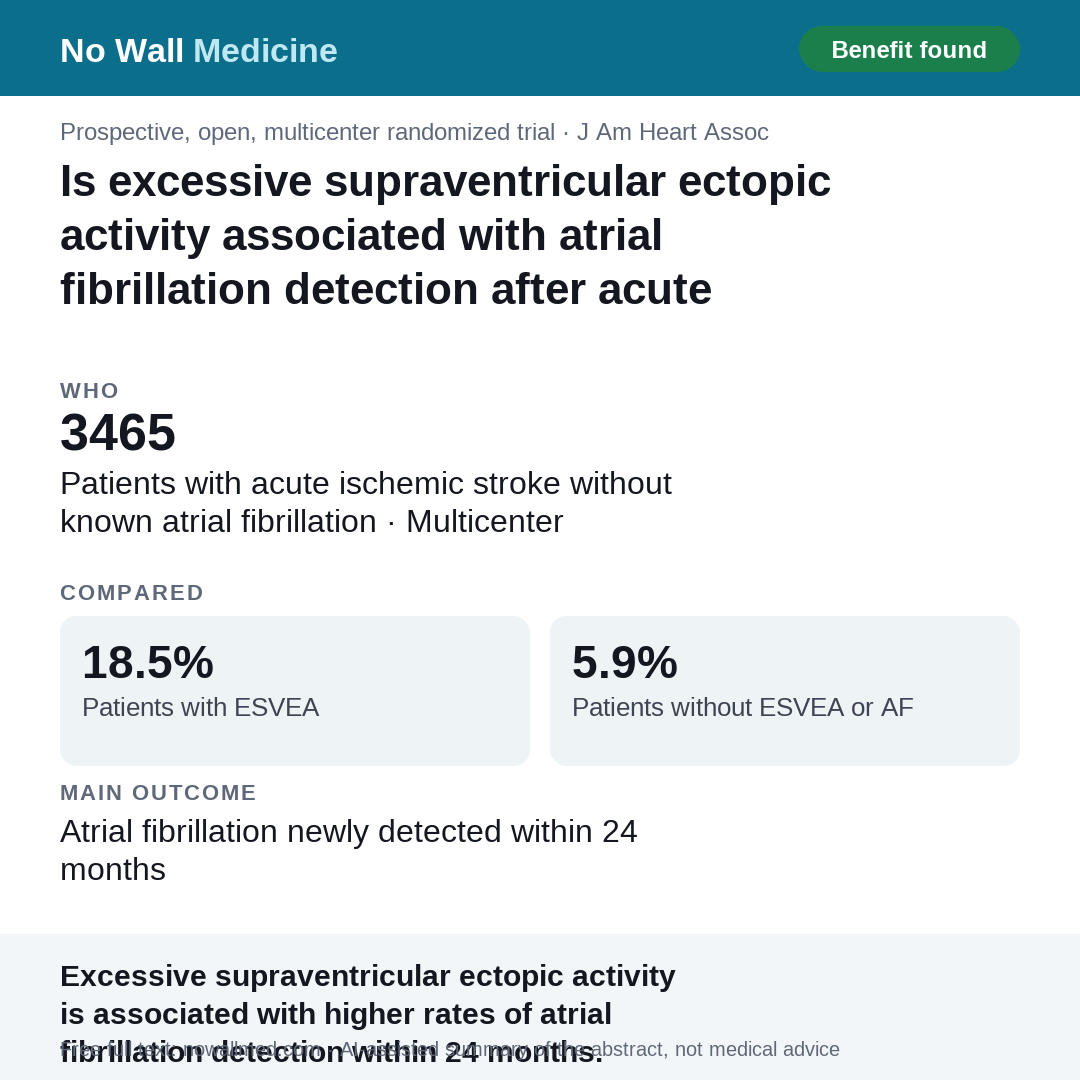
Excessive supraventricular ectopic activity was associated with higher rates of atrial fibrillation detection after stroke
Excessive Supraventricular Ectopic Activity in Patients With Acute Ischemic Stroke Is Associated With Atrial Fibrillation Detection Within 24 Months After Stroke: A Predefined Analysis of the MonDAFIS Study
Prospective, open, multicenter randomized trialBenefit found
Is excessive supraventricular ectopic activity associated with atrial fibrillation detection after acute ischemic stroke?
Who
3465
Patients with acute ischemic stroke without known atrial fibrillation · Multicenter
Compared
18.5%Patients with ESVEA
5.9%Patients without ESVEA or AF
Main outcome
Atrial fibrillation newly detected within 24 months
Bottom line: Excessive supraventricular ectopic activity is associated with higher rates of atrial fibrillation detection within 24 months.
J Am Heart Assoc · 2025-01-10Download image
Clinical question: Is excessive supraventricular ectopic activity associated with atrial fibrillation detection after acute ischemic stroke?
Why it matters: It was unknown if excessive supraventricular ectopic activity, which includes extra heartbeats or short bursts of irregular rhythm, serves as a marker for detecting atrial fibrillation after a stroke.
Key points
- Researchers analyzed 1714 patients randomized to receive additive Holter monitoring, which is a portable device that records heart rhythms, for up to 7 days after an acute ischemic stroke.
- Within 24 months, atrial fibrillation was newly detected in 18.5% of patients with excessive supraventricular ectopic activity compared to 5.9% of patients without that activity or atrial fibrillation.
- The composite outcome at 24 months was not different between patients with excessive supraventricular ectopic activity and those without, at 15.2% versus 12.6% (P=0.242).
Headline and key points written with AI from the paper’s abstract, with every number checked against it. Read the paper before relying on them.
Topics
Cite this article
Haeusler KG, Tütüncü S, Fiessler C, Jawad-Ul-Qamar M, Kunze C, Schurig J. Excessive Supraventricular Ectopic Activity in Patients With Acute Ischemic Stroke Is Associated With Atrial Fibrillation Detection Within 24 Months After Stroke: A Predefined Analysis of the MonDAFIS Study. J Am Heart Assoc. 2025. doi:10.1161/JAHA.123.034512
Spotted a mistake? Suggest a correction
Top studies every Monday
The week’s key trials and guidelines in your specialties, by email. Free.
Get the weekly digest