Resistance exercise training may reduce white matter hyperintensity progression in women with cognitive impairment
Exercise and white matter hyperintensities: a randomized clinical trial
Single-blinded, proof-of-concept randomized clinical trialMixed results
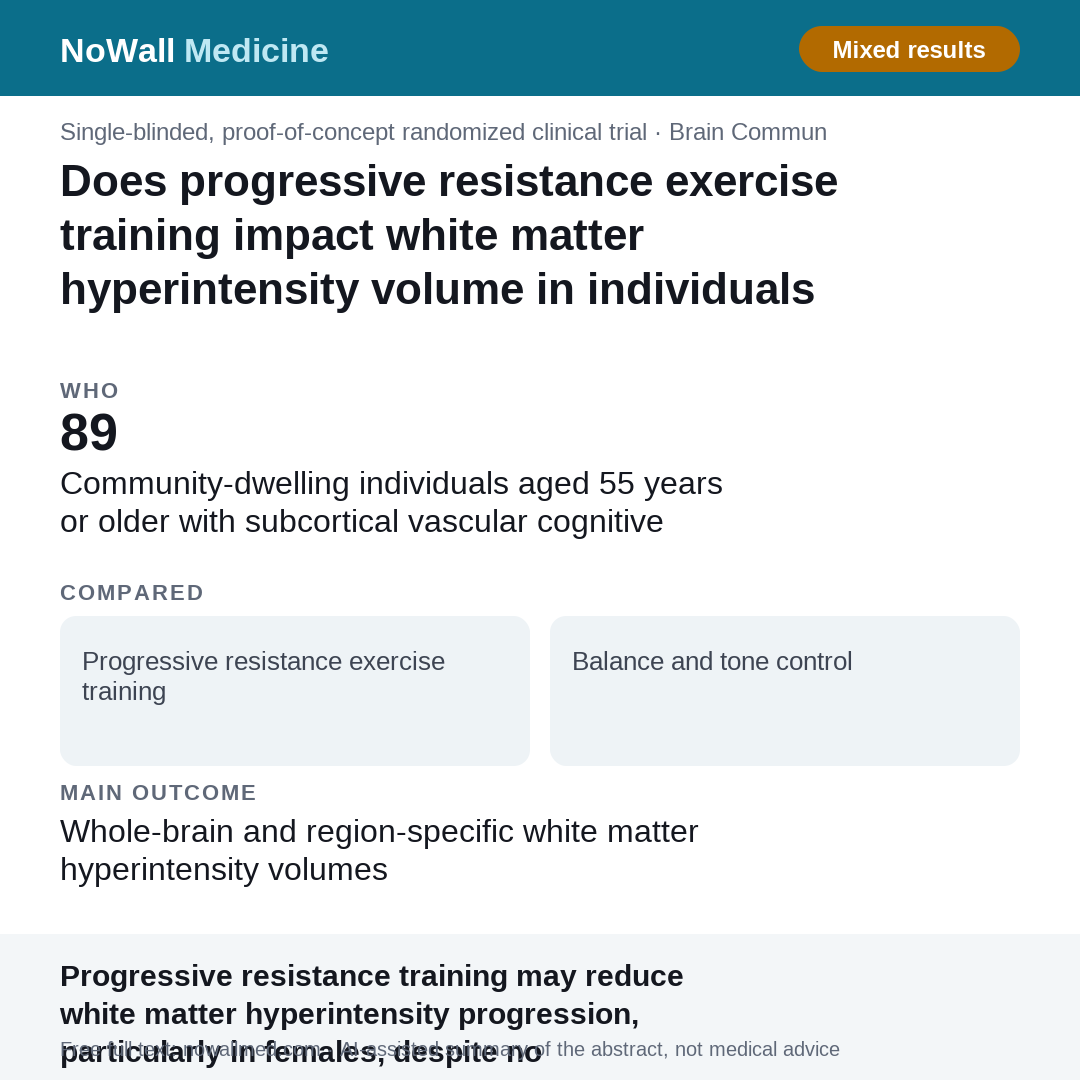
Does progressive resistance exercise training impact white matter hyperintensity volume in individuals with subcortical vascular cognitive impairment?
Who
89
Community-dwelling individuals aged 55 years or older with subcortical vascular cognitive impairment
Compared
Progressive resistance exercise training
Balance and tone control
Main outcome
Whole-brain and region-specific white matter hyperintensity volumes
Result: -0.016 (-0.052 to 0.019) log-transformed cm3
Bottom line: Progressive resistance training may reduce white matter hyperintensity progression, particularly in females, despite no significant whole-brain difference.
Brain Commun · 2026-10-08Download image
Clinical question: Does progressive resistance exercise training impact white matter hyperintensity volume in individuals with subcortical vascular cognitive impairment?
Why it matters: White matter hyperintensity lesions are a hallmark of subcortical vascular cognitive impairment, which is a risk factor for dementia.
Key points
- Researchers studied 89 community-dwelling individuals aged 55 years or older with subcortical vascular cognitive impairment, comparing resistance training to a balance and tone control group.
- While whole-brain white matter hyperintensity volume showed no difference between groups, resistance training significantly reduced these lesion volumes in the temporal lobe and splenium of the corpus callosum.
- In female participants, resistance training significantly reduced whole-brain white matter hyperintensity volume, but no such effect was found in male participants.
Headline and key points written with AI from the paper’s abstract, with every number checked against it. Read the paper before relying on them.
Spotted a mistake? Suggest a correction
More in Neurology
Automated model correctly identified 68 out of 90 seizure events as epileptic or nonepileptic
Video-Based Automated Seizure Classification Using Multimodal Large Language Models
Neuroimmune interactions contribute to migraine headache generation
Cortical and meningeal neuroimmune interactions contribute to the generation of migraine headaches
Pain and depressive symptoms linked to lower cognitive performance in older adults
Joint trajectories of pain and depressive symptoms in relation to repeated cognitive performance: a harmonized longitudinal analysis of four aging cohorts
AD biomarker-positive participants with DLB had faster cognitive decline than biomarker-negative ones
Biomarker-informed differences in treatment-associated cognitive decline in dementia with Lewy bodies