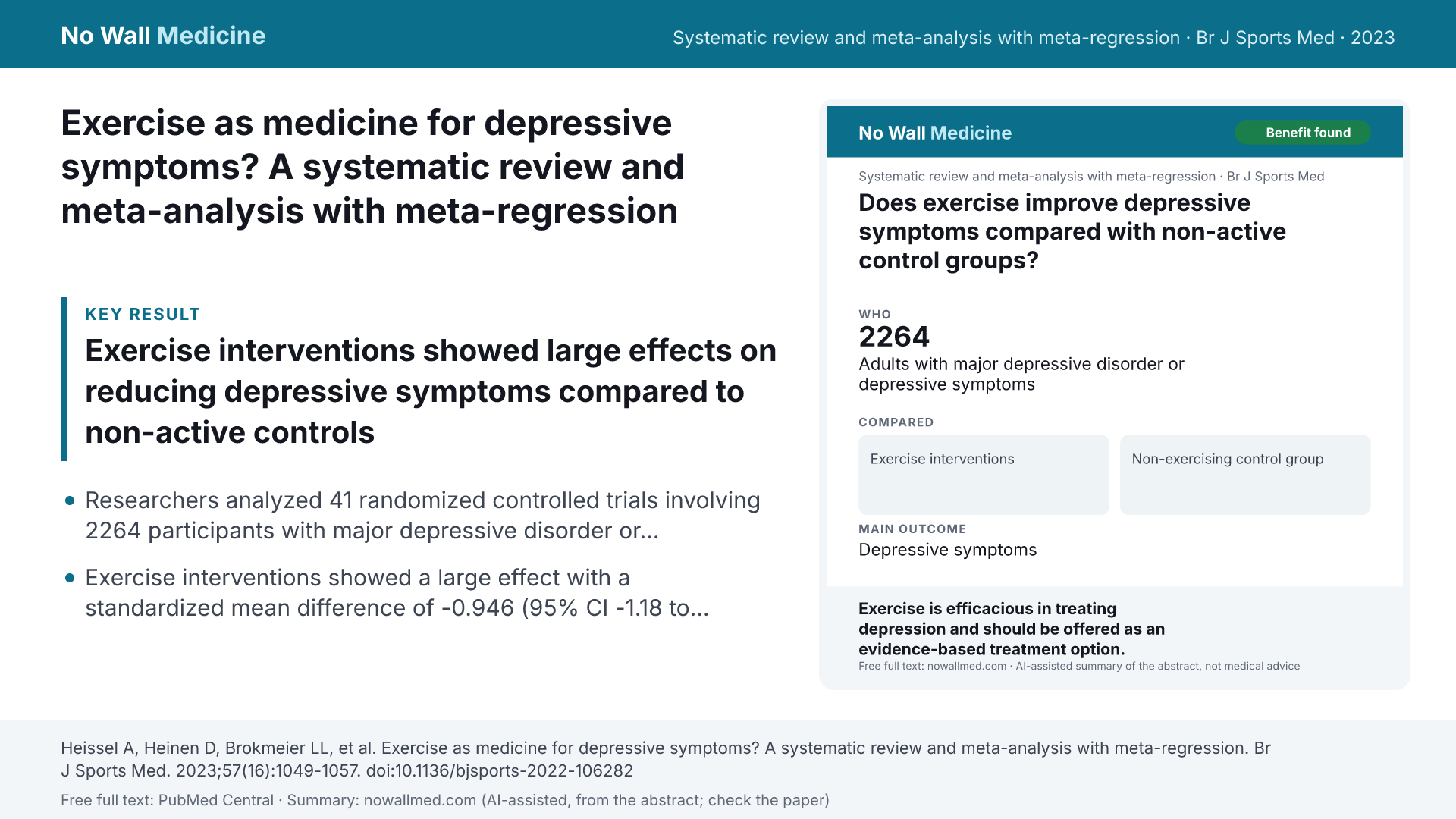
Exercise interventions showed large effects on reducing depressive symptoms compared to non-active controls
Exercise as medicine for depressive symptoms? A systematic review and meta-analysis with meta-regression
Systematic review and meta-analysis with meta-regressionBenefit found
Does exercise improve depressive symptoms compared with non-active control groups?
Who
2264
Adults with major depressive disorder or depressive symptoms
Compared
Exercise interventions
Non-exercising control group
Main outcome
Depressive symptoms
Result: standardised mean difference -0.946 (95% CI -1.18 to -0.71)
Bottom line: Exercise is efficacious in treating depression and should be offered as an evidence-based treatment option.
Limitation: Small sample sizes of many trials and high heterogeneity in methods.
Br J Sports Med · 2023-02-01 · Save PNG
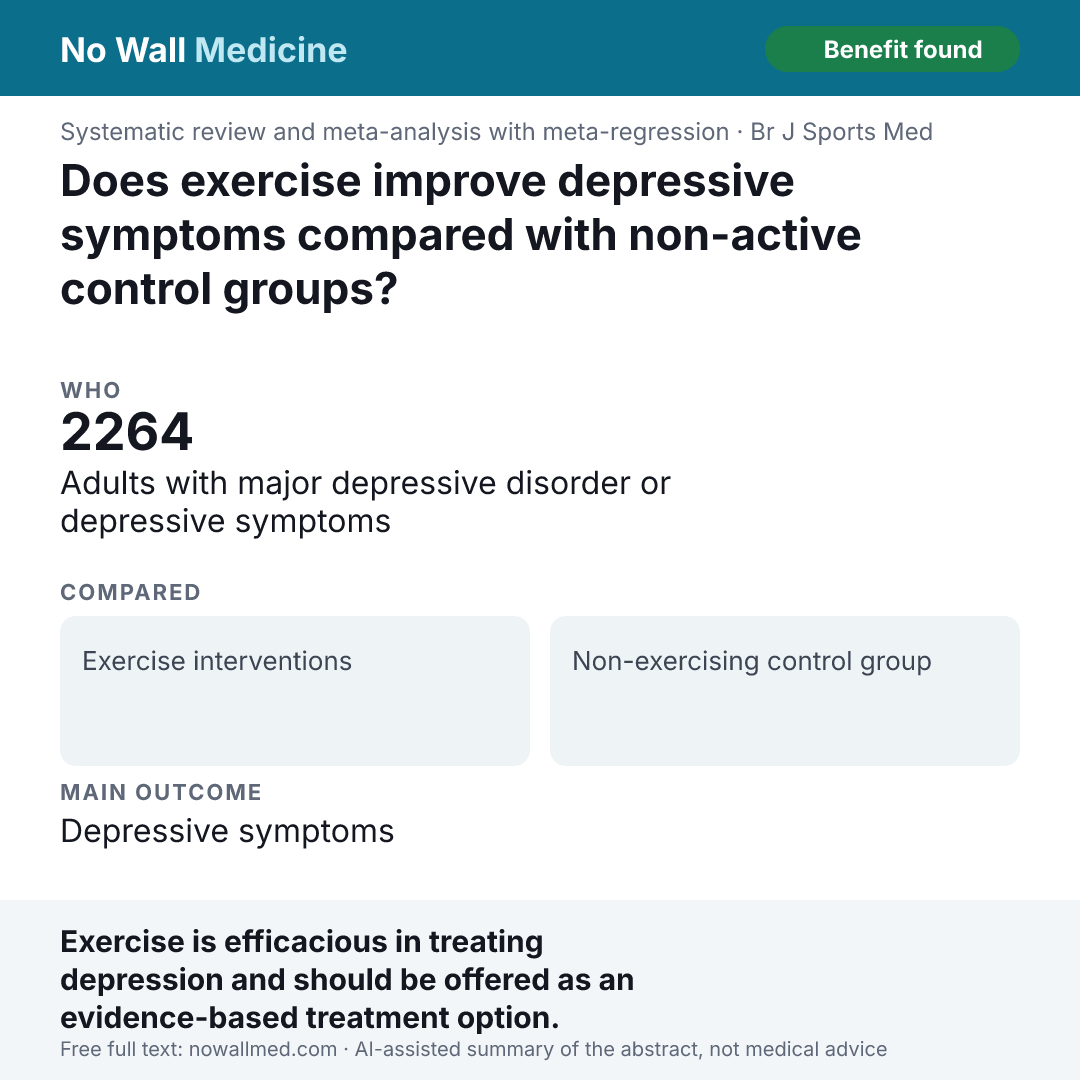
Clinical question: Does exercise improve depressive symptoms compared with non-active control groups?
Why it matters: The efficacy of exercise compared to non-active control groups for treating depression and depressive symptoms needed to be estimated.
Key points
- Researchers analyzed 41 randomized controlled trials involving 2264 participants with major depressive disorder or depressive symptoms.
- Exercise interventions showed a large effect with a standardized mean difference of -0.946 (95% CI -1.18 to -0.71) and a number needed to treat of 2 (95% CI 1.68 to 2.59).
- Large effects were observed in supervised exercise interventions with a standardized mean difference of -1.026 (95% CI -1.28 to -0.77).
Limitation the authors note: The authors noted that many trials had small sample sizes and there was high heterogeneity in methods.
Headline and key points written with AI from the paper’s abstract, with every number checked against it. Read the paper before relying on them.
Was this summary helpful?
Abstract
Objective
To estimate the efficacy of exercise on depressive symptoms compared with non-active control groups and to determine the moderating effects of exercise on depression and the presence of publication bias. Design
Systematic review and meta-analysis with meta-regression. Data sources
The Cochrane Central Register of Controlled Trials, PubMed, MEDLINE, Embase, SPORTDiscus, PsycINFO, Scopus and Web of Science were searched without language restrictions from inception to 13 September2022 (PROSPERO registration no CRD42020210651). Eligibility criteria for selecting studies
Randomised controlled trials including participants aged 18 years or older with a diagnosis of major depressive disorder or those with depressive symptoms determined by validated screening measures scoring above the threshold value, investigating the effects of an exercise intervention (aerobic and/or resistance exercise) compared with a non-exercising control group. Results
Forty-one studies, comprising 2264 participants post intervention were included in the meta-analysis demonstrating large effects (standardised mean difference (SMD)=-0.946, 95% CI -1.18 to -0.71) favouring exercise interventions which corresponds to the number needed to treat (NNT)=2 (95% CI 1.68 to 2.59). Large effects were found in studies with individuals with major depressive disorder (SMD=-0.998, 95% CI -1.39 to -0.61, k=20), supervised exercise interventions (SMD=-1.026, 95% CI -1.28 to -0.77, k=40) and moderate effects when analyses were restricted to low risk of bias studies (SMD=-0.666, 95% CI -0.99 to -0.34, k=12, NNT=2.8 (95% CI 1.94 to 5.22)). Conclusion
Exercise is efficacious in treating depression and depressive symptoms and should be offered as an evidence-based treatment option focusing on supervised and group exercise with moderate intensity and aerobic exercise regimes. The small sample sizes of many trials and high heterogeneity in methods should be considered when interpreting the results.
Abstract reproduced under the article’s CC BY NC licence.
Subject terms
Headline, design, result, key points, caveat and citation as plain text.
Cite this article
Heissel A, Heinen D, Brokmeier LL, et al. Exercise as medicine for depressive symptoms? A systematic review and meta-analysis with meta-regression. Br J Sports Med. 2023;57(16):1049-1057. doi:10.1136/bjsports-2022-106282
Spotted a mistake? Suggest a correction