Exercise for falls prevention in aged care: systematic review and trial endpoint meta-analyses
Systematic review and meta-analysisMixed results
Does exercise prevent falls in residential aged care?
Who
Older people living in residential aged care · Residential aged care
Compared
Exercise
Usual care
Main outcome
Number of falls and risk of falling
Result: rate ratio 0.68 (95% CI 0.49-0.95) at end of intervention
Bottom line: Exercise reduces falls during the intervention but has little or no lasting effect after the programme ends.
Age Ageing · 2023-12-18Download image
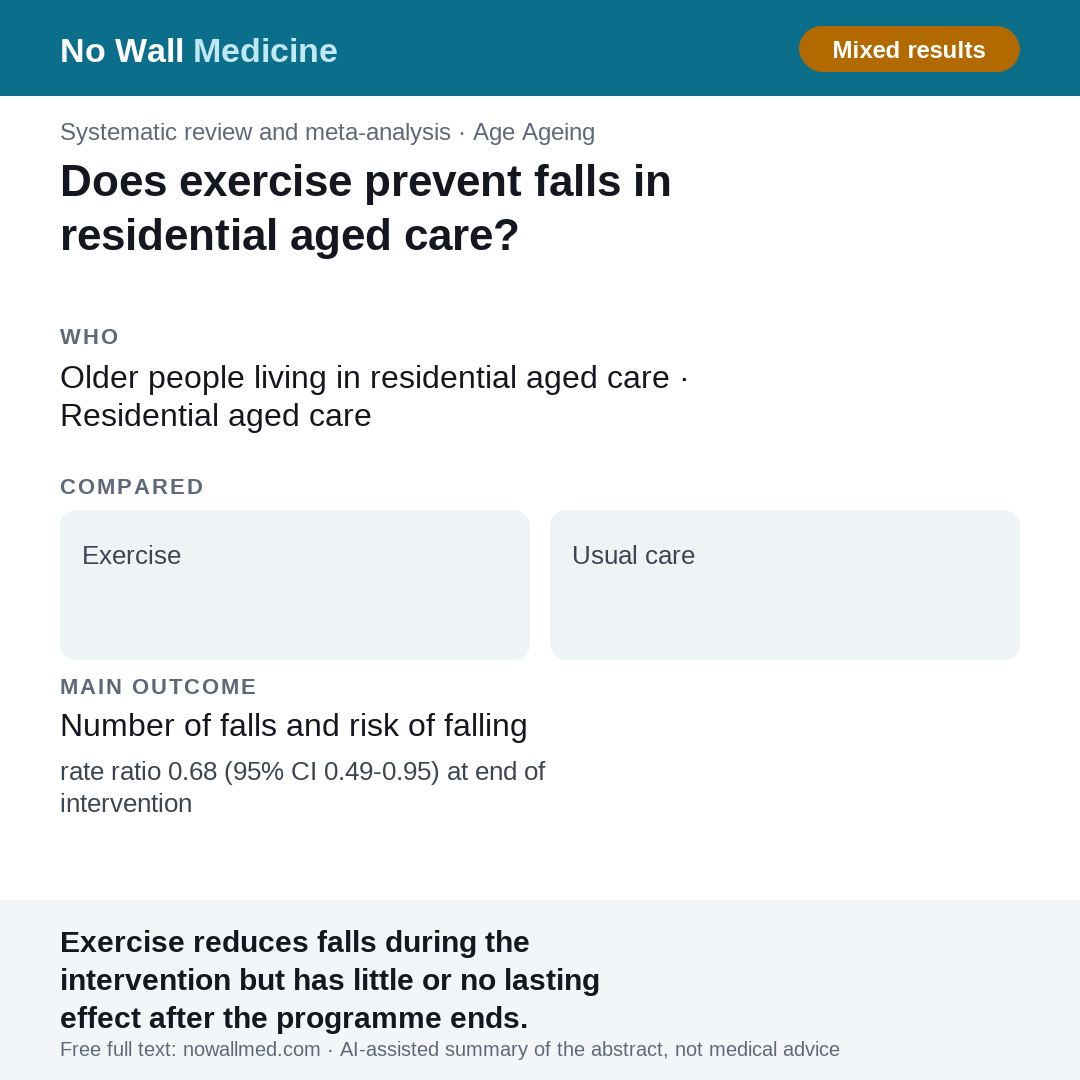
Clinical question: Does exercise prevent falls in residential aged care?
Abstract
Background
There is strong evidence that exercise reduces falls in older people living in the community, but its effectiveness in residential aged care is less clear. This systematic review examines the effectiveness of exercise for falls prevention in residential aged care, meta-analysing outcomes measured immediately after exercise or after post-intervention follow-up. Methods
Systematic review and meta-analysis, including randomised controlled trials from a Cochrane review and additional trials, published to December 2022. Trials of exercise as a single intervention compared to usual care, reporting data suitable for meta-analysis of rate or risk of falls, were included. Meta-analyses were conducted according to Cochrane Collaboration methods and quality of evidence rated using the Grading of Recommendations Assessment, Development and Evaluation approach. Results
12 trials from the Cochrane review plus 7 new trials were included. At the end of the intervention period, exercise probably reduces the number of falls (13 trials, rate ratio [RaR] = 0.68, 95% confidence interval [CI] = 0.49-0.95), but after post-intervention follow-up exercise had little or no effect (8 trials, RaR = 1.01, 95% CI = 0.80-1.28). The effect on the risk of falling was similar (end of intervention risk ratio (RR) = 0.84, 95% CI = 0.72-0.98, 12 trials; post-intervention follow-up RR = 1.05, 95% CI = 0.92-1.20, 8 trials). There were no significant subgroup differences according to cognitive impairment. Conclusions
Exercise is recommended as a fall prevention strategy for older people living in aged care who are willing and able to participate (moderate certainty evidence), but exercise has little or no lasting effect on falls after the end of a programme (high certainty evidence).
Topics
Cite this article
Dyer SM, Suen J, Kwok WS, Dawson R, McLennan C, Cameron ID. Exercise for falls prevention in aged care: systematic review and trial endpoint meta-analyses. Age Ageing. 2023. doi:10.1093/ageing/afad217
Spotted a mistake? Suggest a correction
Top studies every Monday
The week’s key trials and guidelines in your specialties, plus any topics you follow. By email, free.
Get the weekly digest