Twelve weeks of high intensity interval training increased brain structure markers in people with cannabis use disorder
Exercise-induced brain changes in cannabis use disorder: a longitudinal MRI study of a 12-week supervised HIIT program
Randomised, single-blind, comparator-controlled trialBenefit found
Does a 12-week high intensity interval training program change brain structure in cannabis use disorder?
Who
59
59 individuals with cannabis use disorder
Compared
High Intensity Interval Training: significant increases in fractional anisotropy and cortical thickness
Strength and Resistance training
Main outcome
brain structural organisation via diffusion and anatomical MRI scans
Bottom line: A 12-week high intensity interval training intervention can enhance brain plasticity in individuals with cannabis use disorder.
Mol Psychiatry · 2026-07-02Download image
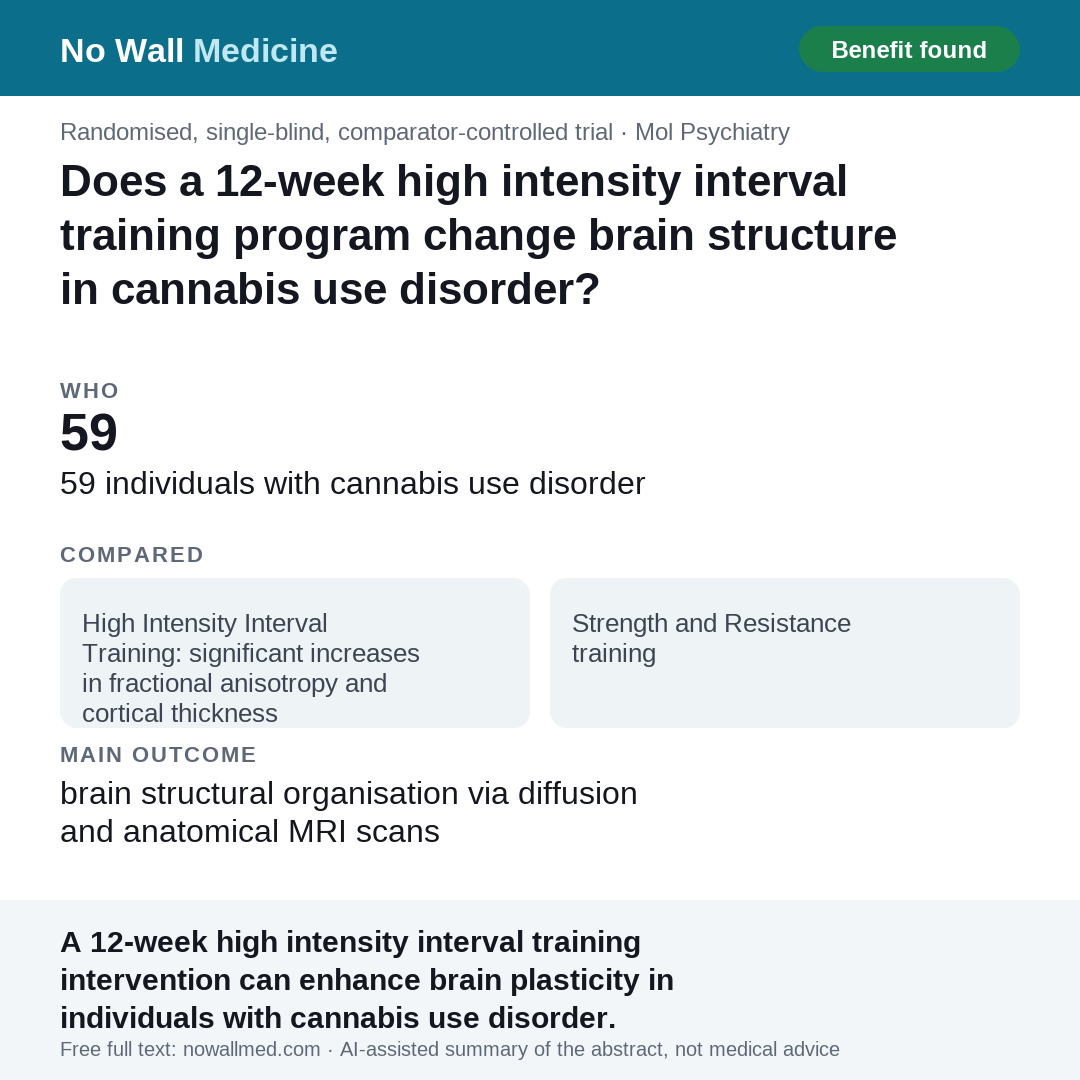
Clinical question: Does a 12-week high intensity interval training program change brain structure in cannabis use disorder?
Why it matters: Cannabis use disorder is associated with structural brain alterations, and non-abstinence-based interventions are needed to restore these changes.
Key points
- Researchers studied 59 individuals with cannabis use disorder, comparing 12 weeks of high intensity interval training to strength and resistance training.
- The high intensity group showed increased fractional anisotropy, a measure of white matter integrity, in the left uncinate fasciculus and increased cortical thickness in the right pars opercularis.
- These brain changes correlated with the total hours participants spent with heart rates above 80% of their maximum.
Headline and key points written with AI from the paper’s abstract, with every number checked against it. Read the paper before relying on them.
Topics
Spotted a mistake? Suggest a correction
More in Psychiatry & Mental Health
Depressive symptoms linked to stronger defensive response in panic disorder patients
Defensive reactivity to interoceptive perturbation in panic disorder: Depressive symptom burden and panic severity dimensions
Genes linked to mitochondria implicated in psychiatric disorders
Brain-derived multi-omics prioritization of mitochondria-related genes in schizophrenia, bipolar disorder, and major depressive disorder
Brain structure variations linked to alcohol use severity in large studies
A reproducible structural brain axis of alcohol use severity
Most animal psychedelic studies use stress-inducing methods and brief testing
Animal models in psychedelic research - Tripping over translation