Exercise training improves mitochondrial respiration and is associated with an altered intramuscular phospholipid signature in women with obesity
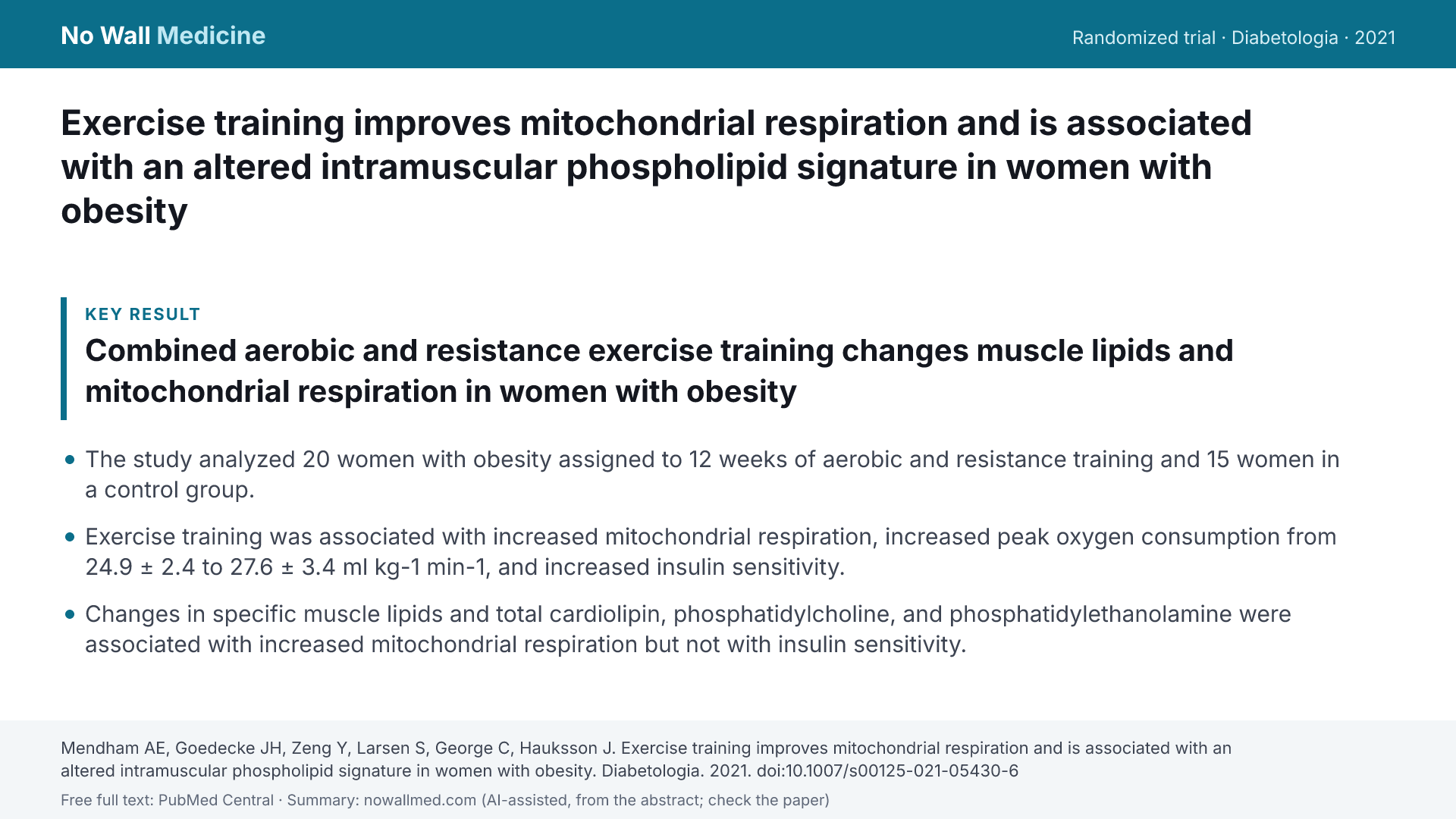
Key result: Combined aerobic and resistance exercise training changes muscle lipids and mitochondrial respiration in women with obesity
Key points
- The study analyzed 20 women with obesity assigned to 12 weeks of aerobic and resistance training and 15 women in a control group.
- Exercise training was associated with increased mitochondrial respiration, increased peak oxygen consumption from 24.9 ± 2.4 to 27.6 ± 3.4 ml kg-1 min-1, and increased insulin sensitivity.
- Changes in specific muscle lipids and total cardiolipin, phosphatidylcholine, and phosphatidylethanolamine were associated with increased mitochondrial respiration but not with insulin sensitivity.
Why it matters: The relationships between mitochondrial respiration, insulin sensitivity, and skeletal muscle lipid and metabolite signatures in response to exercise in women with obesity were unknown.
Discussion prompts
- Would these patients look like yours? Who was left out?
- Is the main outcome one that matters to patients?
- Is the difference large enough to change what you do?
Cite: Mendham AE, Goedecke JH, Zeng Y, Larsen S, George C, Hauksson J. Exercise training improves mitochondrial respiration and is associated with an altered intramuscular phospholipid signature in women with obesity. Diabetologia. 2021. doi:10.1007/s00125-021-05430-6
Free full text: PubMed Central · Summary and visual abstract: nowallmed.com/a/exercise-training-improves-mitochondrial-respiration-and-is-lv7kj6/ (AI-assisted from the abstract; check the paper before relying on it).