Structured exercise programme improved arm and hand function after non-reconstructive breast cancer surgery
Exercise versus usual care after non-reconstructive breast cancer surgery (UK PROSPER): multicentre randomised controlled trial and economic evaluation
Multicentre, pragmatic, superiority, randomised controlled trialBenefit found
Does a structured exercise programme improve functional and health related quality of life outcomes?
Who
392
Women undergoing breast cancer surgery at risk of upper limb morbidity · 17 UK National Health Service cancer centres
Compared
Usual care plus exercise: mean DASH 16.3 (SD 17.6)
23.7Usual care alone (22.9)
Main outcome
Disability of Arm, Hand and Shoulder questionnaire at 12 months
Result: adjusted mean difference 7.81, 95% confidence interval 3.17 to 12.44
Bottom line: A physiotherapy led exercise programme improved upper limb function and was cost effective after breast cancer surgery.
BMJ · 2021-11-10Download image
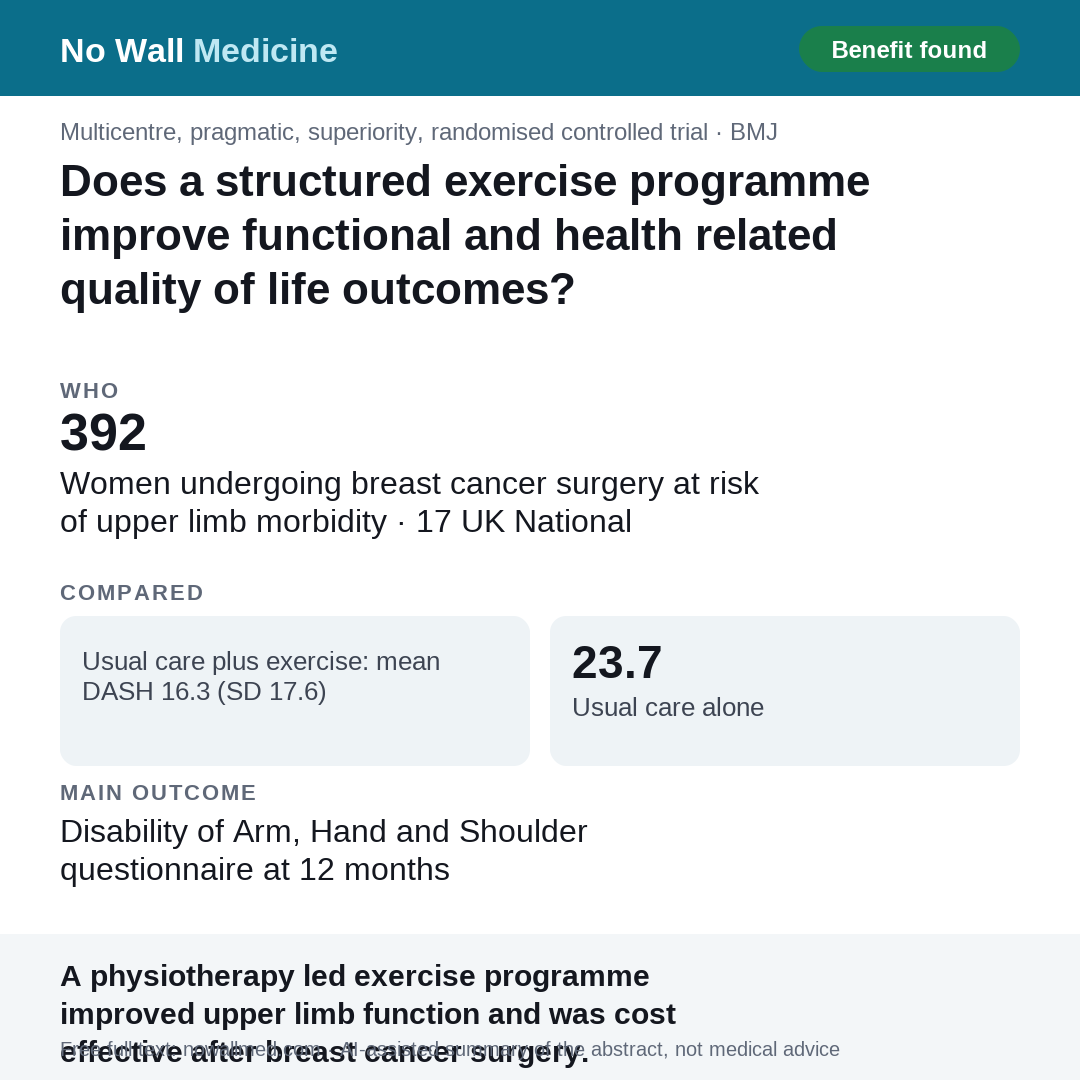
Clinical question: Does a structured exercise programme improve functional and health related quality of life outcomes?
Why it matters: It was unknown if a structured exercise programme improves functional outcomes and quality of life for women at high risk of upper limb disability after breast cancer surgery.
Key points
- Researchers studied 392 women at risk of upper limb disability who were randomized to receive either usual care plus a physiotherapy-led exercise programme or usual care alone.
- At 12 months, the exercise group had better upper limb function with a mean Disability of Arm, Hand and Shoulder score of 16.3 compared to 23.7 in the usual care group.
- The exercise group also reported lower pain intensity and fewer arm disability symptoms without an increase in complications or lymphoedema, which is swelling caused by lymph fluid buildup.
Headline and key points written with AI from the paper’s abstract, with every number checked against it. Read the paper before relying on them.
Was this summary helpful?
Abstract
Objective
To evaluate whether a structured exercise programme improved functional and health related quality of life outcomes compared with usual care for women at high risk of upper limb disability after breast cancer surgery. Design
Multicentre, pragmatic, superiority, randomised controlled trial with economic evaluation. Setting
17 UK National Health Service cancer centres. Participants
392 women undergoing breast cancer surgery, at risk of postoperative upper limb morbidity, randomised (1:1) to usual care with structured exercise (n=196) or usual care alone (n=196). Interventions
Usual care (information leaflets) only or usual care plus a physiotherapy led exercise programme, incorporating stretching, strengthening, physical activity, and behavioural change techniques to support adherence to exercise, introduced at 7-10 days postoperatively, with two further appointments at one and three months. Main outcome measures
Disability of Arm, Hand and Shoulder (DASH) questionnaire at 12 months, analysed by intention to treat. Secondary outcomes included DASH subscales, pain, complications, health related quality of life, and resource use, from a health and personal social services perspective. Results
Between 26 January 2016 and 31 July 2017, 951 patients were screened and 392 (mean age 58.1 years) were randomly allocated, with 382 (97%) eligible for intention to treat analysis. 181 (95%) of 191 participants allocated to exercise attended at least one appointment. Upper limb function improved after exercise compared with usual care (mean DASH 16.3 (SD 17.6) for exercise (n=132); 23.7 (22.9) usual care (n=138); adjusted mean difference 7.81, 95% confidence interval 3.17 to 12.44; P=0.001). Secondary outcomes favoured exercise over usual care, with lower pain intensity at 12 months (adjusted mean difference on numerical rating scale -0.68, -1.23 to -0.12; P=0.02) and fewer arm disability symptoms at 12 months (adjusted mean difference on Functional Assessment of Cancer Therapy-Breast+4 (FACT-B+4) -2.02, -3.11 to -0.93; P=0.001). No increase in complications, lymphoedema, or adverse events was noted in participants allocated to exercise. Exercise accrued lower costs per patient (on average -£387 (€457; $533) (95% confidence interval -£2491 to £1718; 2015 pricing) and was cost effective compared with usual care. Conclusions
The PROSPER exercise programme was clinically effective and cost effective and reduced upper limb disability one year after breast cancer treatment in patients at risk of treatment related postoperative complications. Trial registration
ISRCTN Registry ISRCTN35358984.
Abstract reproduced under the article’s CC BY licence.
Subject terms
Cite this article
Bruce J, Mazuquin B, Canaway A, Hossain A, Williamson E, Mistry P. Exercise versus usual care after non-reconstructive breast cancer surgery (UK PROSPER): multicentre randomised controlled trial and economic evaluation. BMJ. 2021. doi:10.1136/bmj-2021-066542
Spotted a mistake? Suggest a correction
Top studies every Monday
The week’s key trials and guidelines in your specialties, plus any topics you follow. By email, free.
Get the weekly digest