Nurse-delivered telehealth did not substantially lower blood sugar more than self-monitoring in diabetes patients
Expanding Technology-Enabled, Nurse-Delivered Chronic Disease Care : A Pragmatic, Randomized, Effectiveness-Implementation Trial
Pragmatic, randomized, effectiveness-implementation trialNo clear difference
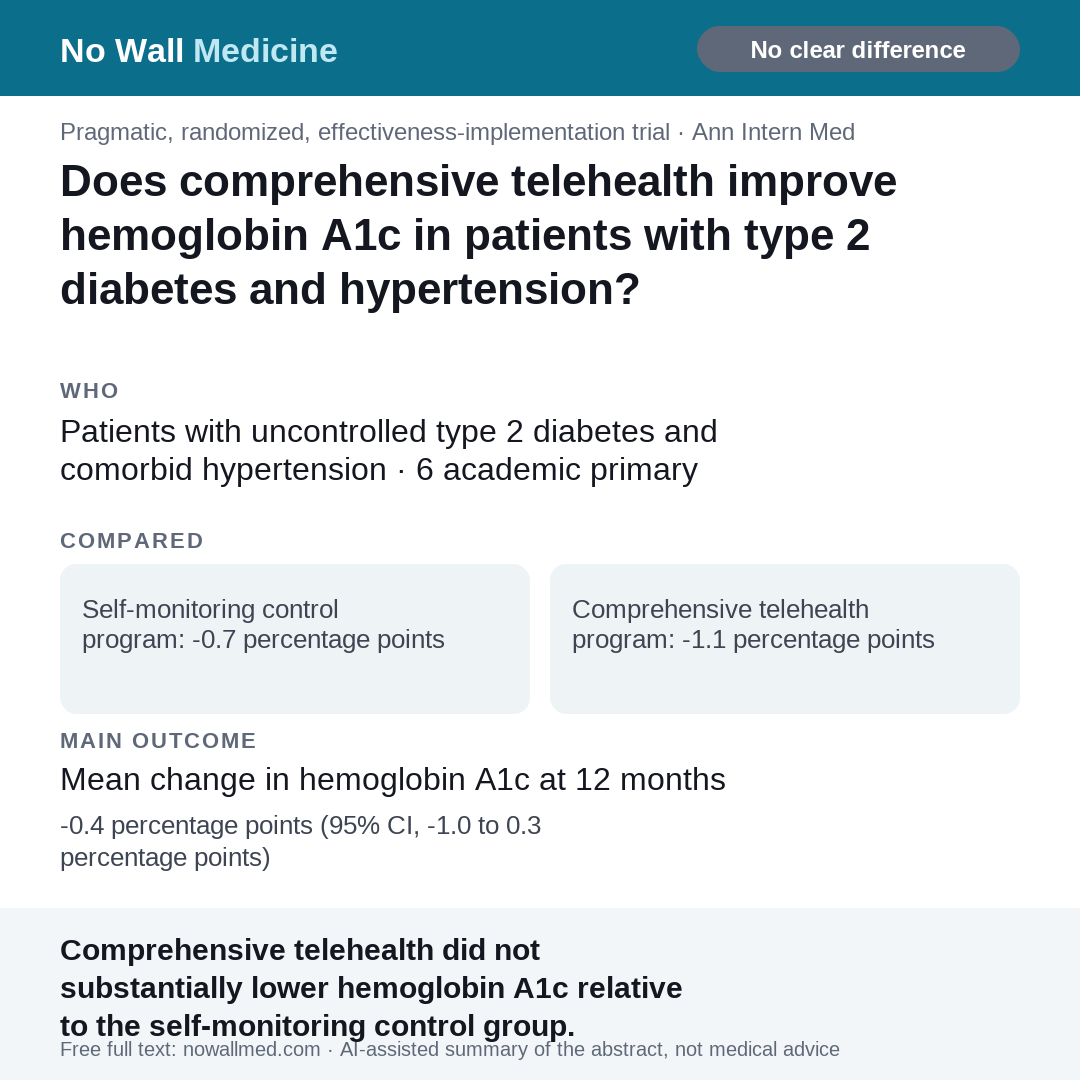
Does comprehensive telehealth improve hemoglobin A1c in patients with type 2 diabetes and hypertension?
Who
Patients with uncontrolled type 2 diabetes and comorbid hypertension · 6 academic primary care or endocrinology clinics
Compared
Self-monitoring control program: -0.7 percentage points
Comprehensive telehealth program: -1.1 percentage points
Main outcome
Mean change in hemoglobin A1c at 12 months
Result: -0.4 percentage points (95% CI, -1.0 to 0.3 percentage points)
Bottom line: Comprehensive telehealth did not substantially lower hemoglobin A1c relative to the self-monitoring control group.
Limitation: Generalizability to dissimilar populations and systems lacking telehealth infrastructure may be limited.
Funded by: National Institute of Nursing Research and Duke Clinical & Translational Science Institute
Ann Intern Med · 2026-06-23Download image
Clinical question: Does comprehensive telehealth improve hemoglobin A1c in patients with type 2 diabetes and hypertension?
Why it matters: Comprehensive telehealth has seldom been implemented in health systems that primarily provide fee-for-service care for patients with uncontrolled chronic diseases.
Key points
- Researchers studied patients with uncontrolled type 2 diabetes and hypertension across 6 academic clinics to compare self-monitoring with a nurse-delivered telehealth program.
- The telehealth group saw a mean hemoglobin A1c reduction of -1.1 percentage points compared to -0.7 percentage points for the self-monitoring group.
- The difference in hemoglobin A1c change between groups was -0.4 percentage points and was not statistically significant.
Limitation the authors note: Generalizability to dissimilar populations and systems lacking telehealth infrastructure may be limited.
Headline and key points written with AI from the paper’s abstract, with every number checked against it. Read the paper before relying on them.
Topics
Cite this article
Crowley MJ, Lewinski AA, Yang Q, Hatch D, Palipana A, Bosworth HB. Expanding Technology-Enabled, Nurse-Delivered Chronic Disease Care : A Pragmatic, Randomized, Effectiveness-Implementation Trial. Ann Intern Med. 2026. doi:10.7326/ANNALS-26-00132
Spotted a mistake? Suggest a correction