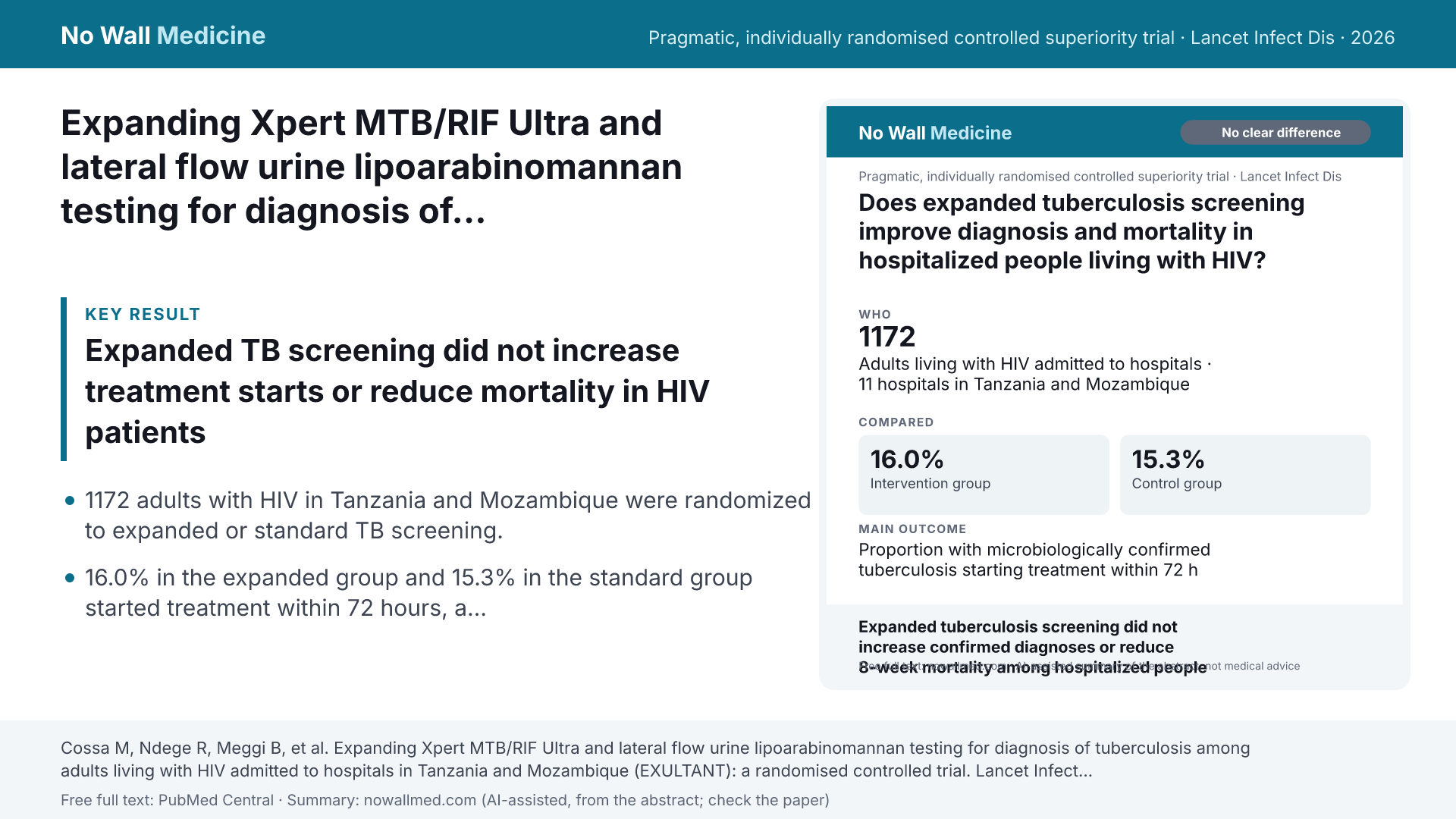
Expanded tuberculosis screening did not increase early treatment rates among hospitalized people living with HIV
Expanding Xpert MTB/RIF Ultra and lateral flow urine lipoarabinomannan testing for diagnosis of tuberculosis among adults living with HIV admitted to hospitals in Tanzania and Mozambique (EXULTANT): a randomised controlled trial
Pragmatic, individually randomised controlled superiority trialNo clear difference
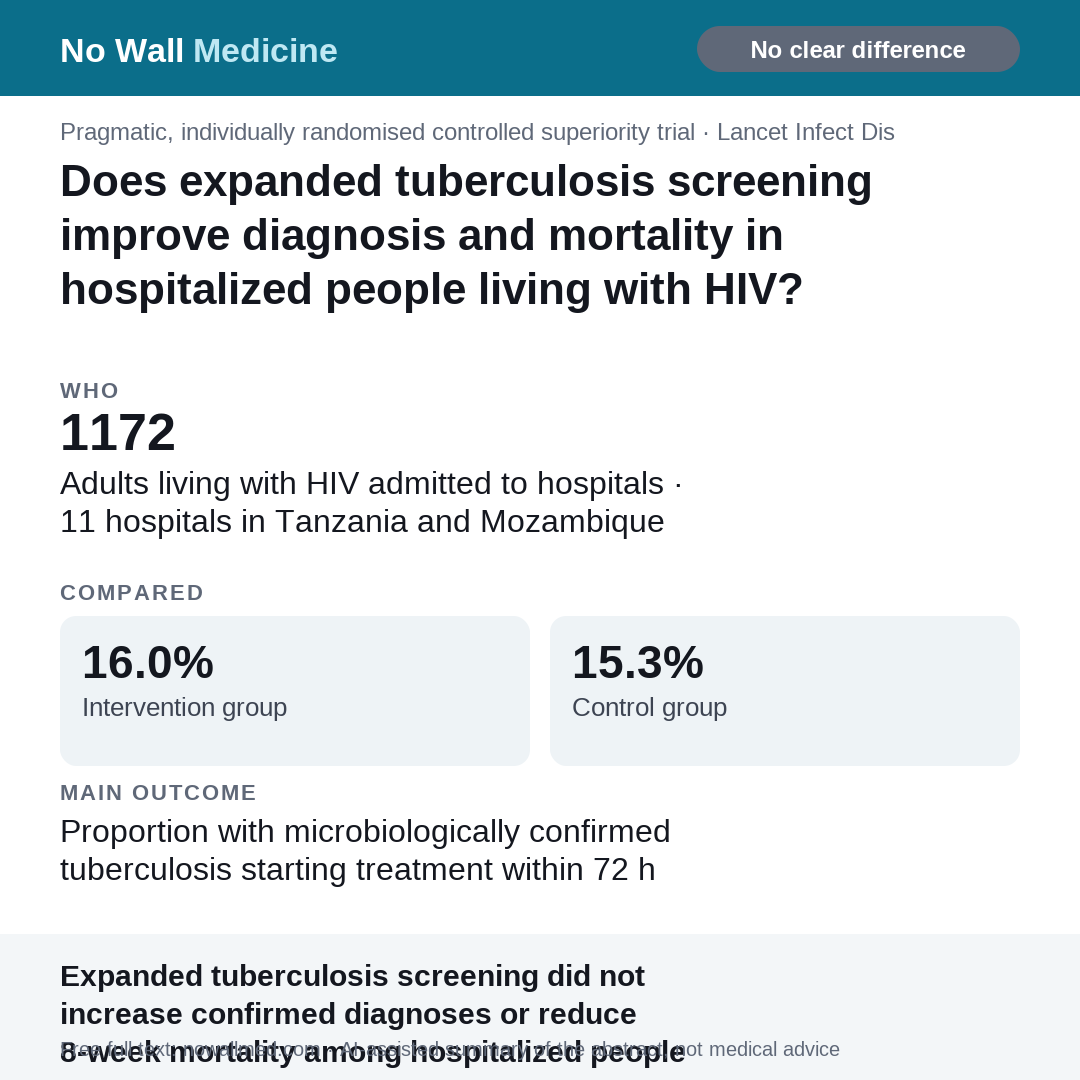
Does expanded tuberculosis screening improve diagnosis and mortality in hospitalized people living with HIV?
Who
1172
Adults living with HIV admitted to hospitals · 11 hospitals in Tanzania and Mozambique
Compared
16.0%Intervention group (93/582)
15.3%Control group (90/590)
Main outcome
Proportion with microbiologically confirmed tuberculosis starting treatment within 72 h
Result: difference 0.7%, 95% CI -3.4 to 4.8
Bottom line: Expanded tuberculosis screening did not increase confirmed diagnoses or reduce 8-week mortality among hospitalized people living with HIV.
Funded by: EDCTP2 programme, supported by the EU
Lancet Infect Dis · 2026-05-06Download image
Clinical question: Does expanded tuberculosis screening improve diagnosis and mortality in hospitalized people living with HIV?
Why it matters: Tuberculosis is the leading cause of death for hospitalized people living with HIV, and non-sputum-based diagnostic tests might improve patient outcomes.
Key points
- Researchers randomized 1172 adults living with HIV in Tanzania and Mozambique to either an expanded screening strategy or standard symptom-based testing.
- The proportion of participants starting microbiologically confirmed tuberculosis treatment within 72 hours was 16.0% in the intervention group and 15.3% in the control group.
- There was no significant difference in 8-week all-cause mortality between the intervention group (25.8%) and the control group (28.8%).
Headline and key points written with AI from the paper’s abstract, with every number checked against it. Read the paper before relying on them.
Was this summary helpful?
Abstract
Background
Tuberculosis is the main cause of death among hospitalised people living with HIV. Non-sputum-based diagnostics could improve patient outcomes. The EXULTANT trial aims to evaluate an expanded tuberculosis screening strategy among people with HIV in two African countries with a high tuberculosis and HIV burden. Methods
This pragmatic, individually randomised controlled superiority trial was conducted across 11 hospitals in Tanzania and Mozambique. We consecutively enrolled adults living with HIV (aged ≥18 years) without an existing tuberculosis diagnosis or recent tuberculosis treatment, within 24 h of admission. The intervention group underwent Xpert MTB/RIF Ultra (Xpert Ultra) testing from sputum, stool, and urine, plus lateral flow urine lipoarabinomannan (LF-LAM) testing (Determine TB LAM Ag assay), irrespective of symptoms. The control group followed standard-of-care, symptom-based, WHO-recommended sputum Xpert Ultra and LF-LAM testing. The primary endpoint was the proportion of participants with microbiologically confirmed tuberculosis starting treatment within 72 h. Secondary endpoints included 8-week all-cause mortality and time to tuberculosis diagnosis. The trial is registered at ClinicalTrials.gov (NCT04568967) and is completed. Findings
From Sept 25, 2022, to March 15, 2024, we screened 1534 participants, and randomly assigned 1172 (76·6%) to either the intervention group (n=582) or the control group (n=590). At admission, 715 participants (61·0%) were female, 845 (75·4%) were on antiretroviral therapy (ART), and median CD4 count was 232 cells per μL (IQR 87-490). In the control group, 505 (85·6%) had tuberculosis-compatible symptoms and were eligible for sputum Xpert Ultra testing (306 of them [60·6%] provided a sample) and 538 (91·2%) met WHO criteria for LF-LAM testing. In the intention-to-treat analysis, 93 (16·0%) of 582 participants in the intervention group and 90 (15·3%) of 590 in the control group had microbiologically confirmed tuberculosis and started treatment within 72 h (difference 0·7%, 95% CI -3·4 to 4·8, p=0·73). 8-week all-cause mortality was 25·8% (150 of 582) in the intervention group and 28·8% (170 of 590) in the control group (hazard ratio 0·86, 95% CI 0·69 to 1·07, p=0·18). Median time to tuberculosis treatment initiation was 0·98 days (IQR 0·83-1·92) and 0·92 days (0·79-1·86) in the intervention and control groups, respectively (hazard ratio 1·05, 95% CI 0·82 to 1·33, p=0·72). Interpretation
An expanded screening strategy among people living with HIV admitted to hospital did not increase the proportion of individuals with microbiologically confirmed tuberculosis starting treatment or reduce 8-week mortality. Funding
EDCTP2 programme, supported by the EU.
Abstract reproduced under the article’s CC BY licence.
Subject terms
Cite this article
Cossa M, Ndege R, Meggi B, et al. Expanding Xpert MTB/RIF Ultra and lateral flow urine lipoarabinomannan testing for diagnosis of tuberculosis among adults living with HIV admitted to hospitals in Tanzania and Mozambique (EXULTANT): a randomised controlled trial. Lancet Infect Dis. 2026. doi:10.1016/S1473-3099(26)00133-7
Spotted a mistake? Suggest a correction