Expedited transfer to a cardiac arrest centre did not reduce 30-day mortality after cardiac arrest
Expedited transfer to a cardiac arrest centre for non-ST-elevation out-of-hospital cardiac arrest (ARREST): a UK prospective, multicentre, parallel, randomised clinical trial
Prospective, multicentre, open-label, randomised superiority trialNo clear difference
Does expedited transfer to a cardiac arrest centre reduce deaths after non-ST-elevation out-of-hospital cardiac arrest?
Who
862
Adults with return of spontaneous circulation after non-ST-elevation out-of-hospital cardiac arrest · London, United Kingdom
Compared
63%Cardiac arrest centre (258/411)
63%Standard care (258/412)
Main outcome
All-cause mortality at 30 days
Result: unadjusted risk ratio for survival 1·00 (95% CI 0·90-1·11)
Bottom line: Expedited transfer to a cardiac arrest centre did not reduce 30-day mortality compared to standard care.
Funded by: British Heart Foundation
Lancet · 2023-08-27Download image
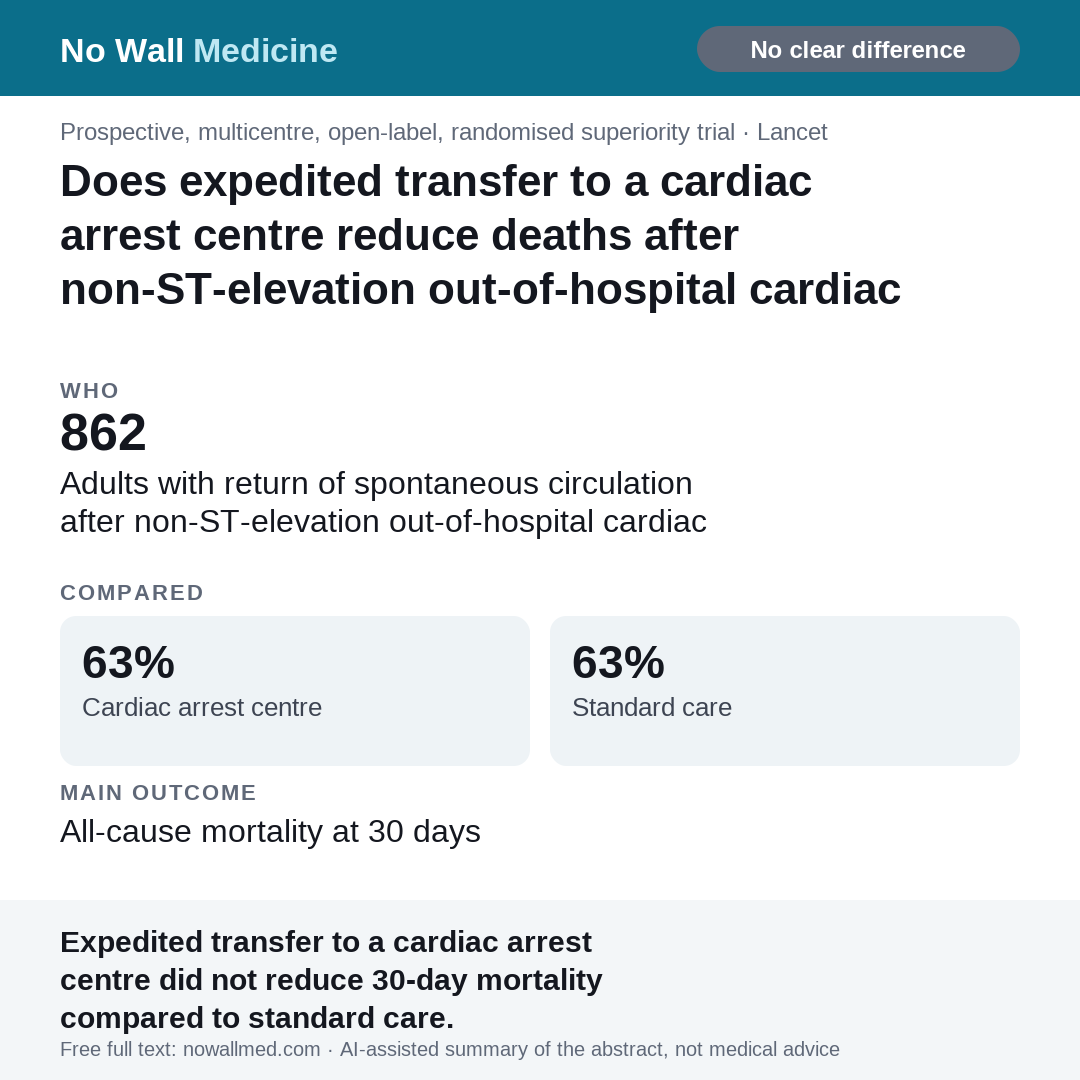
Clinical question: Does expedited transfer to a cardiac arrest centre reduce deaths after non-ST-elevation out-of-hospital cardiac arrest?
Why it matters: The International Liaison Committee on Resuscitation called for a randomized trial to determine if delivering patients to a cardiac arrest centre reduces deaths.
Key points
- Researchers studied 862 adult patients who experienced out-of-hospital cardiac arrest without ST elevation on the heart monitor and regained spontaneous circulation.
- The 30-day mortality rate was 63% for the 411 patients sent to a cardiac arrest centre and 63% for the 412 patients receiving standard care.
- Serious adverse events occurred in 2% of the cardiac arrest centre group and 1% of the standard care group, with none related to the intervention.
Headline and key points written with AI from the paper’s abstract, with every number checked against it. Read the paper before relying on them.
Was this summary helpful?
Abstract
Background
The International Liaison Committee on Resuscitation has called for a randomised trial of delivery to a cardiac arrest centre. We aimed to assess whether expedited delivery to a cardiac arrest centre compared with current standard of care following resuscitated cardiac arrest reduces deaths. Methods
ARREST is a prospective, parallel, multicentre, open-label, randomised superiority trial. Patients (aged ≥18 years) with return of spontaneous circulation following out-of-hospital cardiac arrest without ST elevation were randomly assigned (1:1) at the scene of their cardiac arrest by London Ambulance Service staff using a secure online randomisation system to expedited delivery to the cardiac catheter laboratory at one of seven cardiac arrest centres or standard of care with delivery to the geographically closest emergency department at one of 32 hospitals in London, UK. Masking of the ambulance staff who delivered the interventions and those reporting treatment outcomes in hospital was not possible. The primary outcome was all-cause mortality at 30 days, analysed in the intention-to-treat (ITT) population excluding those with unknown mortality status. Safety outcomes were analysed in the ITT population. The trial was prospectively registered with the International Standard Randomised Controlled Trials Registry, 96585404. Findings
Between Jan 15, 2018, and Dec 1, 2022, 862 patients were enrolled, of whom 431 (50%) were randomly assigned to a cardiac arrest centre and 431 (50%) to standard care. 20 participants withdrew from the cardiac arrest centre group and 19 from the standard care group, due to lack of consent or unknown mortality status, leaving 411 participants in the cardiac arrest centre group and 412 in the standard care group for the primary analysis. Of 822 participants for whom data were available, 560 (68%) were male and 262 (32%) were female. The primary endpoint of 30-day mortality occurred in 258 (63%) of 411 participants in the cardiac arrest centre group and in 258 (63%) of 412 in the standard care group (unadjusted risk ratio for survival 1·00, 95% CI 0·90-1·11; p=0·96). Eight (2%) of 414 patients in the cardiac arrest centre group and three (1%) of 413 in the standard care group had serious adverse events, none of which were deemed related to the trial intervention. Interpretation
In adult patients without ST elevation, transfer to a cardiac arrest centre following resuscitated cardiac arrest in the community did not reduce deaths. Funding
British Heart Foundation.
Abstract reproduced under the article’s CC BY licence.
Subject terms
Cite this article
Patterson T, Perkins GD, Perkins A, Clayton T, Evans R, Dodd M. Expedited transfer to a cardiac arrest centre for non-ST-elevation out-of-hospital cardiac arrest (ARREST): a UK prospective, multicentre, parallel, randomised clinical trial. Lancet. 2023. doi:10.1016/S0140-6736(23)01351-X
Spotted a mistake? Suggest a correction
Top studies every Monday
The week’s key trials and guidelines in your specialties, plus any topics you follow. By email, free.
Get the weekly digest