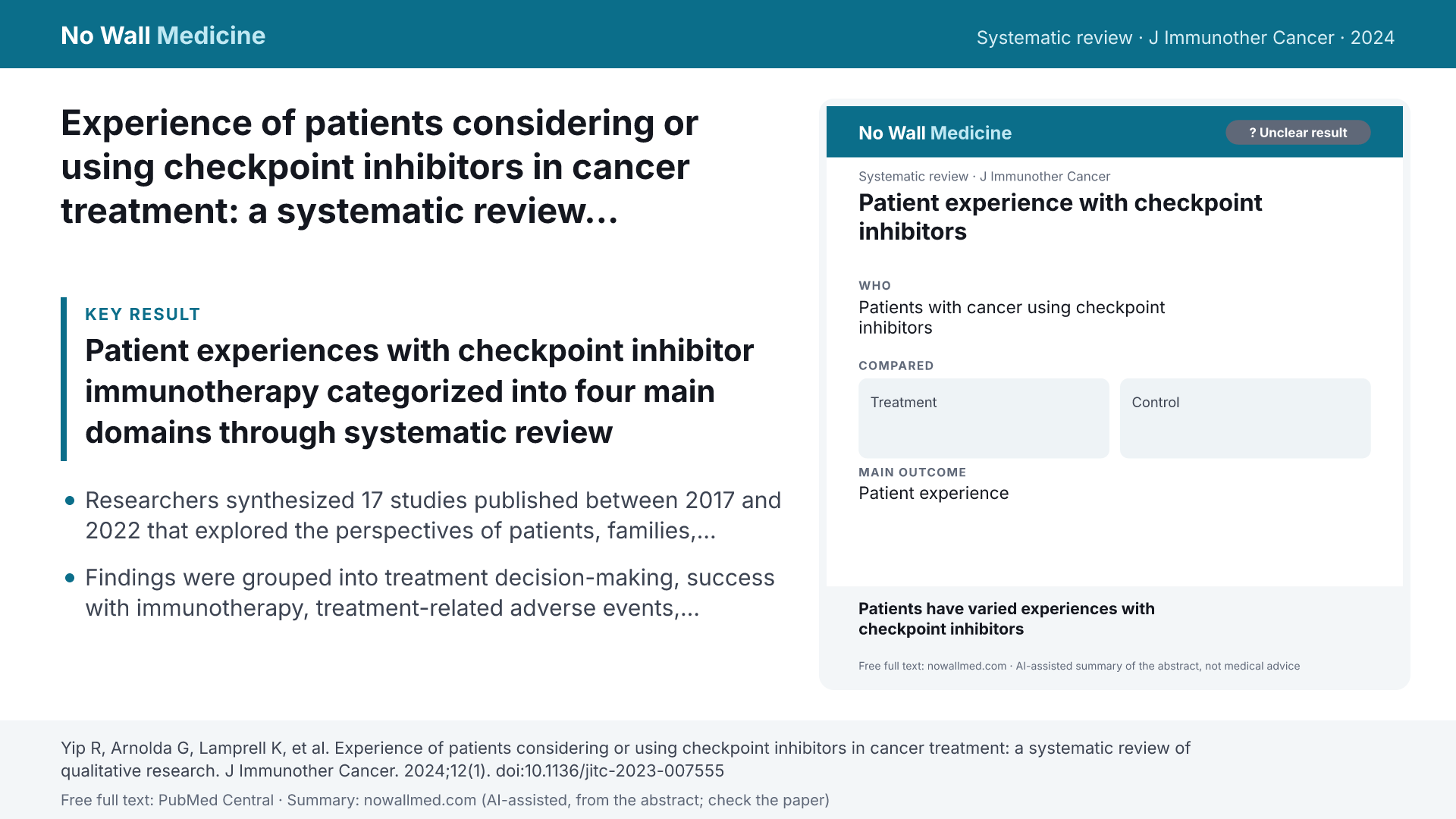
Patient experiences with checkpoint inhibitor immunotherapy categorized into four main domains through systematic review
Experience of patients considering or using checkpoint inhibitors in cancer treatment: a systematic review of qualitative research
Systematic reviewUnclear result
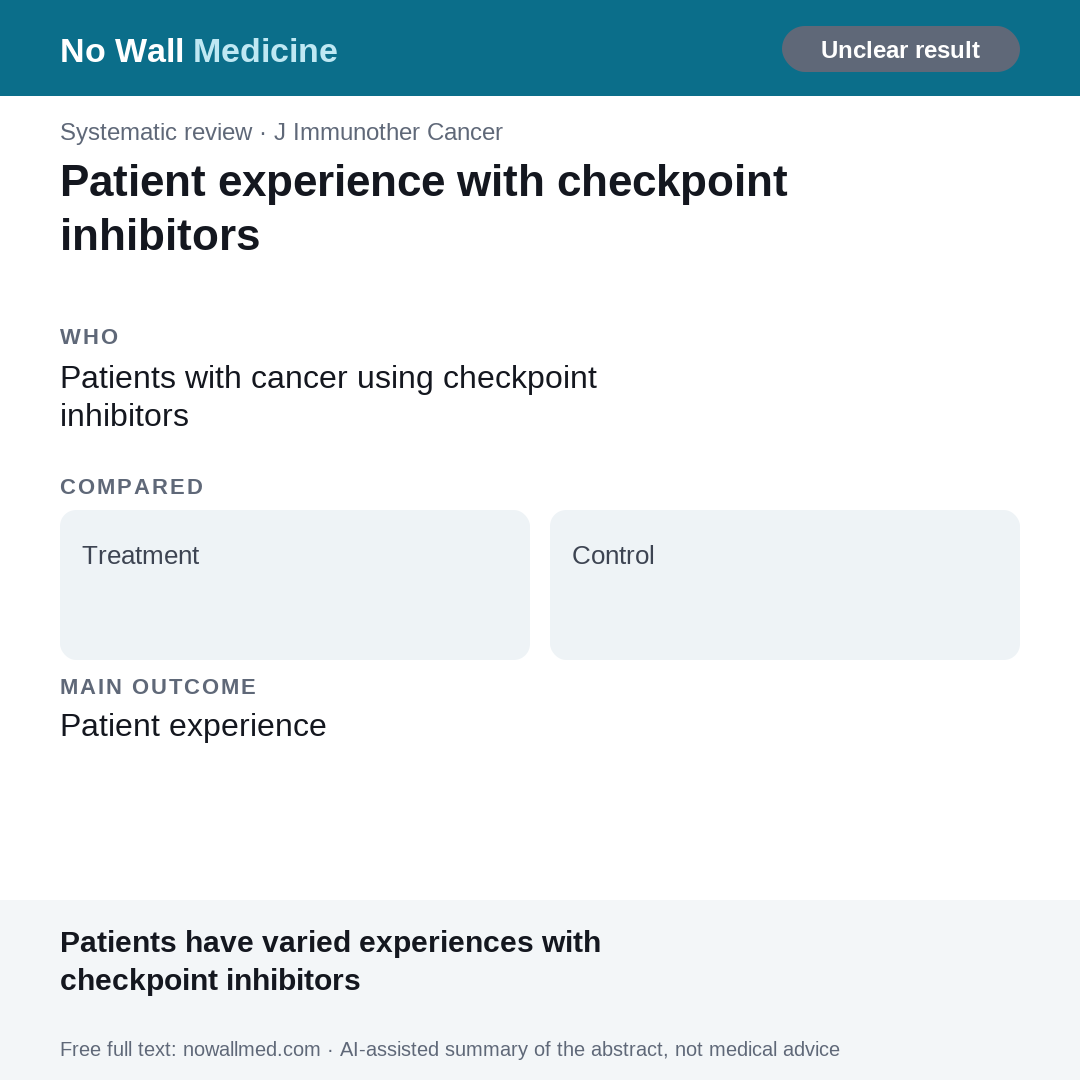
Patient experience with checkpoint inhibitors
Who
Patients with cancer using checkpoint inhibitors
Compared
Treatment
Control
Main outcome
Patient experience
Bottom line: Patients have varied experiences with checkpoint inhibitors
Limitation: Most studies focused on successful treatments
J Immunother Cancer · 2024-01-11Download image
Why it matters: It was unknown how patients and their families perceive the experience of using checkpoint inhibitor immunotherapy for cancer treatment.
Key points
- Researchers synthesized 17 studies published between 2017 and 2022 that explored the perspectives of patients, families, or carers regarding checkpoint inhibitor therapy.
- Findings were grouped into treatment decision-making, success with immunotherapy, treatment-related adverse events, and quality of life.
- Most included studies focused on patients with advanced stage melanoma who had successful treatment, which may exclude those who do not respond or stop therapy.
Limitation the authors note: Most studies focused on patients who had successful treatment, effectively excluding those who do not respond or discontinue due to serious side effects.
Headline and key points written with AI from the paper’s abstract, with every number checked against it. Read the paper before relying on them.
Was this summary helpful?
Abstract
Increasing numbers of patients with cancer are considering or undergoing immunotherapy, however, little is known about patients' perspectives on this treatment. We undertook a systematic review for use by clinicians and researchers, consolidating published qualitative research studies on patient experience of checkpoint inhibitor therapy. A search of Medline, Embase, and PsycINFO was carried out for publications in English to 30 June 2022. Publications were selected if they reported a qualitative study of patient experience with checkpoint inhibitor therapy for cancer, either by patients or their families or carers. Quality was appraised using the Johanna Briggs Institute quality assessment tool for qualitative studies. A thematic synthesis was conducted. The Preferred Reporting Items for Systematic Reviews and Meta-Analyses standard was followed. We identified 17 eligible studies published between 2017 and 2022, 9 using mixed methods, and 8 solely using qualitative methods. Most studies reported on the experiences of patients with advanced stage melanoma and were using the earliest approved checkpoint inhibitors for cancer therapy. Studies met most formal quality criteria but varied in the extent of their qualitative explorations of data; some mixed methods studies had limited reporting of qualitative results. Through thematic synthesis, we categorized study findings into four domains: (1) treatment decision-making; (2) success with immunotherapy; (3) treatment-related adverse events (AEs); and (4) quality of life on immunotherapy. Our review identified several areas with potential for improving the care system. These include, for example: routinely linking patients to peers who have experienced this therapy; improving the capacity of patients and carers to identify and report AEs faster; and supporting patients and carers to live with changed circumstances after successful treatment. Most studies focused on patients who had successful treatment, effectively excluding those who do not respond or who discontinue due to serious side effects; future research targets are suggested.
Abstract reproduced under the article’s CC BY NC licence.
Subject terms
Cite this article
Yip R, Arnolda G, Lamprell K, et al. Experience of patients considering or using checkpoint inhibitors in cancer treatment: a systematic review of qualitative research. J Immunother Cancer. 2024. doi:10.1136/jitc-2023-007555
Spotted a mistake? Suggest a correction