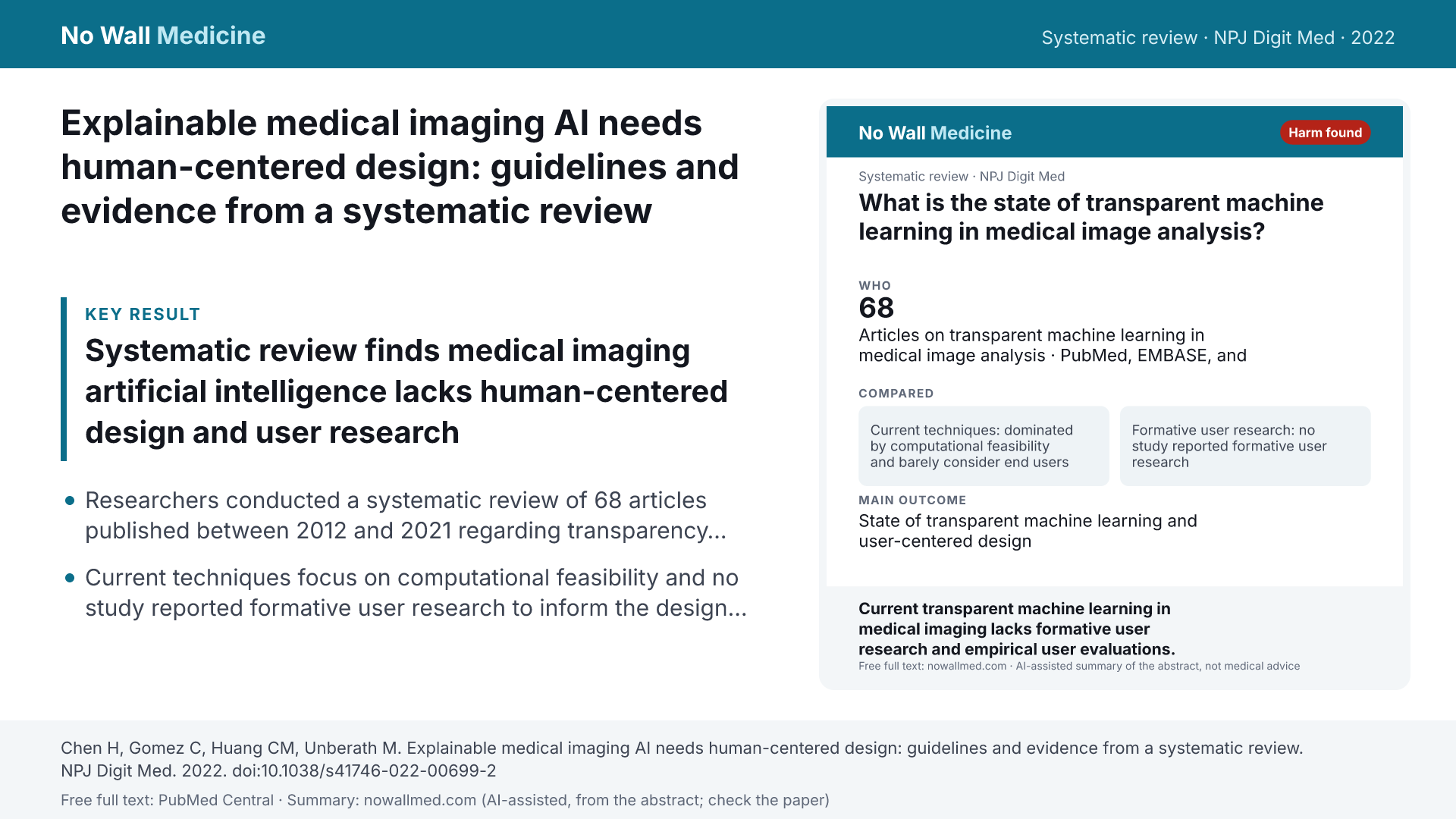
Explainable medical imaging AI needs human-centered design: guidelines and evidence from a systematic review
Key result: Systematic review finds medical imaging artificial intelligence lacks human-centered design and user research
Systematic reviewHarm found
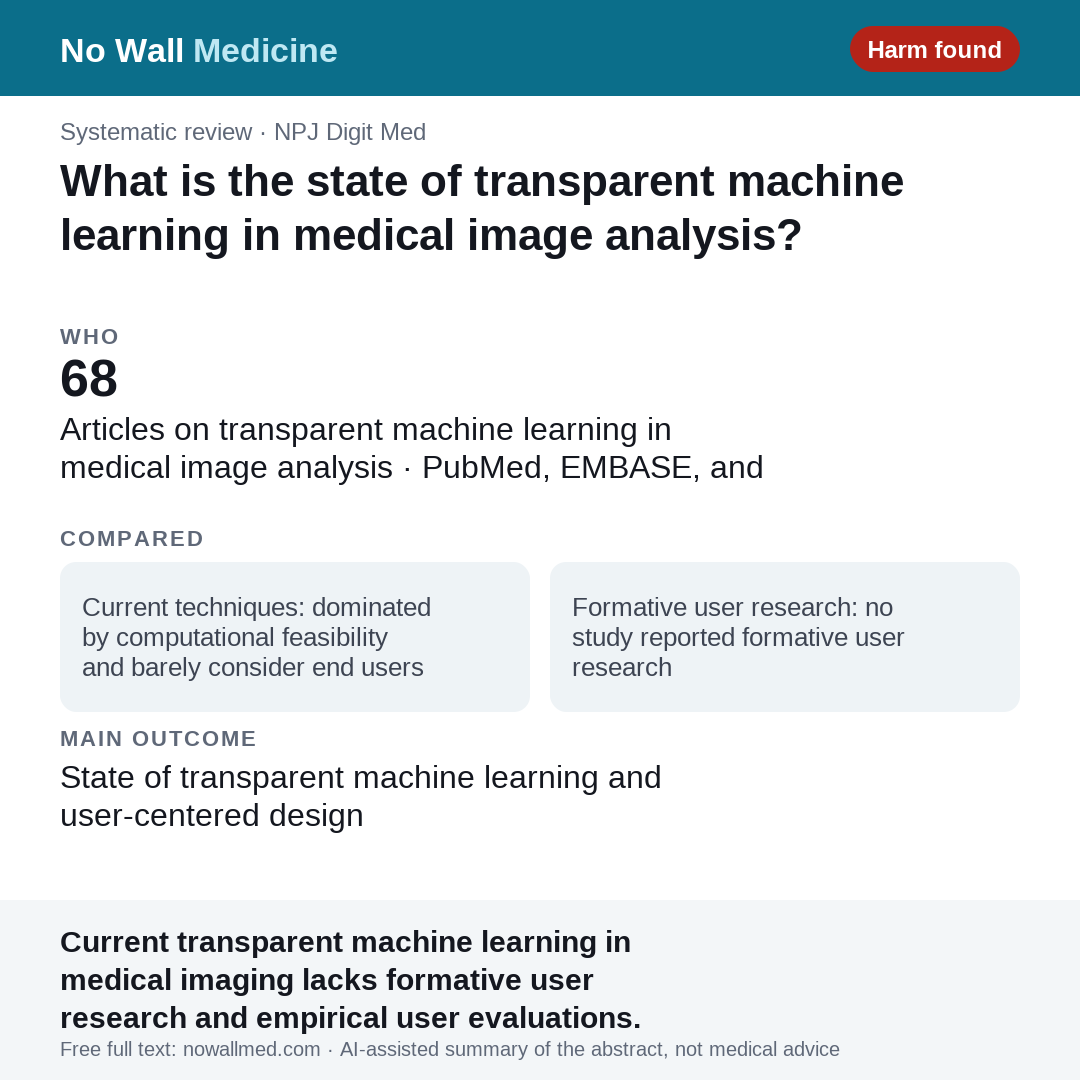
What is the state of transparent machine learning in medical image analysis?
Who
68
Articles on transparent machine learning in medical image analysis · PubMed, EMBASE, and Compendex databases
Compared
Current techniques: dominated by computational feasibility and barely consider end users
Formative user research: no study reported formative user research
Main outcome
State of transparent machine learning and user-centered design
Bottom line: Current transparent machine learning in medical imaging lacks formative user research and empirical user evaluations.
NPJ Digit Med · 2022-10-19Download image
Key points
- Researchers conducted a systematic review of 68 articles published between 2012 and 2021 regarding transparency in machine learning for medical image analysis.
- Current techniques focus on computational feasibility and no study reported formative user research to inform the design of transparent machine learning models.
- Only a few studies validated transparency claims through empirical user evaluations involving end users or clinical stakeholders.
Why it matters: It is unknown how to effectively design transparent machine learning models that are comprehensible and clinically relevant to medical image analysis users.
Discussion prompts
- Would these patients look like yours? Who was left out?
- Is the main outcome one that matters to patients?
- Is the difference large enough to change what you do?
Cite: Chen H, Gomez C, Huang CM, Unberath M. Explainable medical imaging AI needs human-centered design: guidelines and evidence from a systematic review. NPJ Digit Med. 2022. doi:10.1038/s41746-022-00699-2
Free full text: PubMed Central · Summary and visual abstract: nowallmed.com/a/explainable-medical-imaging-ai-needs-human-centered-design-guidelines-1eacqbr/ (AI-assisted from the abstract; check the paper before relying on it).