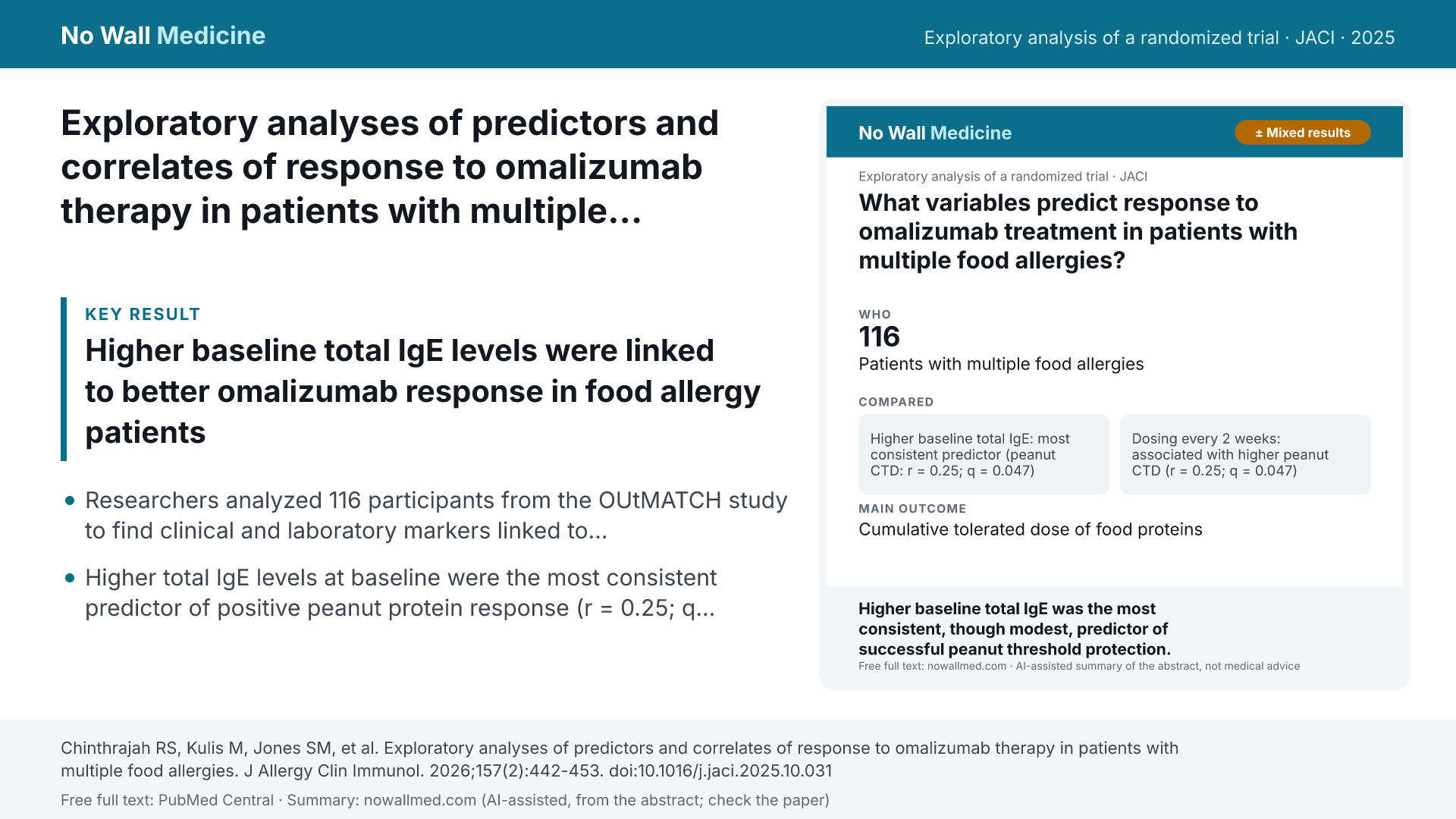
Higher baseline total IgE levels were linked to better omalizumab response in food allergy patients
Exploratory analyses of predictors and correlates of response to omalizumab therapy in patients with multiple food allergies
Exploratory analysis of a randomized trialMixed results
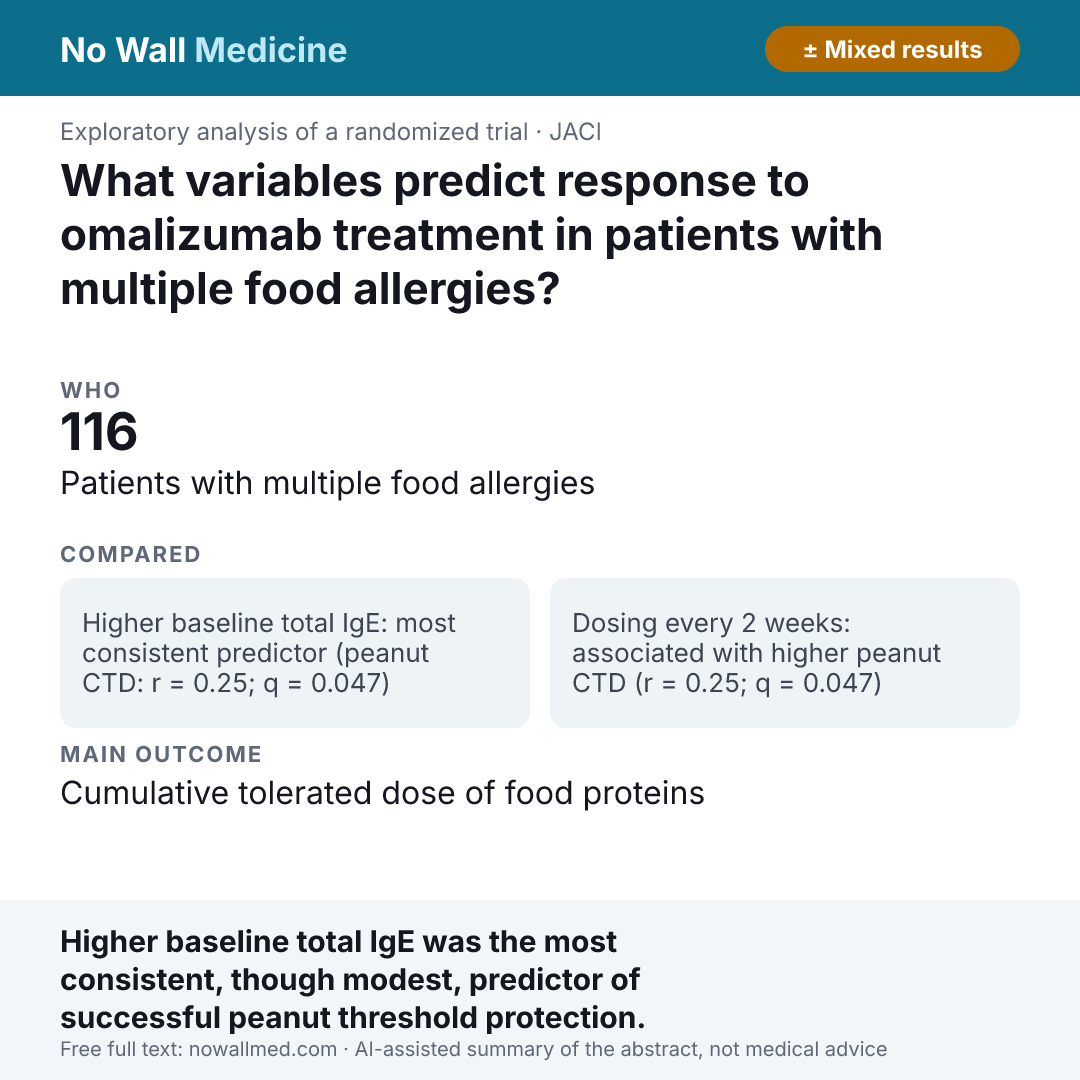
What variables predict response to omalizumab treatment in patients with multiple food allergies?
Who
116
Patients with multiple food allergies
Compared
Higher baseline total IgE: most consistent predictor (peanut CTD: r = 0.25; q = 0.047)
Dosing every 2 weeks: associated with higher peanut CTD (r = 0.25; q = 0.047)
Main outcome
Cumulative tolerated dose of food proteins
Bottom line: Higher baseline total IgE was the most consistent, though modest, predictor of successful peanut threshold protection.
Limitation: This exploratory analysis was not definitive
JACI · 2025-11-12 · Save PNG
Clinical question: What variables predict response to omalizumab treatment in patients with multiple food allergies?
Why it matters: There are no known markers to predict or assess how individual patients will respond to omalizumab treatment for multiple food allergies.
Key points
- Researchers analyzed 116 participants from the OUtMATCH study to find clinical and laboratory markers linked to omalizumab response.
- Higher total IgE levels at baseline were the most consistent predictor of positive peanut protein response (r = 0.25; q = 0.047).
- Omalizumab dosing every 2 weeks was associated with higher peanut cumulative tolerated dose outcomes (r = 0.25; q = 0.047).
Headline and key points written with AI from the paper’s abstract, with every number checked against it. Read the paper before relying on them.
Was this summary helpful?
Subject terms
Headline, design, result, key points, caveat and citation as plain text.
Cite this article
Chinthrajah RS, Kulis M, Jones SM, et al. Exploratory analyses of predictors and correlates of response to omalizumab therapy in patients with multiple food allergies. J Allergy Clin Immunol. 2026;157(2):442-453. doi:10.1016/j.jaci.2025.10.031
Spotted a mistake? Suggest a correction