Inflammation markers improved more than clinical symptoms in patients with axial spondyloarthritis
Exploratory analysis of the potential disconnect between objective inflammatory response and clinical response following certolizumab pegol treatment in patients with active axial spondyloarthritis
Post hoc analysis of randomized trial dataMixed results
Is there a disconnect between objective inflammation and clinical response after certolizumab pegol treatment?
Who
136
Patients with active axial spondyloarthritis
Compared
Objective inflammation (CRP) ≥50% reduction: 136/136 [100.0%]
Clinical response (BASDAI) ≥50% improvement: 64/136 [47.1%]
Clinical response (ASDAS) ≥50% improvement: 66/136 [48.5%]
Main outcome
Proportion of patients achieving improvements in inflammation and clinical measures
Bottom line: Objective inflammatory improvements often did not translate into similar clinical response improvements in patients with axial spondyloarthritis.
RMD Open · 2024-08-28Download image
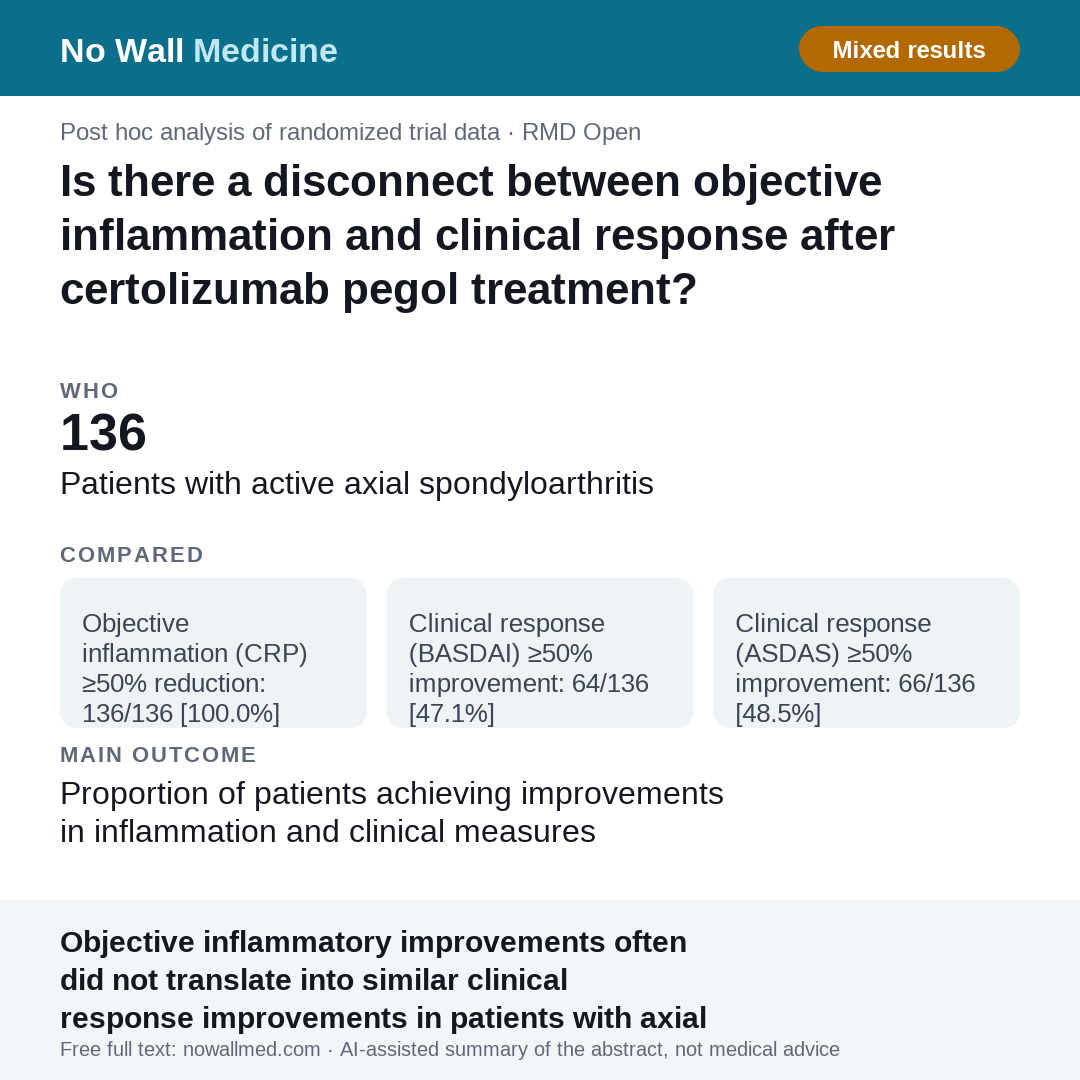
Clinical question: Is there a disconnect between objective inflammation and clinical response after certolizumab pegol treatment?
Why it matters: It is unknown if objective measures of inflammation, such as blood tests and magnetic resonance imaging, align with how patients clinically feel during treatment.
Key points
- The study analyzed 136 patients with active axial spondyloarthritis, including 76 with radiographic and 60 with non-radiographic disease, after 12 weeks of certolizumab pegol treatment.
- While 100.0% of patients saw a 50% reduction in C reactive protein, less than half of patients achieved a 50% improvement in clinical scores like BASDAI (47.1%) and ASDAS (48.5%).
- Improvements in magnetic resonance imaging (MRI) and C reactive protein did not translate into similar clinical improvements for most patients.
Headline and key points written with AI from the paper’s abstract, with every number checked against it. Read the paper before relying on them.
Abstract
Introduction
This post hoc analysis evaluated the relationship between objective measures of inflammation and clinical outcomes following 12 weeks of certolizumab pegol (CZP) treatment in patients with active axial spondyloarthritis (axSpA). Methods
We report the proportion of patients achieving ≥50% and ≥75% improvements in clinical composite outcome measures of disease activity (Axial Spondyloarthritis Disease Activity Score [ASDAS], Bath Ankylosing Spondylitis Disease Activity Index [BASDAI]) and objective measures of inflammation (C reactive protein [CRP], Ankylosing Spondylitis spine MRI score [ASspiMRI-a] Berlin score and Spondyloarthritis Research Consortium of Canada [SPARCC] MRI Sacroiliac Joints [SIJ] score) following 12 weeks of CZP treatment. Data from two independent readers over four MRI reading campaigns were pooled using a mixed model with repeated measures for each variable. Results
136 patients (radiographic axSpA [r-axSpA]: 76; non-radiographic axSpA [nr-axSpA]: 60) were included. Following CZP treatment, CRP, ASspiMRI-a Berlin score and SPARCC SIJ score were reduced by ≥50% in most patients (CRP: 136/136 [100.0%]; Berlin: 73/136 [53.7%]; SPARCC SIJ: 71/136 [52.2%]), and often by ≥75%. Less than half of patients with r-axSpA and nr-axSpA showed ≥50% reduction in clinical responses (BASDAI: 64/136 [47.1%]; ASDAS: 66/136 [48.5%]). These results were also observed at the individual patient level; ≥50% improvements in MRI/CRP inflammatory measures did not translate into similar improvements in clinical responses for most patients. Conclusion
There is a potential disconnect between objective measures of inflammation and clinical outcome responses in patients with axSpA. The use of only clinical response measures as trial endpoints may underestimate anti-inflammatory treatment effects. Trial registration number
NCT01087762.
Abstract reproduced under the article’s CC BY NC licence.
Topics
Cite this article
Rudwaleit M, Marzo-Ortega H, Navarro-Compán V, Tham R, Kumke T, Bauer L. Exploratory analysis of the potential disconnect between objective inflammatory response and clinical response following certolizumab pegol treatment in patients with active axial spondyloarthritis. RMD Open. 2024. doi:10.1136/rmdopen-2024-004369
Spotted a mistake? Suggest a correction
Top studies every Monday
The week’s key trials and guidelines in your specialties, plus any topics you follow. By email, free.
Get the weekly digest