Exploring differential response to an emergency department-based care transition intervention
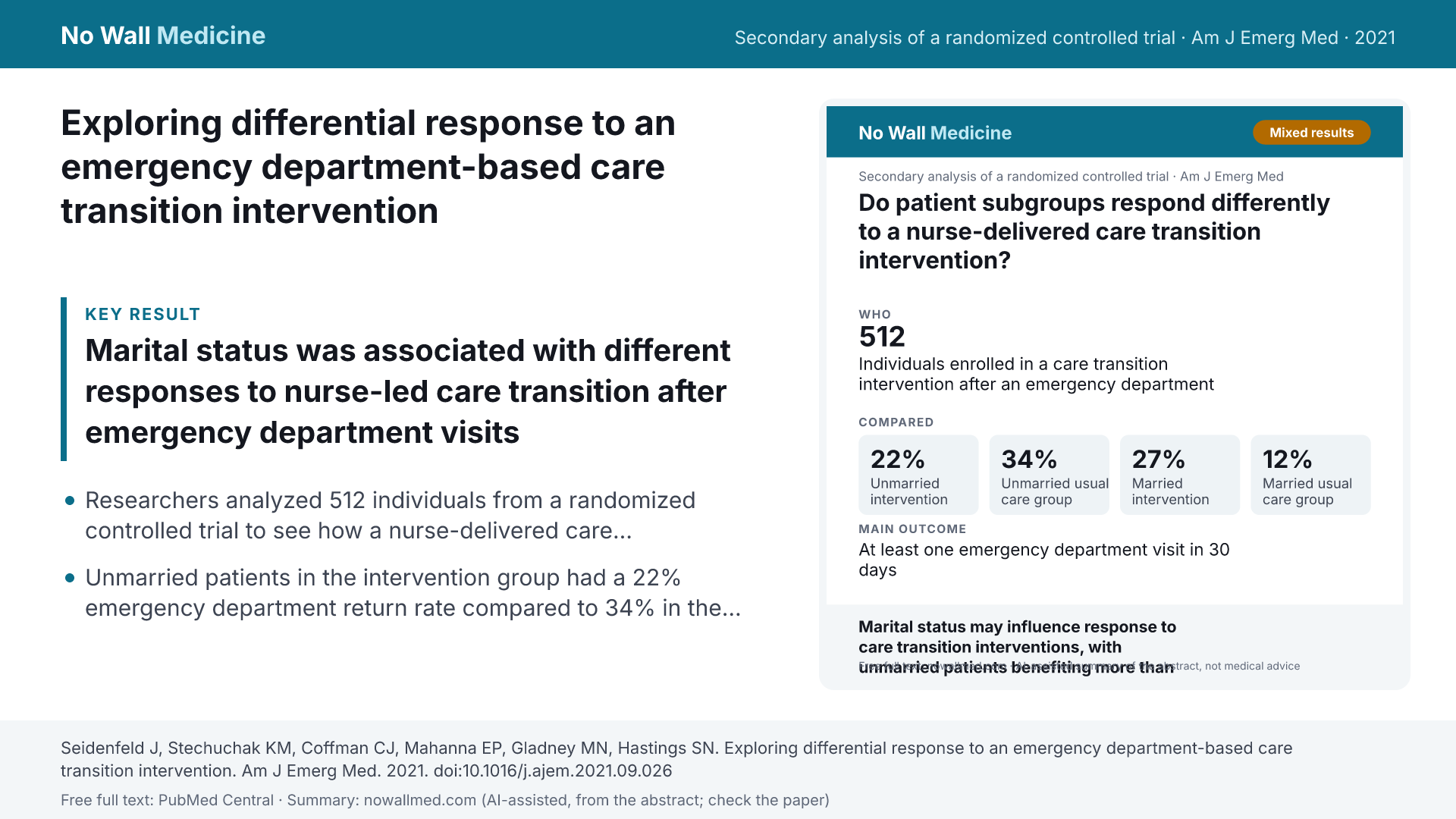
Key result: Marital status was associated with different responses to nurse-led care transition after emergency department visits
Secondary analysis of a randomized controlled trialMixed results
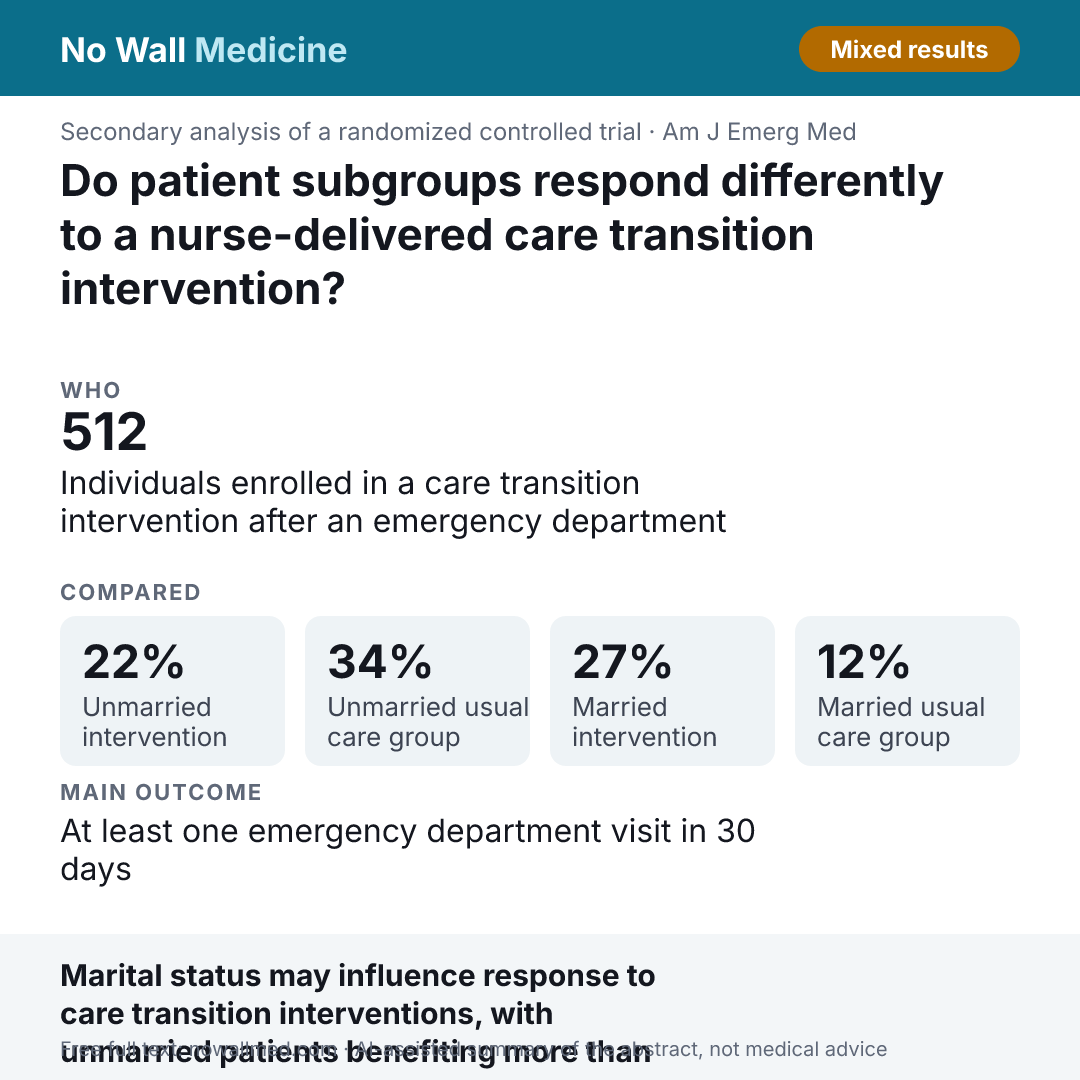
Do patient subgroups respond differently to a nurse-delivered care transition intervention?
Who
512
Individuals enrolled in a care transition intervention after an emergency department visit
Compared
22%Unmarried intervention group
34%Unmarried usual care group
27%Married intervention group
12%Married usual care group
Main outcome
At least one emergency department visit in 30 days
Bottom line: Marital status may influence response to care transition interventions, with unmarried patients benefiting more than married patients.
Limitation: The results are exploratory and based on a secondary analysis.
Am J Emerg Med · 2021-09-16 · Save PNG
Key points
- Researchers analyzed 512 individuals from a randomized controlled trial to see how a nurse-delivered care transition program affected emergency department return rates.
- Unmarried patients in the intervention group had a 22% emergency department return rate compared to 34% in the usual care group.
- Married patients in the intervention group had a 27% emergency department return rate compared to 12% in the usual care group.
Limitation the authors note: The results are exploratory and based on a secondary analysis of a randomized controlled trial.
Discussion prompts
- Would these patients look like yours? Who was left out?
- Is the main outcome one that matters to patients?
- Is the difference large enough to change what you do?
Cite: Seidenfeld J, Stechuchak KM, Coffman CJ, Mahanna EP, Gladney MN, Hastings SN. Exploring differential response to an emergency department-based care transition intervention. Am J Emerg Med. 2021. doi:10.1016/j.ajem.2021.09.026
Free full text: PubMed Central · Summary and visual abstract: nowallmed.com/a/exploring-differential-response-to-an-emergency-department-based-care-1vdht9s/ (AI-assisted from the abstract; check the paper before relying on it).