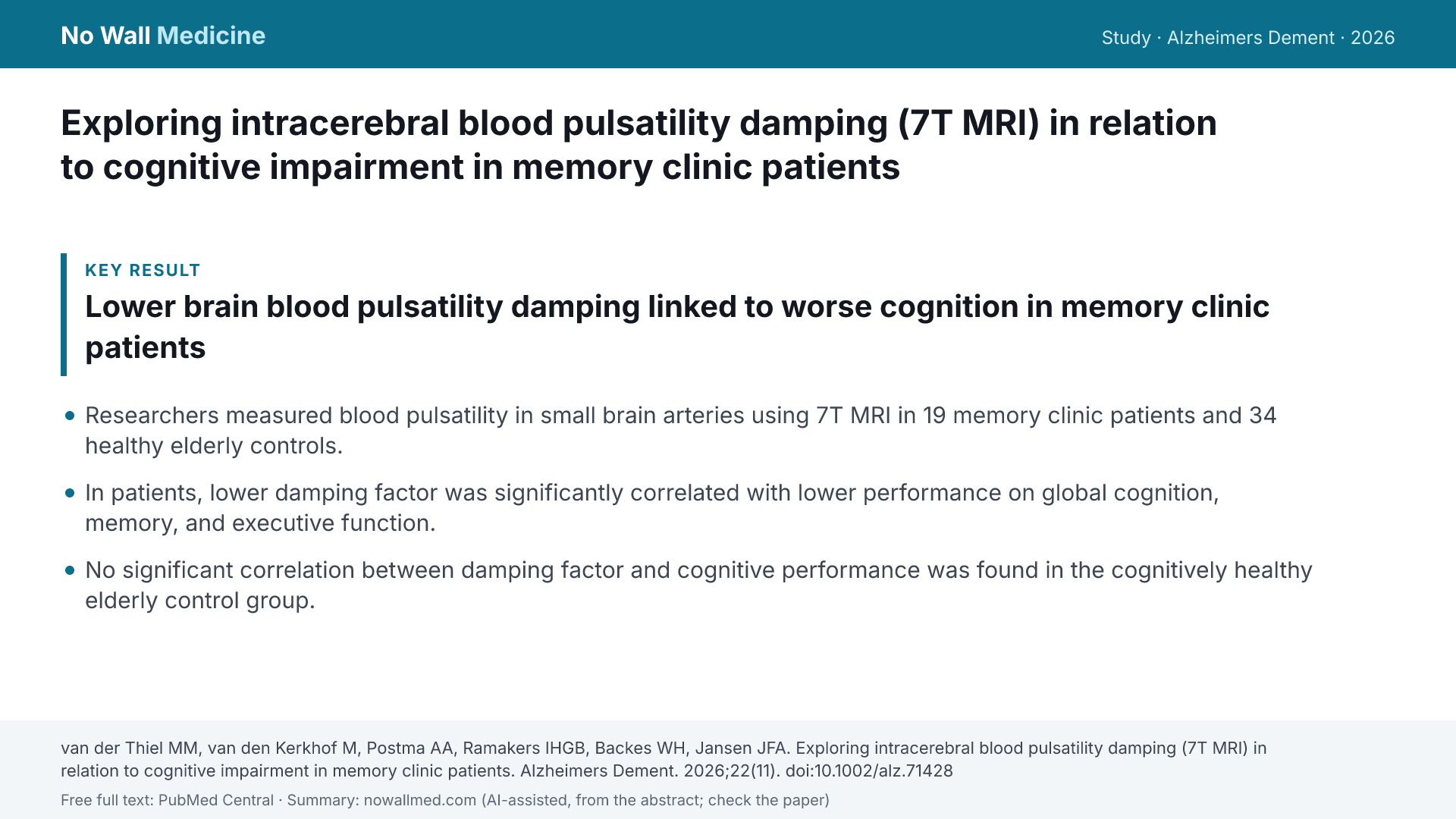
Exploring intracerebral blood pulsatility damping (7T MRI) in relation to cognitive impairment in memory clinic patients
Key result: Lower brain blood pulsatility damping linked to worse cognition in memory clinic patients
Key points
- Researchers measured blood pulsatility in small brain arteries using 7T MRI in 19 memory clinic patients and 34 healthy elderly controls.
- In patients, lower damping factor was significantly correlated with lower performance on global cognition, memory, and executive function.
- No significant correlation between damping factor and cognitive performance was found in the cognitively healthy elderly control group.
Why it matters: Applies to memory clinic patients; suggests impaired pulsatility damping is associated with cognitive decline in those with presumed Alzheimer's pathology.
Limitation the authors note: The study included a small sample size of 19 patients and 34 controls.
Discussion prompts
- Would these patients look like yours? Who was left out?
- Is the main outcome one that matters to patients?
- Is the difference large enough to change what you do?
Cite: van der Thiel MM, van den Kerkhof M, Postma AA, Ramakers IHGB, Backes WH, Jansen JFA. Exploring intracerebral blood pulsatility damping (7T MRI) in relation to cognitive impairment in memory clinic patients. Alzheimers Dement. 2026;22(11). doi:10.1002/alz.71428
Free full text: PubMed Central · Summary and visual abstract: nowallmed.com/a/exploring-intracerebral-blood-pulsatility-damping-7t-mri-in-relation-sdc16n/ (AI-assisted from the abstract; check the paper before relying on it).