Tailored treatment modifications did not improve clinical outcomes for patients with rheumatoid arthritis
Exploring possibilities towards PeRsonalIsed MEdicine in Rheumatoid Arthritis (PRIMERA): tailored modifications to standard treat-to-target management-a multicentre, randomised, open-label trial
Multicentre, open-label randomised controlled trialNo clear difference
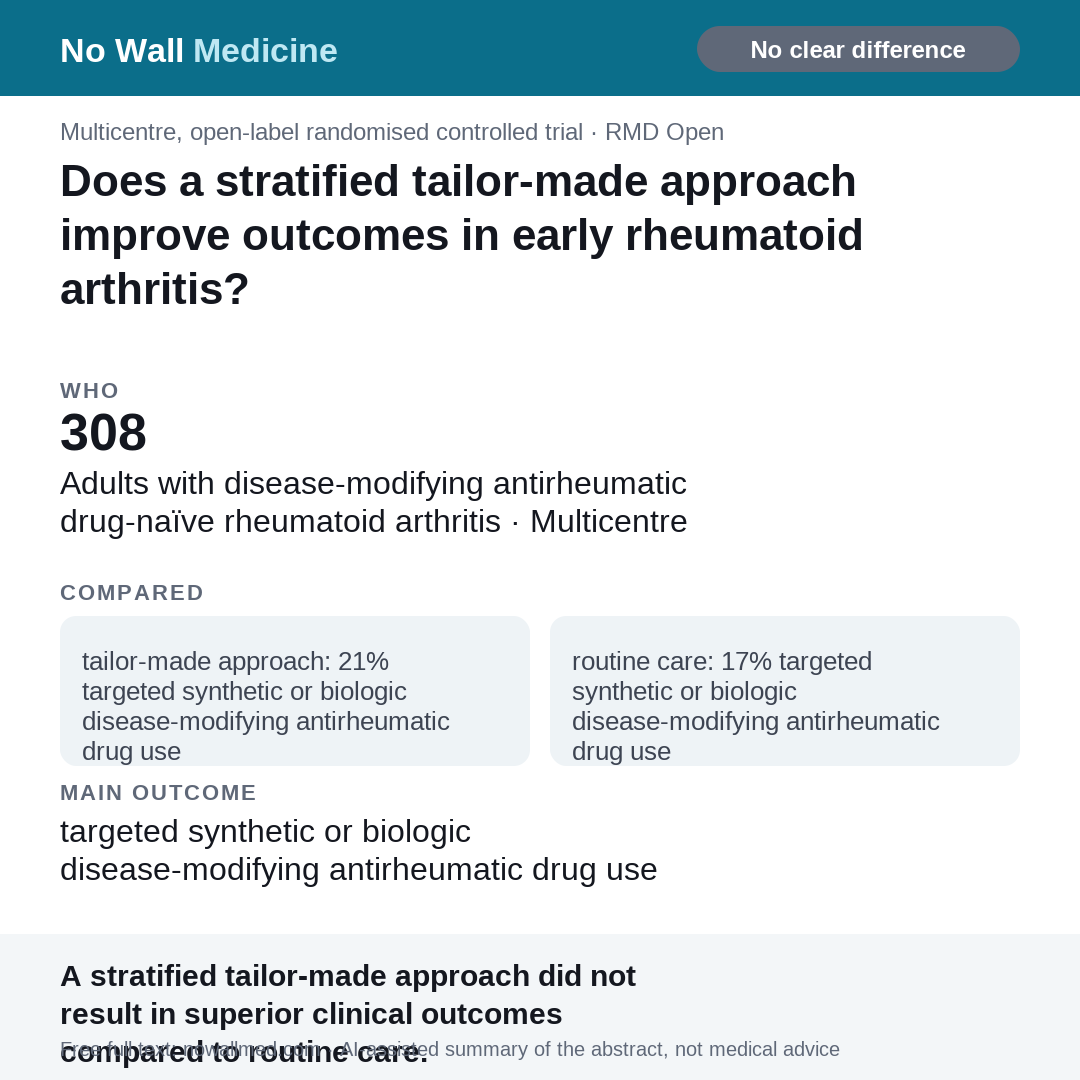
Does a stratified tailor-made approach improve outcomes in early rheumatoid arthritis?
Who
308
Adults with disease-modifying antirheumatic drug-naïve rheumatoid arthritis · Multicentre
Compared
tailor-made approach: 21% targeted synthetic or biologic disease-modifying antirheumatic drug use
routine care: 17% targeted synthetic or biologic disease-modifying antirheumatic drug use
Main outcome
targeted synthetic or biologic disease-modifying antirheumatic drug use
Bottom line: A stratified tailor-made approach did not result in superior clinical outcomes compared to routine care.
RMD Open · 2026-08-20Download image
Clinical question: Does a stratified tailor-made approach improve outcomes in early rheumatoid arthritis?
Why it matters: Current guidelines recommend standard treatment intensification every 3 to 4 months, but it is unclear if personalizing drug selection and accelerating intensification improves results.
Key points
- Researchers studied 308 adults with rheumatoid arthritis who were assigned to either a tailor-made approach or routine care.
- At 10 months, the use of targeted synthetic or biologic disease-modifying antirheumatic drugs was 21% in the tailor-made group versus 17% in routine care.
- There were no significant differences found in mean disease activity scores, patient-reported outcomes, or adverse events between the two groups.
Headline and key points written with AI from the paper’s abstract, with every number checked against it. Read the paper before relying on them.
Abstract
Objectives
Guidelines for early rheumatoid arthritis (RA) recommend starting methotrexate, with optional glucocorticoid (GC) bridging, followed by treat-to-target intensifications after at least 3 months (routine care). Given RA's heterogeneity, we evaluated a stratified treat-to-target approach (tailor-made approach) consisting of two modifications to routine care: first-line disease-modifying antirheumatic drug (DMARD) selection stratified by autoantibody status and rapid treatment intensifications guided by early treatment response (within 1 month). Methods
This multicentre, open-label randomised controlled trial included adults with DMARD-naïve RA (2010 American College of Rheumatology/European Alliance of Associations for Rheumatology (EULAR) criteria) who were randomly assigned (1:1) to the tailor-made approach or routine care. Both arms followed a treat-to-target strategy, intensifying every 3-4 months until Disease Activity Score (DAS) ≤2.4. The tailor-made approach started MTX in autoantibody-positive patients and hydroxychloroquine in autoantibody-negative patients, both with intramuscular GC bridging. Additional intensifications at months 1 and 4 were allowed when DAS >2.4, 1 month after DMARD initiation or intensification, enabling treatment escalation before the standard 3-month reassessment. Routine care started MTX with GC bridging regardless of autoantibody status and without extra intensifications. The two primary outcomes were targeted synthetic/biologic (ts/b)DMARD use at 10 months and mean DAS over time; superiority required both to favour the tailor-made approach. Results
In total, 308 included patients were randomised(152 tailor-made; 156 routine care). At 10 months, ts/bDMARD use was 21% in the tailor-made approach vs 17% in routine care (one-sided p=0.20). Mean DAS trajectories were similar (p=0.57). No differences were observed in mean patient-reported outcome measure trajectories or adverse events. Conclusion
Modifying the standard treat-to-target strategy, by stratifying the initial DMARD according to autoantibody status combined with rapidly intensifying therapy based on early treatment response, did not result in superior clinical outcomes. Trial registration number
ISRCTN16170070.
Abstract reproduced under the article’s CC BY NC licence.
Topics
Spotted a mistake? Suggest a correction