Review of 25 papers shows post hoc methods are common for explaining wearable device data
Exploring the Applications of Explainability in Wearable Data Analytics: Systematic Literature Review
Systematic literature reviewUnclear result
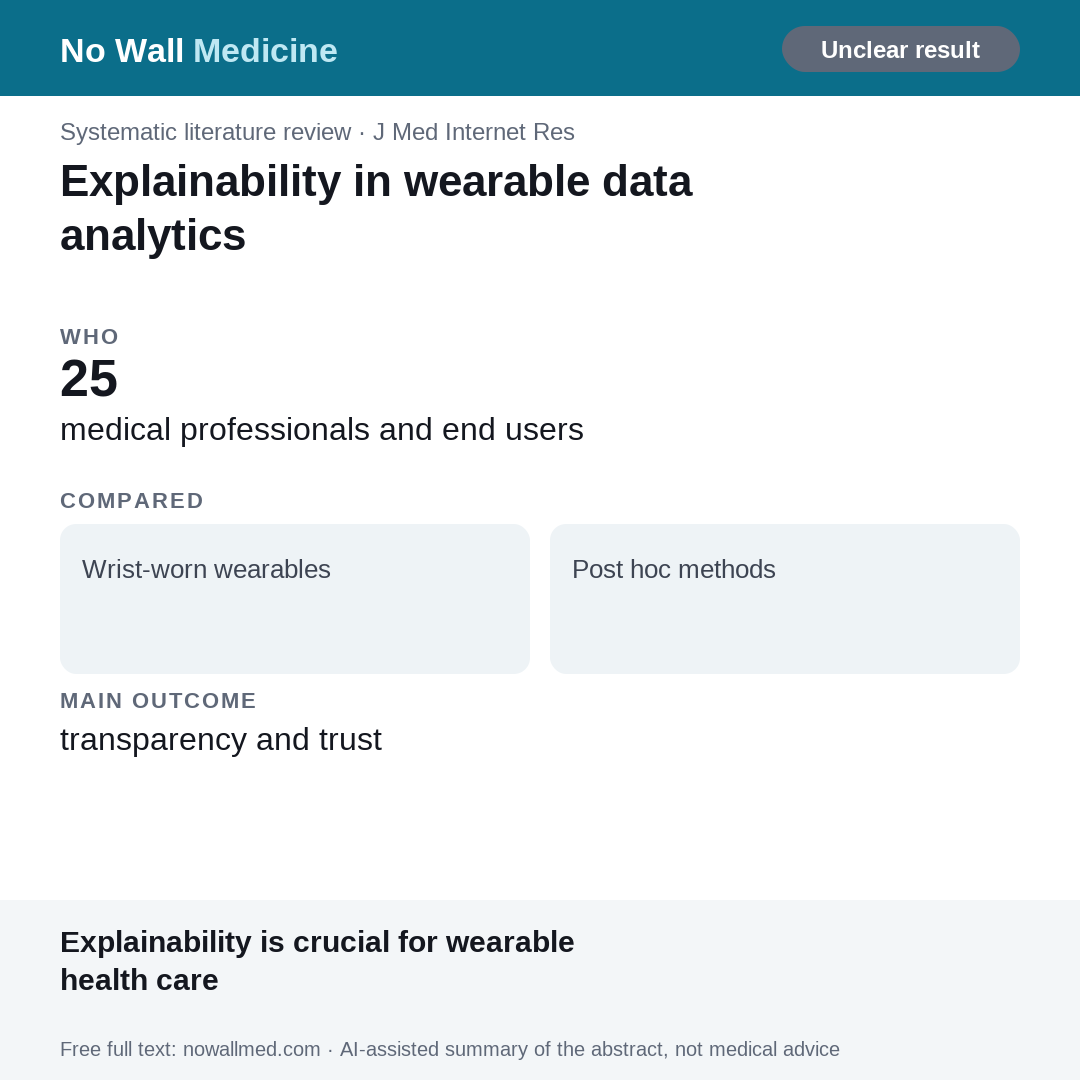
Explainability in wearable data analytics
Who
25
medical professionals and end users
Compared
Wrist-worn wearables
Post hoc methods
Main outcome
transparency and trust
Bottom line: Explainability is crucial for wearable health care
Limitation: user evaluation
J Med Internet Res · 2024-12-24Download image
Why it matters: Complex machine learning and deep learning algorithms often create black box models that lack transparency for medical professionals and end users.
Key points
- Researchers analyzed 25 peer-reviewed publications involving wearable devices, sensors, or mobile phones used in medical contexts between 2018 and 2022.
- Post hoc approaches, specifically Shapley Additive Explanations, were identified as prominent methods for providing visual explanations of complex machine learning algorithms.
- Wrist-worn devices like Fitbit and Empatica E4 were found to be prevalent in healthcare applications.
Limitation the authors note: The authors highlight a limitation in user evaluation and the need for more user involvement in the development process.
Headline and key points written with AI from the paper’s abstract, with every number checked against it. Read the paper before relying on them.
Topics
Cite this article
Abdelaal Y, Aupetit M, Baggag A, Al-Thani D. Exploring the Applications of Explainability in Wearable Data Analytics: Systematic Literature Review. J Med Internet Res. 2024. doi:10.2196/53863
Spotted a mistake? Suggest a correction
Top studies every Monday
The week’s key trials and guidelines in your specialties, by email. Free.
Get the weekly digest