Exploring the association between serotonin transporter promoter region methylation levels and depressive symptoms: a systematic review and multi-level meta-analysis
Systematic review and multi-level meta-analysisNo clear difference
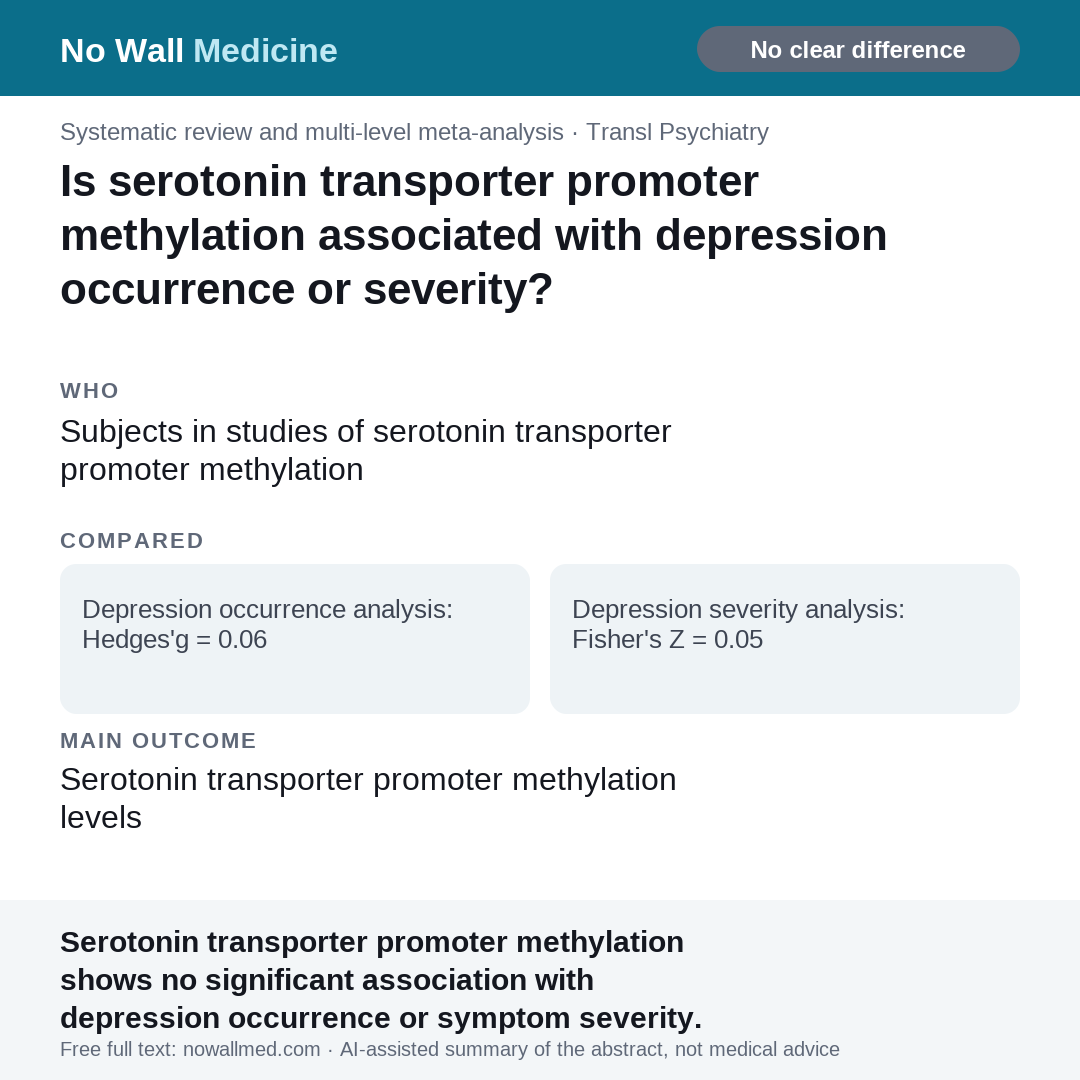
Is serotonin transporter promoter methylation associated with depression occurrence or severity?
Who
Subjects in studies of serotonin transporter promoter methylation
Compared
Depression occurrence analysis: Hedges'g = 0.06
Depression severity analysis: Fisher's Z = 0.05
Main outcome
Serotonin transporter promoter methylation levels
Bottom line: Serotonin transporter promoter methylation shows no significant association with depression occurrence or symptom severity.
Limitation: All reported effects carried potential for bias and asymmetry was detected.
Transl Psychiatry · 2025-05-03Download image
Clinical question: Is serotonin transporter promoter methylation associated with depression occurrence or severity?
Abstract
Depressive disorders result from complex interactions among genetic, epigenetic, and environmental factors. DNA methylation, a key epigenetic mechanism, is crucial in understanding depressive symptoms development. The serotonin transporter gene (5-HTT) and its polymorphisms, like 5-HTTLPR, have been extensively studied in relation to depression, yet conflicting findings regarding the association between 5-HTT promoter methylation and depressive symptoms persist, largely due to methodological differences. Thus, this systematic review and meta-analysis aims to assess (1) 5-HTT promoter methylation levels between depressed and non-depressed conditions and (2) the association between 5-HTT methylation and depressive symptoms severity. We searched PubMed, Google Scholar, and Web of Science from inception to January 15th, 2025 (PROSPERO: CRD42023355414) and performed two independent multi-level meta-analyses to answer our aims. Twenty-four trials were included in the systematic review. All reported effects carried potential for bias. The meta-analysis for depression occurrence (12 studies - 2028 subjects - 127 effects) indicated no significant effect (Hedges'g = 0.06) with moderate within- and low between-study heterogeneity. The depression severity analysis (14 studies - 2296 subjects - 116 effects) revealed a null effect size (Fisher's Z = 0.05), with no within- and moderate between-study heterogeneity. Asymmetry was detected for both meta-analyses. Moderator analyses demonstrated no significant effects of depression severity, methylation techniques, single-CpG sites, cell types assessed, age, and female percentage. This comprehensive review provides insights into the intricate interplay between 5-HTT promoter methylation and depressive symptoms. Furthermore, it offers well-considered recommendations for future research endeavors and delineates guidelines for reporting methylation research.
Topics
Cite this article
Javelle F, Dao G, Ringleb M, Pulverer W, Bloch W. Exploring the association between serotonin transporter promoter region methylation levels and depressive symptoms: a systematic review and multi-level meta-analysis. Transl Psychiatry. 2025. doi:10.1038/s41398-025-03356-w
Spotted a mistake? Suggest a correction
Top studies every Monday
The week’s key trials and guidelines in your specialties, by email. Free.
Get the weekly digest