Intermittent fasting and calorie restriction both cause weight loss through different behavioral pathways
Exploring the impact of intermittent fasting plus time-restricted eating versus calorie restriction on eating behavior, mood, sleep, quality of life in adults with obesity
Randomized controlled trialMixed results
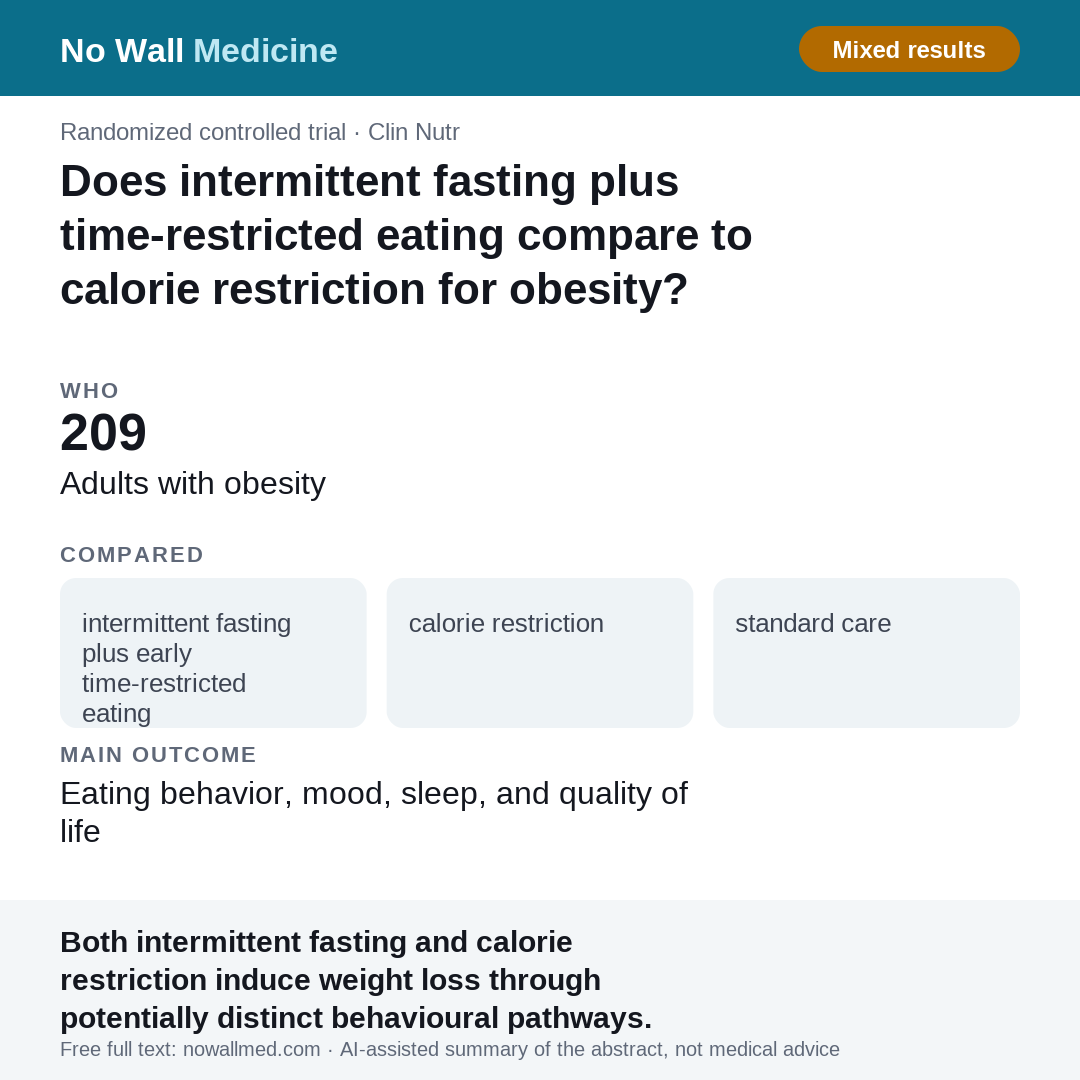
Does intermittent fasting plus time-restricted eating compare to calorie restriction for obesity?
Who
209
Adults with obesity
Compared
intermittent fasting plus early time-restricted eating
calorie restriction
standard care
Main outcome
Eating behavior, mood, sleep, and quality of life
Bottom line: Both intermittent fasting and calorie restriction induce weight loss through potentially distinct behavioural pathways.
Limitation: This is an exploratory analysis.
Clin Nutr · 2026-05-15Download image
Clinical question: Does intermittent fasting plus time-restricted eating compare to calorie restriction for obesity?
Why it matters: The psychological and behavioral effects of intermittent fasting approaches on diet adherence are poorly studied.
Key points
- Researchers studied 209 adults with obesity, comparing intermittent fasting plus early time-restricted eating, calorie restriction, and standard care over 18 months.
- Both intermittent fasting and calorie restriction groups lost more weight than the standard care group at 2 and 6 months.
- Calorie restriction led to greater increases in dietary restraint and greater reductions in hunger and disinhibition compared to the other groups.
Headline and key points written with AI from the paper’s abstract, with every number checked against it. Read the paper before relying on them.
Topics
Spotted a mistake? Suggest a correction