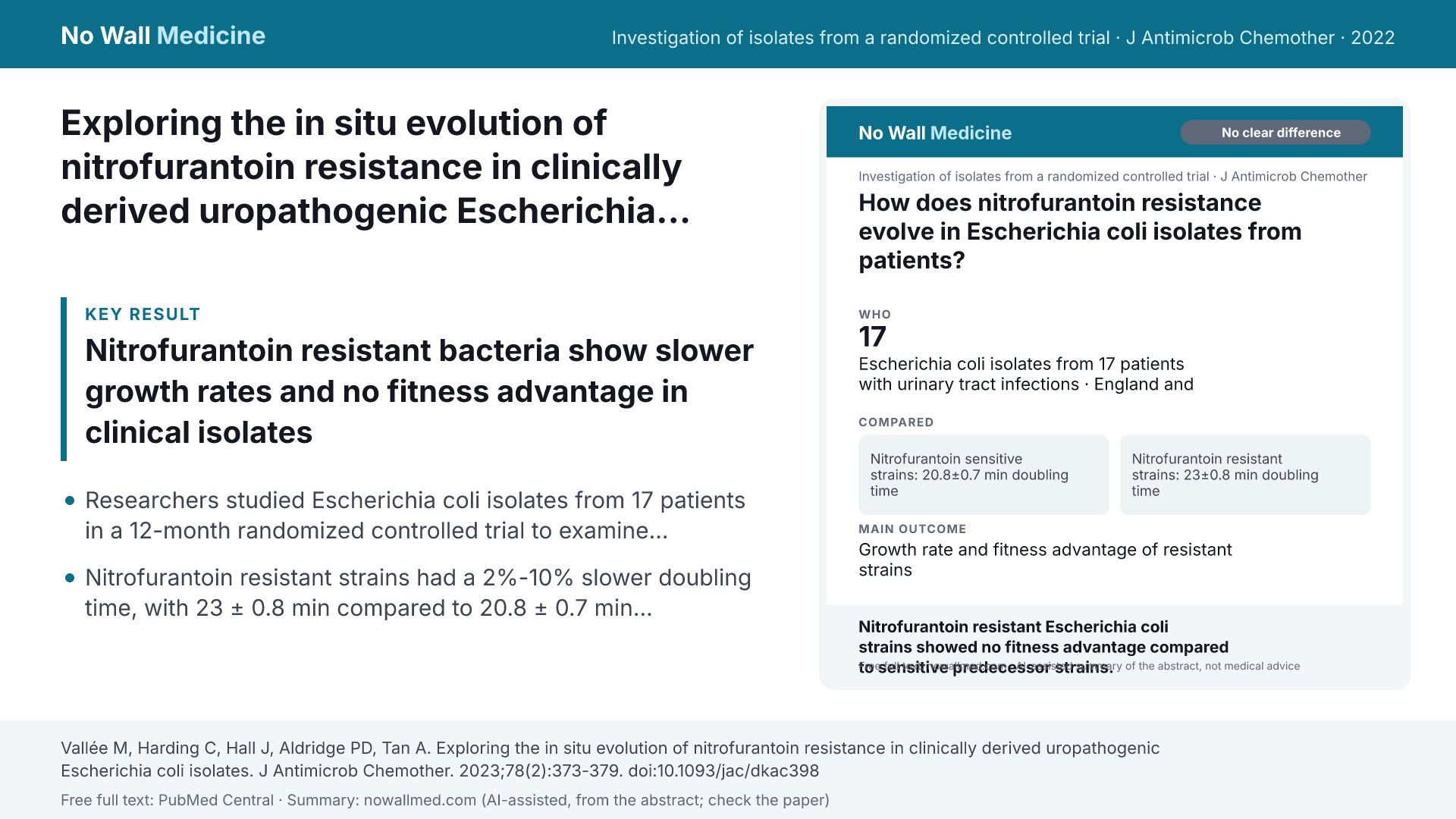
Nitrofurantoin resistant bacteria show slower growth rates and no fitness advantage in clinical isolates
Exploring the in situ evolution of nitrofurantoin resistance in clinically derived uropathogenic Escherichia coli isolates
Investigation of isolates from a randomized controlled trialNo clear difference
How does nitrofurantoin resistance evolve in Escherichia coli isolates from patients?
Who
17
Escherichia coli isolates from 17 patients with urinary tract infections · England and Wales
Compared
Nitrofurantoin sensitive strains: 20.8±0.7 min doubling time
Nitrofurantoin resistant strains: 23±0.8 min doubling time
Main outcome
Growth rate and fitness advantage of resistant strains
Bottom line: Nitrofurantoin resistant Escherichia coli strains showed no fitness advantage compared to sensitive predecessor strains.
J Antimicrob Chemother · 2022-12-09 · Save PNG
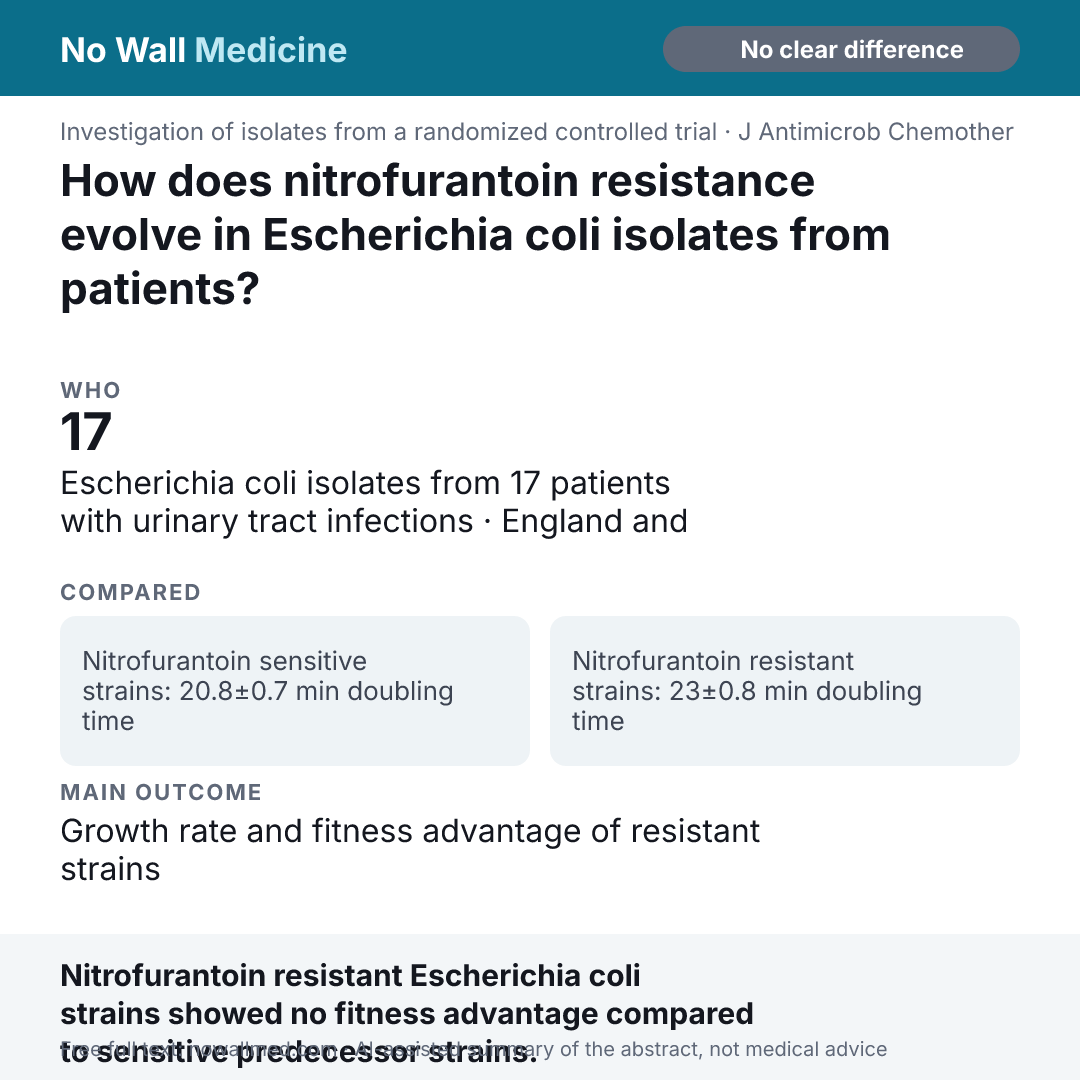
Clinical question: How does nitrofurantoin resistance evolve in Escherichia coli isolates from patients?
Key points
- Researchers studied Escherichia coli isolates from 17 patients in a 12-month randomized controlled trial to examine how resistance to nitrofurantoin evolves.
- Nitrofurantoin resistant strains had a 2%-10% slower doubling time, with 23 ± 0.8 min compared to 20.8 ± 0.7 min for sensitive strains.
- The data indicated no fitness advantage for evolved strains compared to sensitive predecessors (P-value = 0.13) and no fitness advantage in genetically manipulated strains (P-value = 0.22).
Headline and key points written with AI from the paper’s abstract, with every number checked against it. Read the paper before relying on them.
Was this summary helpful?
Subject terms
Headline, design, result, key points, caveat and citation as plain text.
Cite this article
Vallée M, Harding C, Hall J, Aldridge PD, Tan A. Exploring the in situ evolution of nitrofurantoin resistance in clinically derived uropathogenic Escherichia coli isolates. J Antimicrob Chemother. 2023;78(2):373-379. doi:10.1093/jac/dkac398
Spotted a mistake? Suggest a correction