Decision support tools increased clinician confidence in managing cognitive impairment but not in diagnosing it
Exposure to clinical decision support and training increases primary care clinician confidence in managing cognitive impairment care but not confidence to diagnose
Cluster randomized, controlled clinical trialMixed results
Does a clinical decision support system increase clinician confidence in managing and diagnosing cognitive impairment?
Who
Primary care clinicians · 38 primary care clinics
Compared
Clinical decision support system: OR 2.24 [1.05, 4.80]
Usual care
Main outcome
Clinician confidence in managing and diagnosing cognitive impairment
Result: OR 2.24 [1.05, 4.80]
Bottom line: The system increased clinician confidence in managing cognitive impairment care but did not significantly increase confidence in diagnosing it.
Limitation: Self-reported use of the clinical decision support system was modest.
BMC Prim Care · 2025-11-12Download image
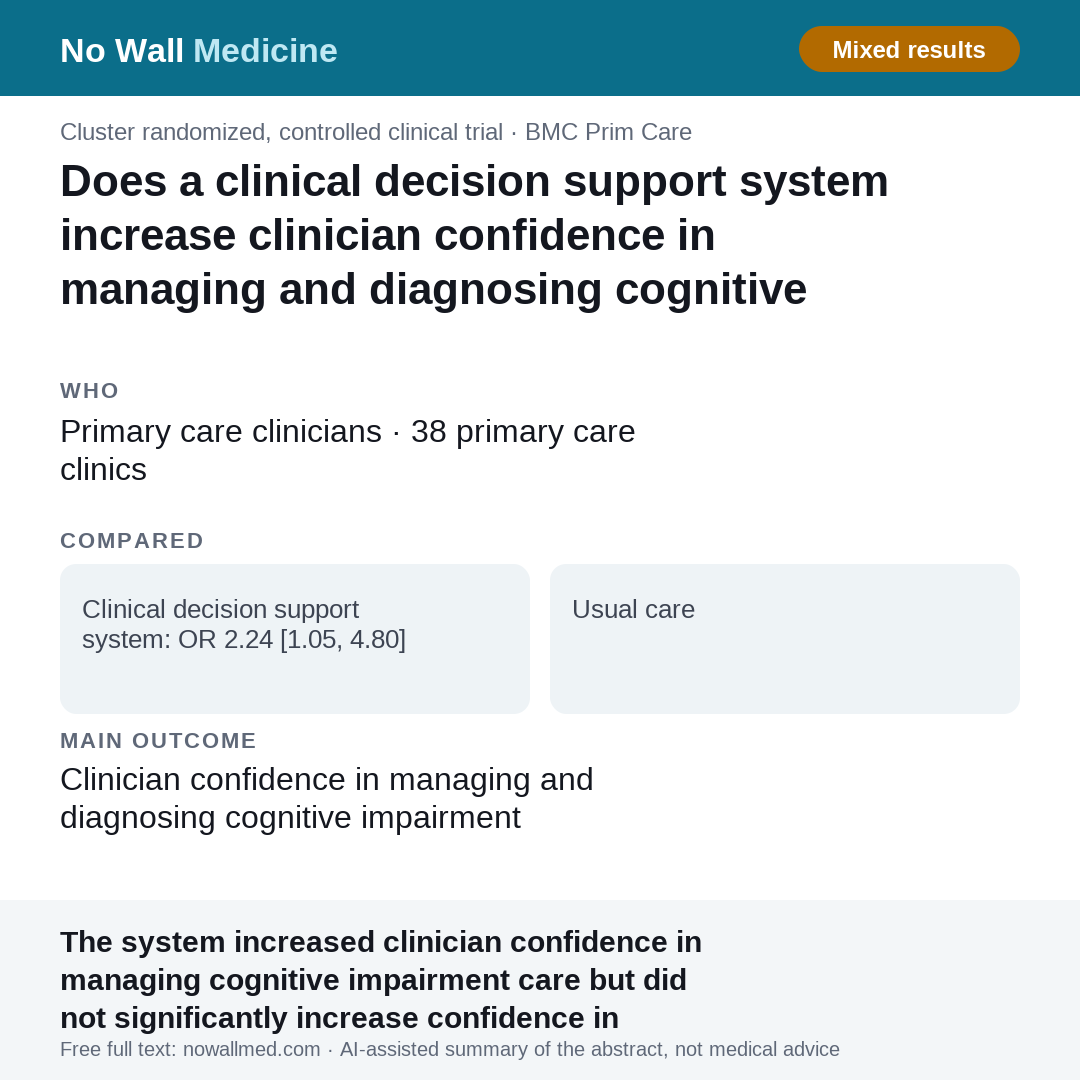
Clinical question: Does a clinical decision support system increase clinician confidence in managing and diagnosing cognitive impairment?
Why it matters: Primary care clinicians report barriers to addressing cognitive impairment, including low confidence in both diagnosing and managing the condition.
Key points
- Researchers conducted a cluster randomized controlled trial in 38 primary care clinics to test a cognitive impairment clinician decision support system.
- Clinicians using the tool reported increased confidence in managing cognitive impairment care compared to usual care (OR = 2.24 [1.05, 4.80]).
- Increases in clinician confidence for diagnosing cognitive impairment were trending but not statistically significant (AME = 9.8, OR = 2.08 [0.84, 5.14]).
Limitation the authors note: Primary outcome results regarding cognitive impairment diagnosis are awaiting the end of the follow-up period.
Headline and key points written with AI from the paper’s abstract, with every number checked against it. Read the paper before relying on them.
Topics
Cite this article
JaKa MM, Rossom RC, Crouse B, Crain AL, Gustafson SK, Ekstrom HL. Exposure to clinical decision support and training increases primary care clinician confidence in managing cognitive impairment care but not confidence to diagnose. BMC Prim Care. 2025. doi:10.1186/s12875-025-03053-z
Spotted a mistake? Suggest a correction