Rude responses were associated with more frequent speaking up during simulated medical scenarios
Exposure to incivility does not hinder speaking up: a randomised controlled high-fidelity simulation-based study
Randomized controlled high-fidelity simulation-based studyNo clear difference
Does witnessing civil, pseudo-civil, or rude responses affect staff speaking up behavior?
Who
125
Interprofessional hospital staff members · Single, large academic teaching hospital
Compared
Psychologically safe condition: γ=0.47 (95% CI, 0.09-0.85)
Rude condition: γ=0.28 (95% CI, 0.05-0.52)
Main outcome
Speaking up behavior
Bottom line: Participants were more likely to speak up in the rude condition than in other conditions.
Br J Anaesth · 2022-09-06Download image
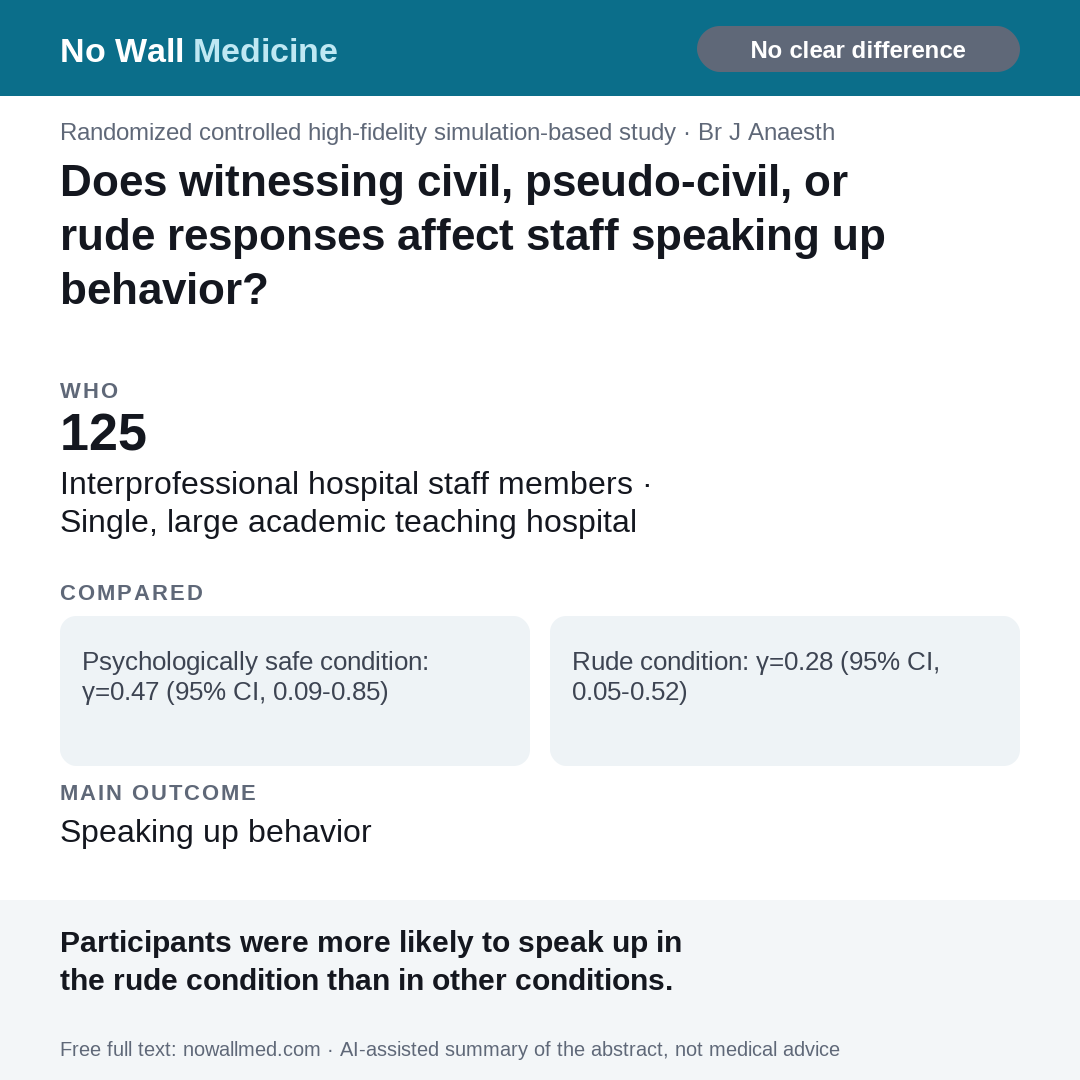
Clinical question: Does witnessing civil, pseudo-civil, or rude responses affect staff speaking up behavior?
Why it matters: It was unknown whether witnessing polite, vague, or rude responses to concerns would change how often hospital staff members speak up.
Key points
- The study involved 125 interprofessional hospital staff members, including 82 (66%) women and 43 (34%) men, participating in simulated basic life support scenarios.
- Participants were more likely to speak up in the rude condition than in the civil or pseudo-civil conditions (γ=0.28; se=0.12; 95% CI, 0.05-0.52; P=0.019).
- Speaking up was more likely when participants felt psychologically safe (γ=0.47; se=0.19; 95% CI, 0.09-0.85; P=0.017).
Headline and key points written with AI from the paper’s abstract, with every number checked against it. Read the paper before relying on them.
Was this summary helpful?
Subject terms
Cite this article
Vauk S, Seelandt JC, Huber K, Grande B, Kolbe M. Exposure to incivility does not hinder speaking up: a randomised controlled high-fidelity simulation-based study. Br J Anaesth. 2022. doi:10.1016/j.bja.2022.07.050
Spotted a mistake? Suggest a correction
Top studies every Monday
The week’s key trials and guidelines in your specialties, plus any topics you follow. By email, free.
Get the weekly digest