Extended intrauterine balloon stent use to prevent adhesion reformation after hysteroscopic adhesiolysis: a randomized trial
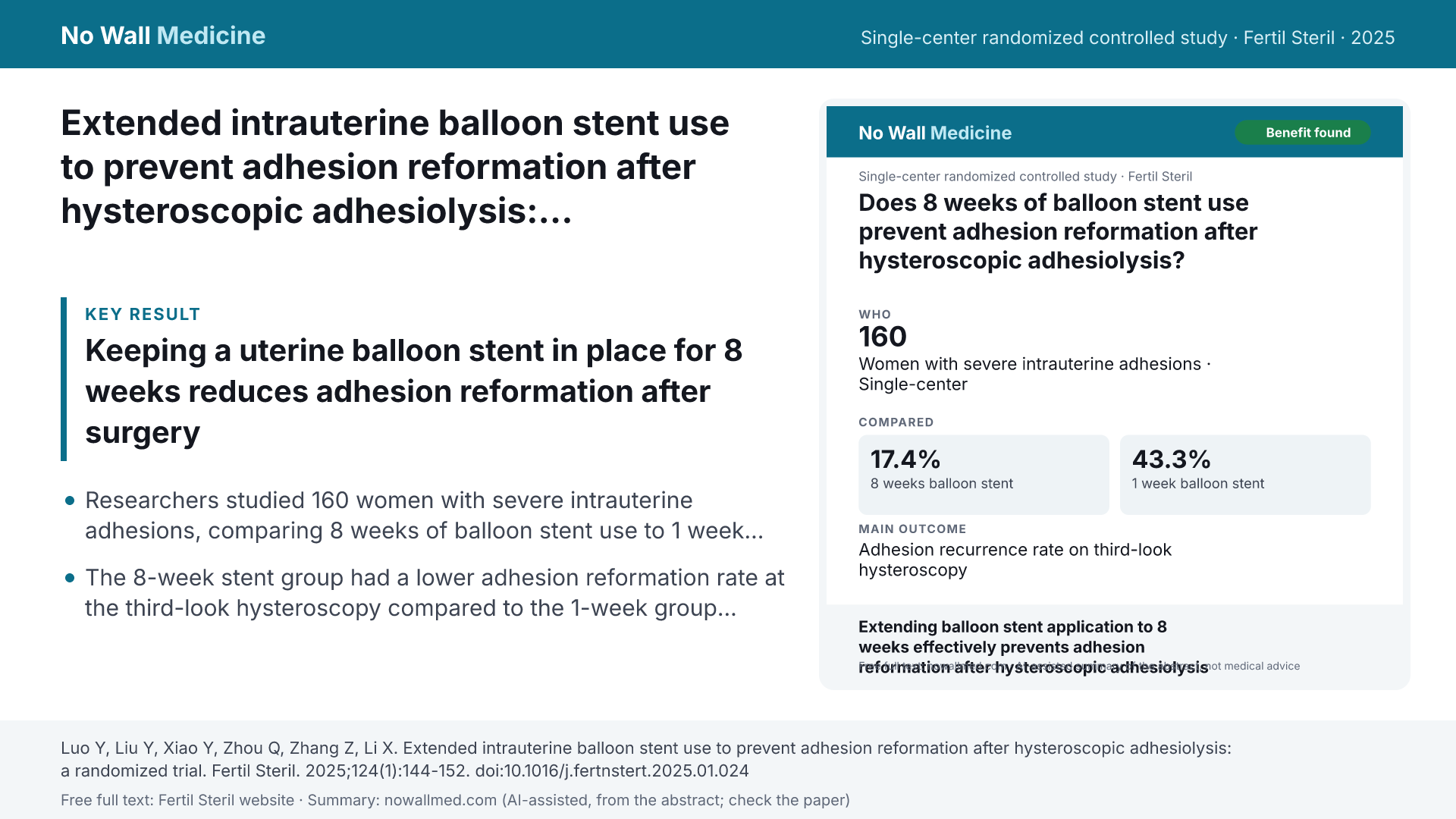
Key result: Keeping a uterine balloon stent in place for 8 weeks reduces adhesion reformation after surgery
Single-center randomized controlled studyBenefit found
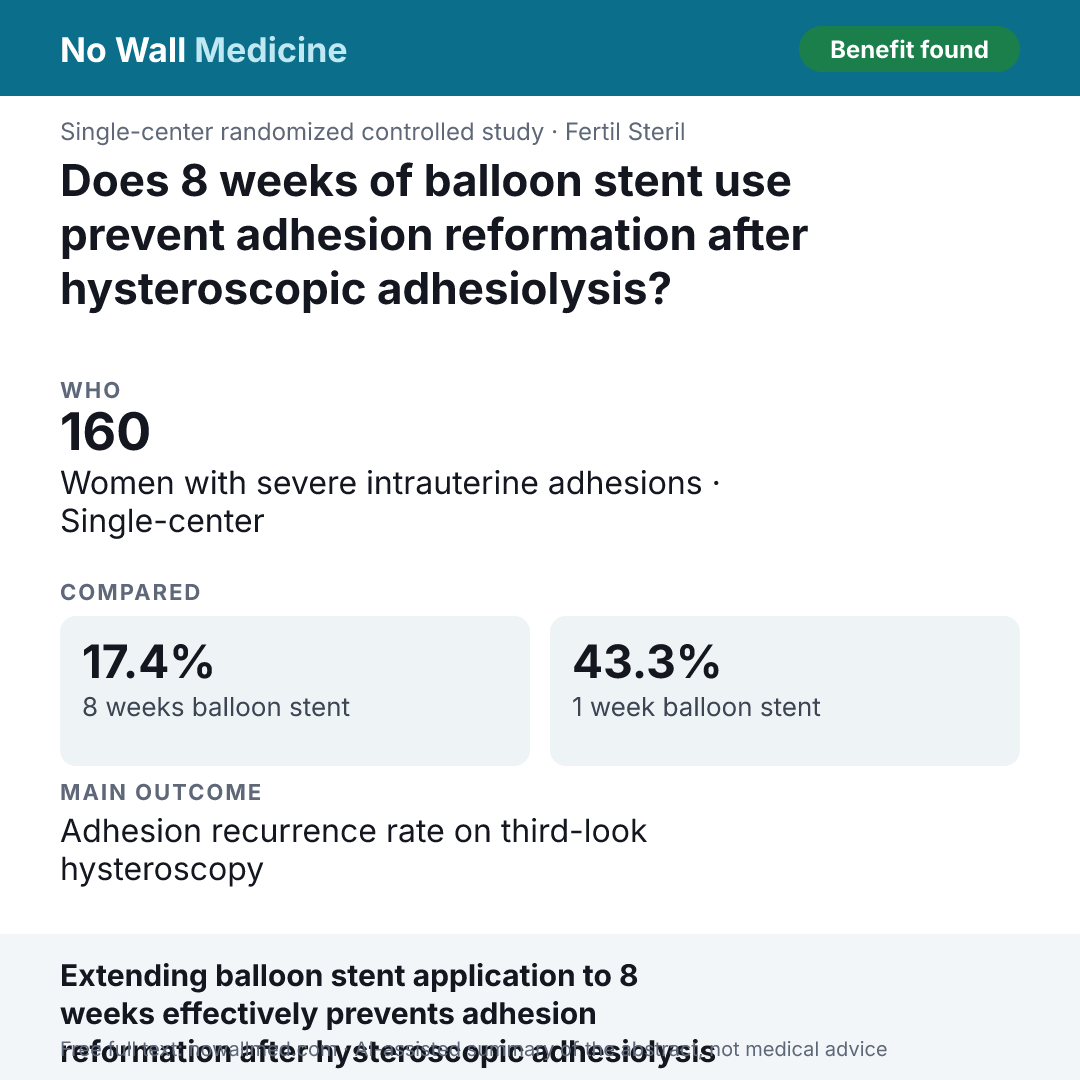
Does 8 weeks of balloon stent use prevent adhesion reformation after hysteroscopic adhesiolysis?
Who
160
Women with severe intrauterine adhesions · Single-center
Compared
17.4%8 weeks balloon stent
43.3%1 week balloon stent
Main outcome
Adhesion recurrence rate on third-look hysteroscopy
Result: relative risk 0.40 (95% confidence interval 0.22-0.72)
Bottom line: Extending balloon stent application to 8 weeks effectively prevents adhesion reformation after hysteroscopic adhesiolysis for severe intrauterine adhesions.
Fertil Steril · 2025-01-28 · Save PNG
Key points
- Researchers studied 160 women with severe intrauterine adhesions, comparing 8 weeks of balloon stent use to 1 week of use.
- The 8-week stent group had a lower adhesion reformation rate at the third-look hysteroscopy compared to the 1-week group at 17.4% vs 43.3%.
- The study group showed a larger reduction in American Fertility Society adhesion scores with a decrease of 10 compared to 7 in the control group.
Discussion prompts
- Would these patients look like yours? Who was left out?
- Is the main outcome one that matters to patients?
- Is the difference large enough to change what you do?
Cite: Luo Y, Liu Y, Xiao Y, Zhou Q, Zhang Z, Li X. Extended intrauterine balloon stent use to prevent adhesion reformation after hysteroscopic adhesiolysis: a randomized trial. Fertil Steril. 2025;124(1):144-152. doi:10.1016/j.fertnstert.2025.01.024
Free full text: Fertil Steril website · Summary and visual abstract: nowallmed.com/a/extended-intrauterine-balloon-stent-use-to-prevent-adhesion-w4fza6/ (AI-assisted from the abstract; check the paper before relying on it).