Extended reality technologies show limited accuracy in mapping blood vessel locations for breast reconstruction
Extended reality for mapping perforator-based flaps in breast reconstruction: a systematic review and meta-analysis
Systematic review and meta-analysisMixed results
What is the role of extended reality in perforator-based breast reconstruction?
Who
229
229 perforator-based flaps
Compared
Augmented reality: 4 mm (95% confidence interval 3.2-4.9)
Virtual reality: 14 mm (95% confidence interval 5.5-22.5)
Main outcome
accuracy of perforator emergence localisation
Bottom line: Extended reality offers limited accuracy benefits but may reduce flap harvesting and total operative time.
Limitation: heterogeneity and quality of the included studies
JPRAS Open · 2025-02-27Download image
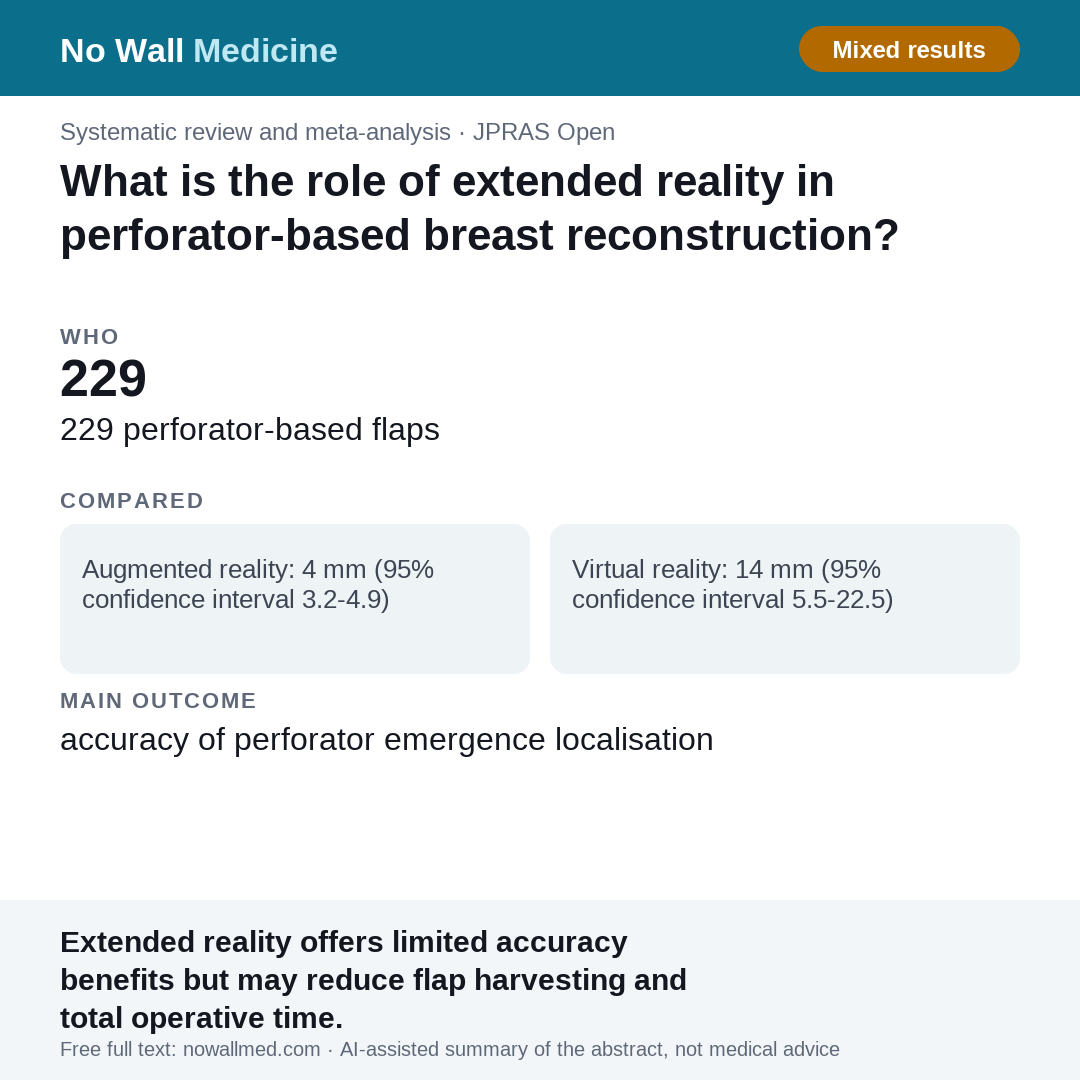
Clinical question: What is the role of extended reality in perforator-based breast reconstruction?
Why it matters: The role of augmented reality and virtual reality in planning and visualizing anatomy for perforator-based breast reconstruction is not fully established.
Key points
- A meta-analysis of 10 studies involving 229 flaps compared augmented reality and virtual reality for mapping blood vessels used in breast reconstruction.
- Augmented reality and virtual reality were 4 mm (95% CI 3.2-4.9) and 14 mm (95% CI 5.5-22.5) away from the correct location, respectively.
- Preoperative virtual reality was associated with shorter operative times than conventional Doppler ultrasound, which is a tool used to locate blood vessels.
Limitation the authors note: The authors state that the included studies were limited by heterogeneity and quality.
Headline and key points written with AI from the paper’s abstract, with every number checked against it. Read the paper before relying on them.
Cite this article
Lacey H, Khan A, Dheansa B. Extended reality for mapping perforator-based flaps in breast reconstruction: a systematic review and meta-analysis. JPRAS Open. 2025. doi:10.1016/j.jpra.2025.02.011
Spotted a mistake? Suggest a correction