Extended thromboprophylaxis for medically ill patients with cancer: a systemic review and meta-analysis
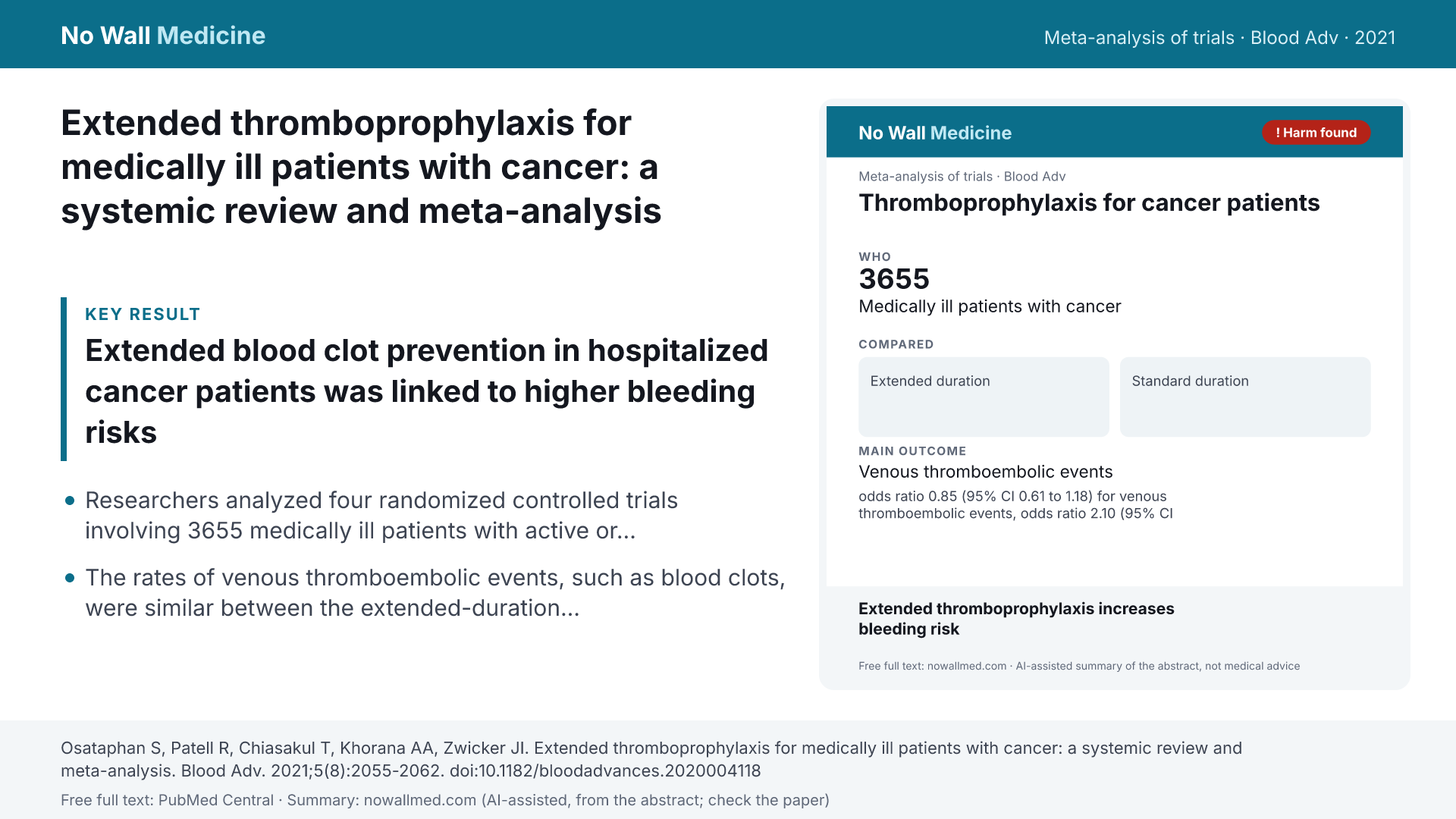
Key result: Extended blood clot prevention in hospitalized cancer patients was linked to higher bleeding risks
Meta-analysis of trialsHarm found
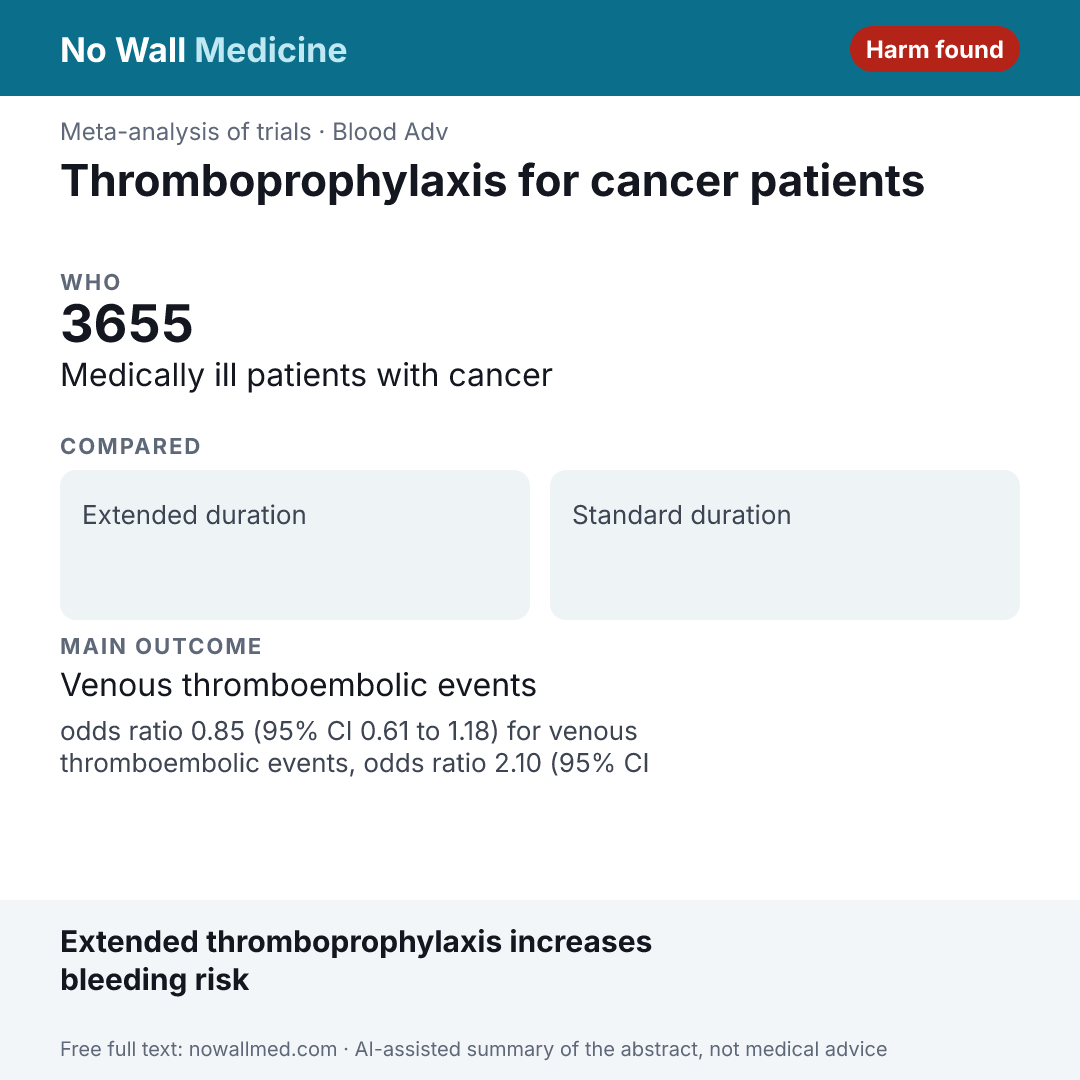
Thromboprophylaxis for cancer patients
Who
3655
Medically ill patients with cancer
Compared
Extended duration
Standard duration
Main outcome
Venous thromboembolic events
Result: odds ratio 0.85 (95% CI 0.61 to 1.18) for venous thromboembolic events, odds ratio 2.10 (95% CI 1.33 to 3.35) for bleeding
Bottom line: Extended thromboprophylaxis increases bleeding risk
Blood Adv · 2021-04-16 · Save PNG
Key points
- Researchers analyzed four randomized controlled trials involving 3655 medically ill patients with active or past cancer to compare extended and standard durations of blood clot prevention.
- The rates of venous thromboembolic events, such as blood clots, were similar between the extended-duration and standard-duration groups (odds ratio 0.85; 95% confidence interval 0.61-1.18).
- Major and clinically relevant nonmajor bleeding occurred significantly more frequently in the extended-duration group (odds ratio 2.10; 95% confidence interval 1.33-3.35).
Discussion prompts
- Would these patients look like yours? Who was left out?
- Is the main outcome one that matters to patients?
- Is the difference large enough to change what you do?
Cite: Osataphan S, Patell R, Chiasakul T, Khorana AA, Zwicker JI. Extended thromboprophylaxis for medically ill patients with cancer: a systemic review and meta-analysis. Blood Adv. 2021;5(8):2055-2062. doi:10.1182/bloodadvances.2020004118
Free full text: PubMed Central · Summary and visual abstract: nowallmed.com/a/extended-thromboprophylaxis-for-medically-ill-patients-with-cancer-a-mvtpb2/ (AI-assisted from the abstract; check the paper before relying on it).