Extending venous thromboembolism secondary prevention with apixaban in cancer patients. The EVE trial
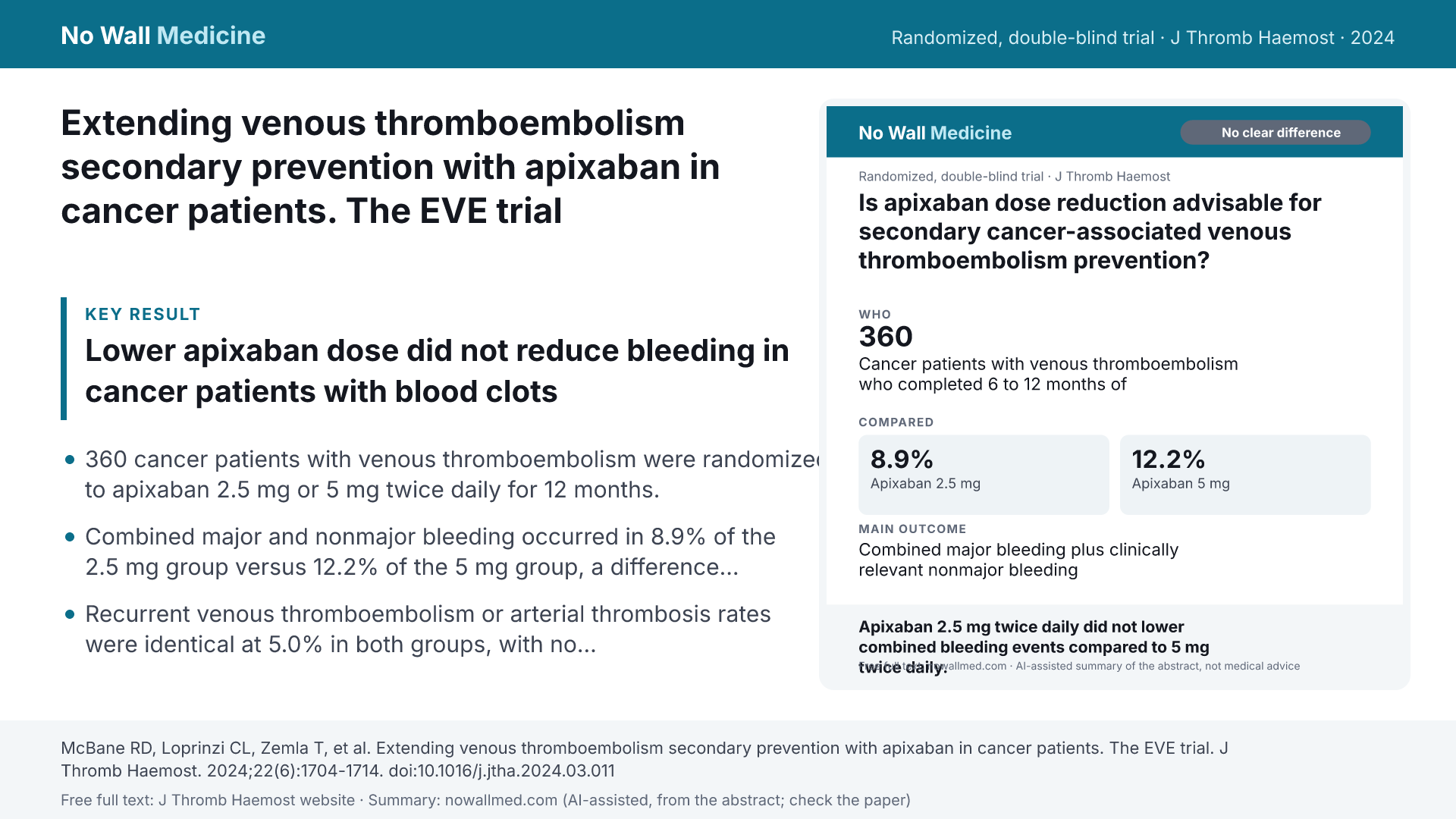
Key result: Lower apixaban dose did not reduce bleeding in cancer patients with blood clots
Randomized, double-blind trialNo clear difference
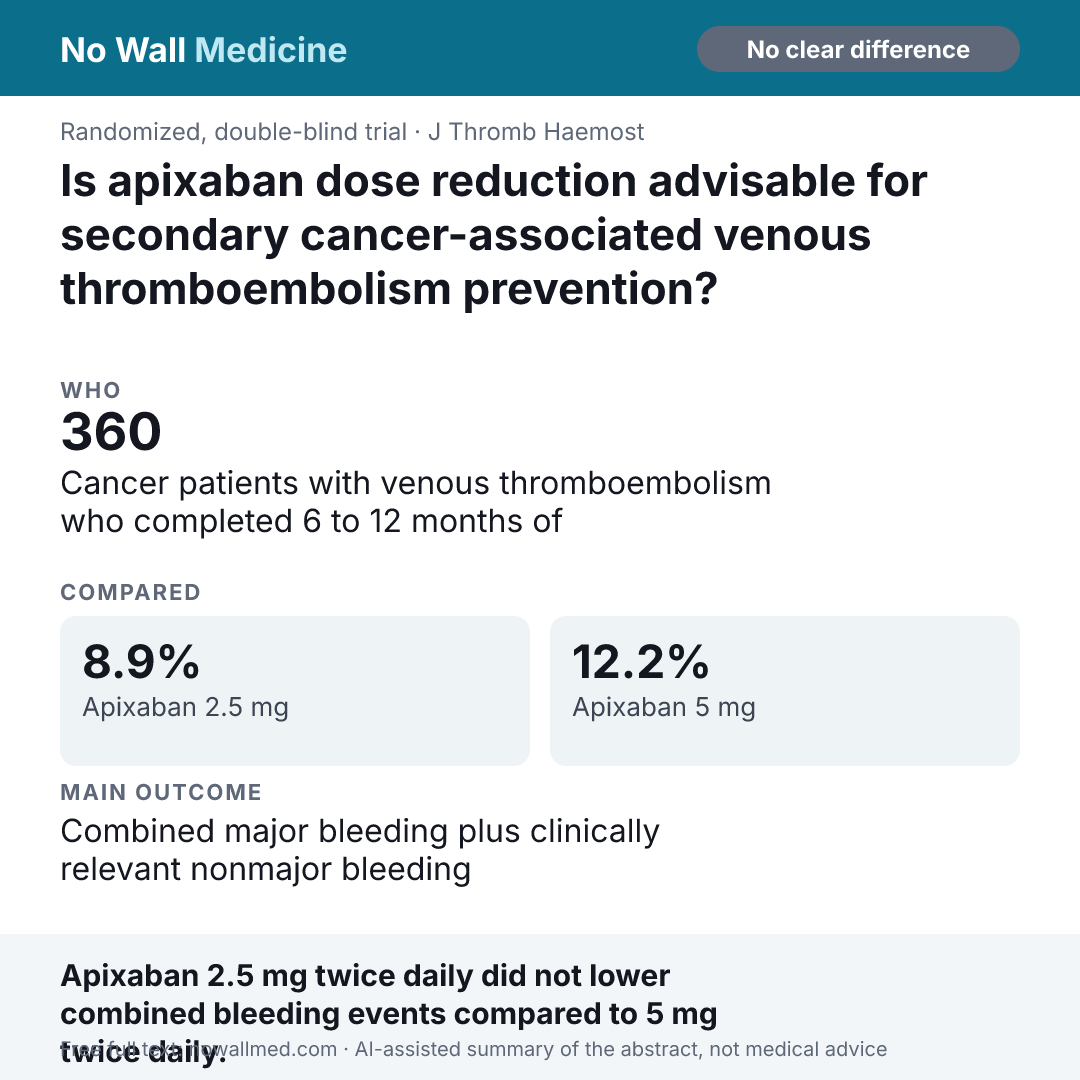
Is apixaban dose reduction advisable for secondary cancer-associated venous thromboembolism prevention?
Who
360
Cancer patients with venous thromboembolism who completed 6 to 12 months of anticoagulation
Compared
8.9%Apixaban 2.5 mg
12.2%Apixaban 5 mg
Main outcome
Combined major bleeding plus clinically relevant nonmajor bleeding
Result: hazard ratio 0.72 (95% CI 0.38-1.37)
Bottom line: Apixaban 2.5 mg twice daily did not lower combined bleeding events compared to 5 mg twice daily.
J Thromb Haemost · 2024-03-25 · Save PNG
Key points
- 360 cancer patients with venous thromboembolism were randomized to apixaban 2.5 mg or 5 mg twice daily for 12 months.
- Combined major and nonmajor bleeding occurred in 8.9% of the 2.5 mg group versus 12.2% of the 5 mg group, a difference that was not statistically significant.
- Recurrent venous thromboembolism or arterial thrombosis rates were identical at 5.0% in both groups, with no significant difference in all-cause mortality.
Discussion prompts
- Would these patients look like yours? Who was left out?
- Is the main outcome one that matters to patients?
- Is the difference large enough to change what you do?
Cite: McBane RD, Loprinzi CL, Zemla T, et al. Extending venous thromboembolism secondary prevention with apixaban in cancer patients. The EVE trial. J Thromb Haemost. 2024;22(6):1704-1714. doi:10.1016/j.jtha.2024.03.011
Free full text: J Thromb Haemost website · Summary and visual abstract: nowallmed.com/a/extending-venous-thromboembolism-secondary-prevention-with-apixaban-i9yq61/ (AI-assisted from the abstract; check the paper before relying on it).