Artificial intelligence model predicts prostate cancer death risk using biopsy images and clinical data
External validation of a digital pathology-based multimodal artificial intelligence-derived prognostic model in patients with advanced prostate cancer starting long-term androgen deprivation therapy: a post-hoc ancillary biomarker study of four phase 3 randomised controlled trials of the STAMPEDE platform protocol
Post-hoc ancillary biomarker study of four phase 3 trialsBenefit found
Is the multimodal artificial intelligence algorithm prognostic in advanced prostate cancer?
Who
3167
Patients starting androgen deprivation therapy with metastatic or high-risk disease · 112 sites
Compared
Highest scoring quartile (Q4): HR 2.12 (non-metastatic) and HR 1.62 (metastatic)
Bottom three quartiles (Q1-3)
Main outcome
prostate cancer-specific mortality
Result: hazard ratio 1.40 (95% CI 1.30-1.51)
Bottom line: The multimodal artificial intelligence algorithm improves prognostication of advanced prostate cancer when combined with disease burden.
Funded by: Prostate Cancer UK, UK Medical Research Council, Cancer Research UK
Lancet Digit Health · 2025-06-03Download image
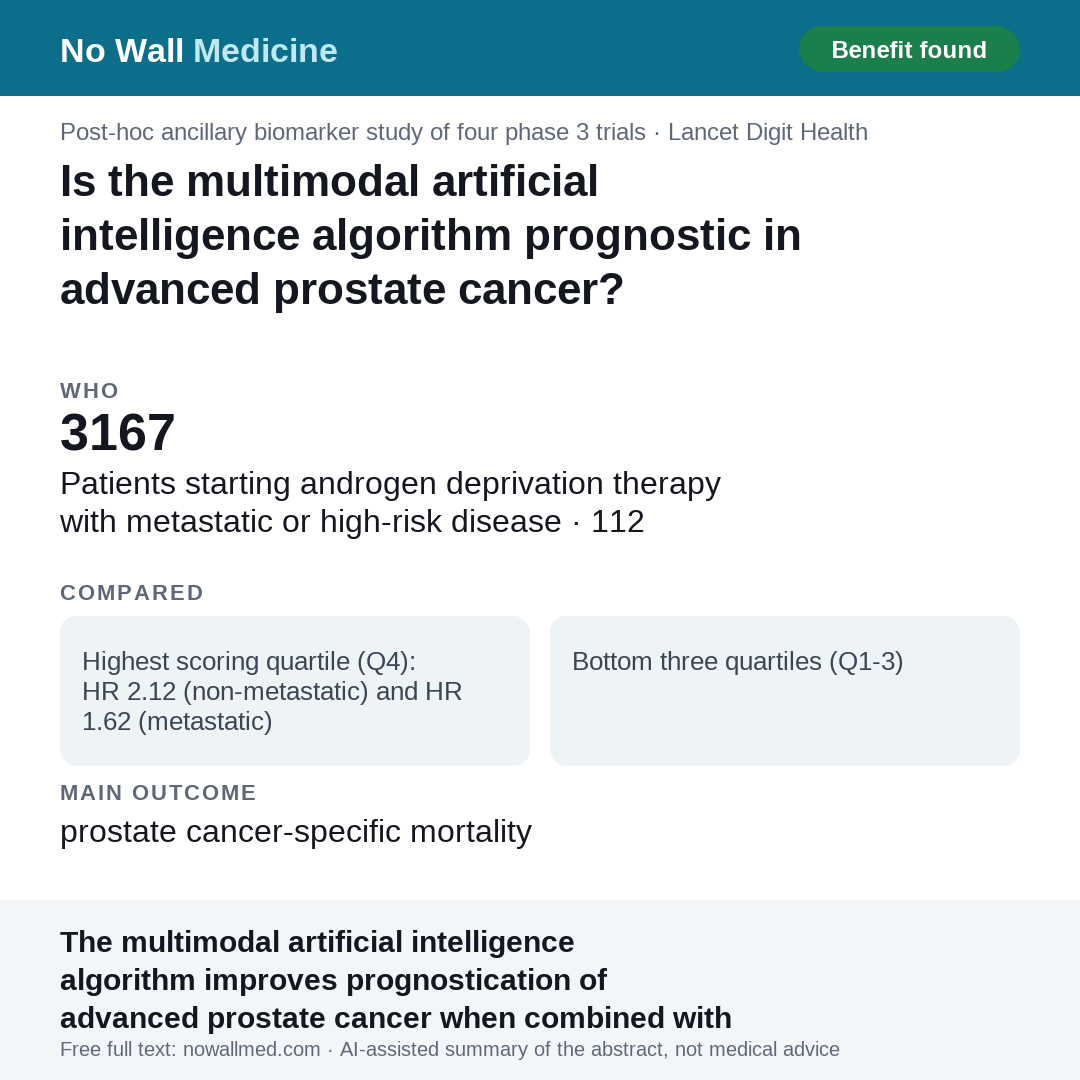
Clinical question: Is the multimodal artificial intelligence algorithm prognostic in advanced prostate cancer?
Why it matters: Clinicians need better ways to predict outcomes for patients with advanced prostate cancer to help select the most effective treatment combinations.
Key points
- Researchers analyzed 3167 patients from four phase 3 clinical trials who were starting hormone therapy for advanced prostate cancer.
- An artificial intelligence algorithm combining biopsy images and clinical variables was associated with prostate cancer-specific mortality (hazard ratio 1.40).
- The highest scoring group of patients had a higher risk of death at 5 years compared to lower scoring groups across different disease stages.
Headline and key points written with AI from the paper’s abstract, with every number checked against it. Read the paper before relying on them.
Topics
Cite this article
Parker CTA, Mendes L, Liu VYT, Grist E, Joun S, Yamashita R. External validation of a digital pathology-based multimodal artificial intelligence-derived prognostic model in patients with advanced prostate cancer starting long-term androgen deprivation therapy: a post-hoc ancillary biomarker study of four phase 3 randomised controlled trials of the STAMPEDE platform protocol. Lancet Digit Health. 2025. doi:10.1016/j.landig.2025.100885
Spotted a mistake? Suggest a correction