Clinical practice patients differ from trial participants in carotid artery revascularization studies
External Validity of Randomised Controlled Trials on Carotid Revascularisation: Trial Populations May Not Always Reflect Patients in Clinical Practice
Analysis of randomized controlled trials and clinical cohortsMixed results
Do carotid revascularisation trial populations reflect patients in routine clinical practice?
Who
Asymptomatic and symptomatic carotid stenosis patients · One tertiary referral university centre
Compared
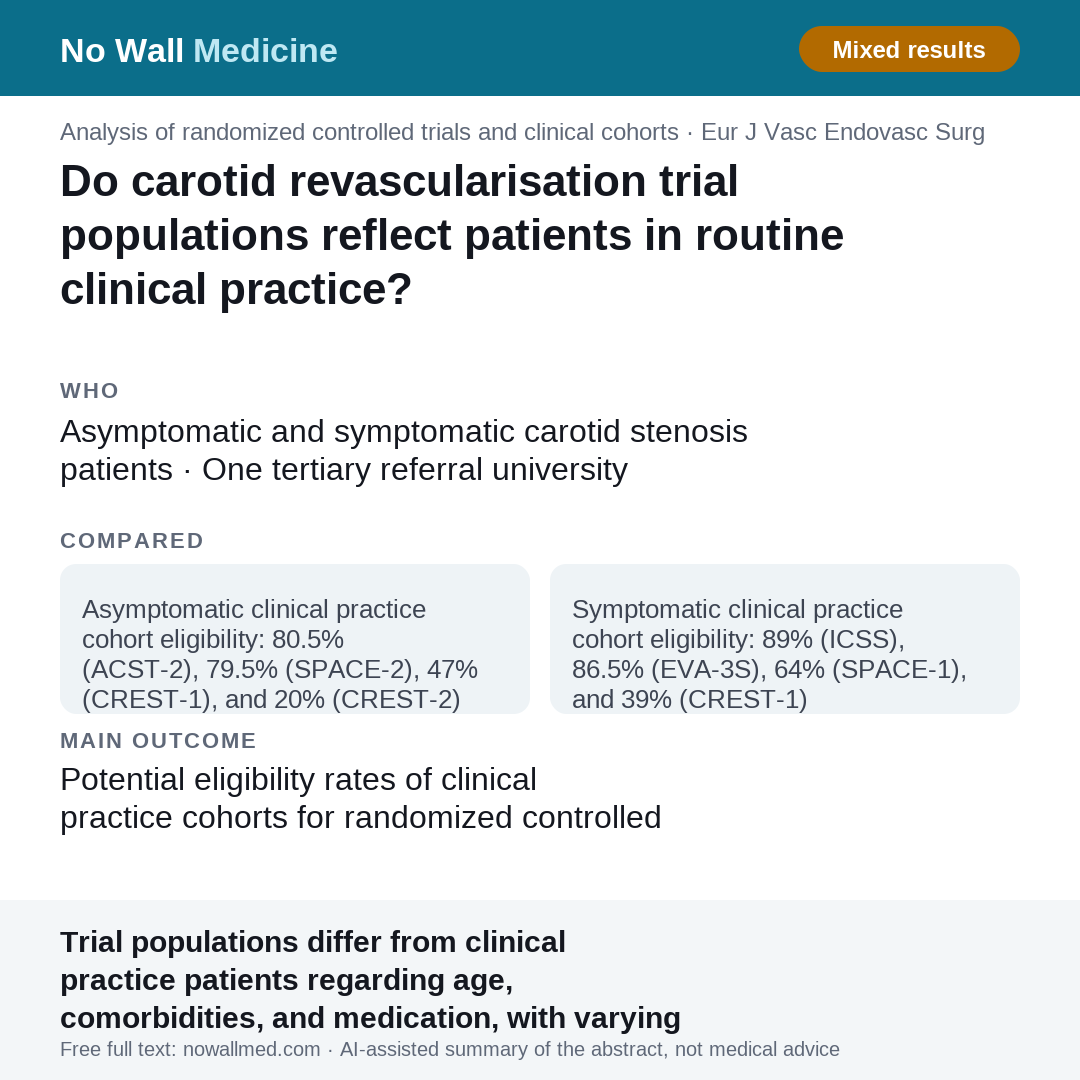
Asymptomatic clinical practice cohort eligibility: 80.5% (ACST-2), 79.5% (SPACE-2), 47% (CREST-1), and 20% (CREST-2)
Symptomatic clinical practice cohort eligibility: 89% (ICSS), 86.5% (EVA-3S), 64% (SPACE-1), and 39% (CREST-1)
Main outcome
Potential eligibility rates of clinical practice cohorts for randomized controlled trials
Bottom line: Trial populations differ from clinical practice patients regarding age, comorbidities, and medication, with varying external validity.
Eur J Vasc Endovasc Surg · 2022-08-17Download image
Clinical question: Do carotid revascularisation trial populations reflect patients in routine clinical practice?
Why it matters: It is unknown how well the results of randomized controlled trials for carotid revascularization can be applied to the actual patients seen in routine clinical practice.
Key points
- Researchers compared clinical practice cohorts of 200 asymptomatic and 200 symptomatic patients to data from eight randomized controlled trials for carotid endarterectomy (surgical removal of plaque) or stenting.
- Eligibility rates for clinical patients varied widely, ranging from 20% in the CREST-2 trial to 89% in the ICSS trial.
- Clinical practice patients were approximately 3 years older, more likely to be male, and had higher rates of smoking, hypertension, and atrial fibrillation compared to trial participants.
Headline and key points written with AI from the paper’s abstract, with every number checked against it. Read the paper before relying on them.
Was this summary helpful?
Subject terms
Cite this article
Kallmayer MA, Knappich C, Karlas A, Trenner M, Kuehnl A, Eckstein HH. External Validity of Randomised Controlled Trials on Carotid Revascularisation: Trial Populations May Not Always Reflect Patients in Clinical Practice. Eur J Vasc Endovasc Surg. 2022. doi:10.1016/j.ejvs.2022.07.044
Spotted a mistake? Suggest a correction
Top studies every Monday
The week’s key trials and guidelines in your specialties, plus any topics you follow. By email, free.
Get the weekly digest