Most pre-eclampsia prediction models have limited performance except one
Externally validated prediction models for pre-eclampsia: systematic review and meta-analysis
Systematic review and meta-analysisMixed results
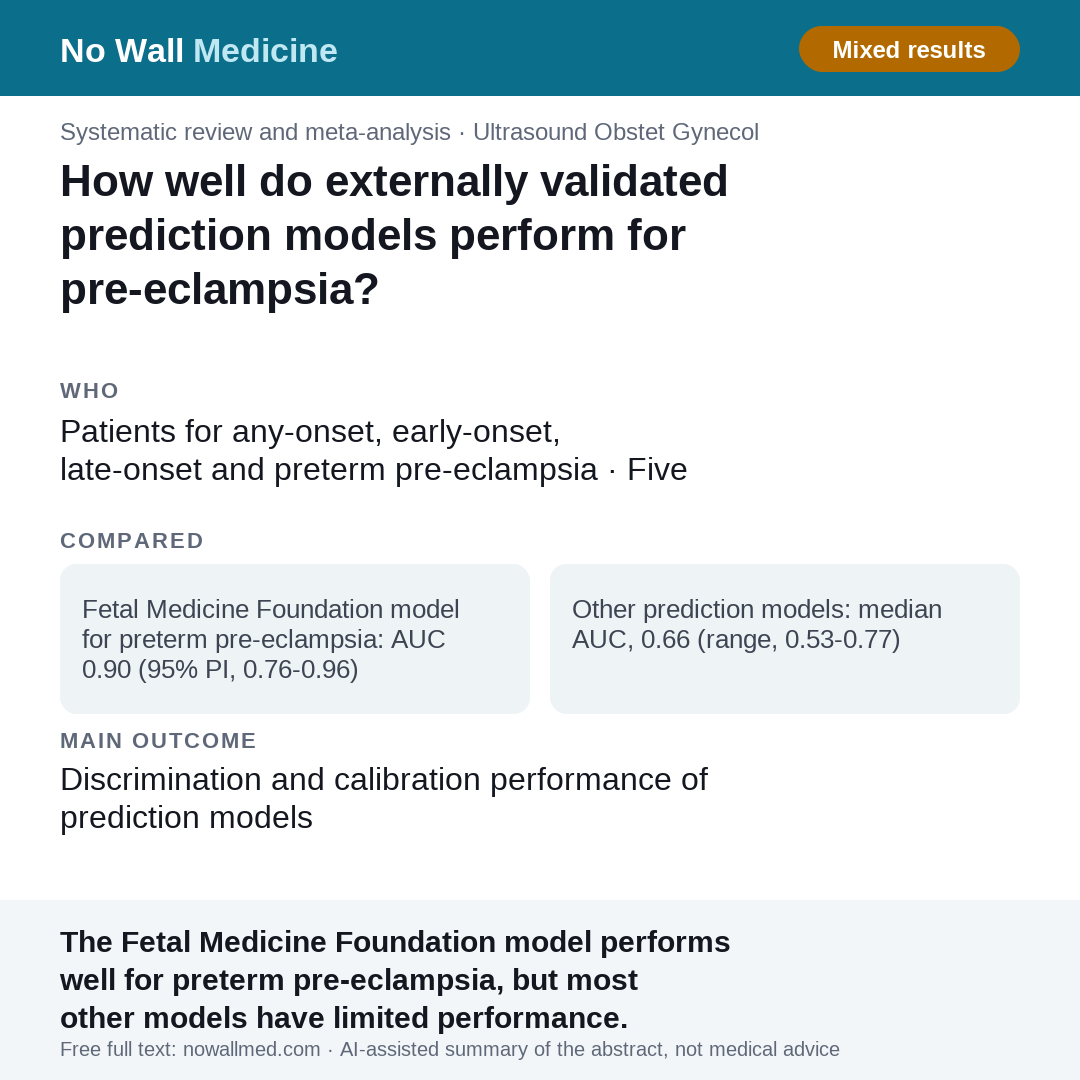
How well do externally validated prediction models perform for pre-eclampsia?
Who
Patients for any-onset, early-onset, late-onset and preterm pre-eclampsia · Five databases including MEDLINE and EMBASE
Compared
Fetal Medicine Foundation model for preterm pre-eclampsia: AUC 0.90 (95% PI, 0.76-0.96)
Other prediction models: median AUC, 0.66 (range, 0.53-0.77)
Main outcome
Discrimination and calibration performance of prediction models
Result: pooled area under the receiver-operating-characteristics curve (AUC) of 0.90 (95% prediction interval (PI), 0.76-0.96)
Bottom line: The Fetal Medicine Foundation model performs well for preterm pre-eclampsia, but most other models have limited performance.
Limitation: Inclusion of specialized biomarkers may limit feasibility and implementation outside of high-resource settings.
Ultrasound Obstet Gynecol · 2023-09-19Download image
Clinical question: How well do externally validated prediction models perform for pre-eclampsia?
Why it matters: Performance of existing pre-eclampsia prediction models was unclear
Key points
- Twenty-three studies reported 52 externally validated prediction models for pre-eclampsia.
- The FMF model for preterm pre-eclampsia had a pooled area under the curve of 0.90.
- Most models had poor-to-good discrimination performance with a median area under the curve of 0.66.
Limitation the authors note: The inclusion of specialized biomarkers in some models may limit feasibility and implementation outside of high-resource settings
Headline and key points written with AI from the paper’s abstract, with every number checked against it. Read the paper before relying on them.
Topics
Cite this article
Tiruneh SA, Vu CT, Moran LJ, Callander EJ, Allotey J, Thangaratinam S. Externally validated prediction models for pre-eclampsia: systematic review and meta-analysis. Ultrasound Obstet Gynecol. 2023. doi:10.1002/uog.27490
Spotted a mistake? Suggest a correction
Top studies every Monday
The week’s key trials and guidelines in your specialties, plus any topics you follow. By email, free.
Get the weekly digest