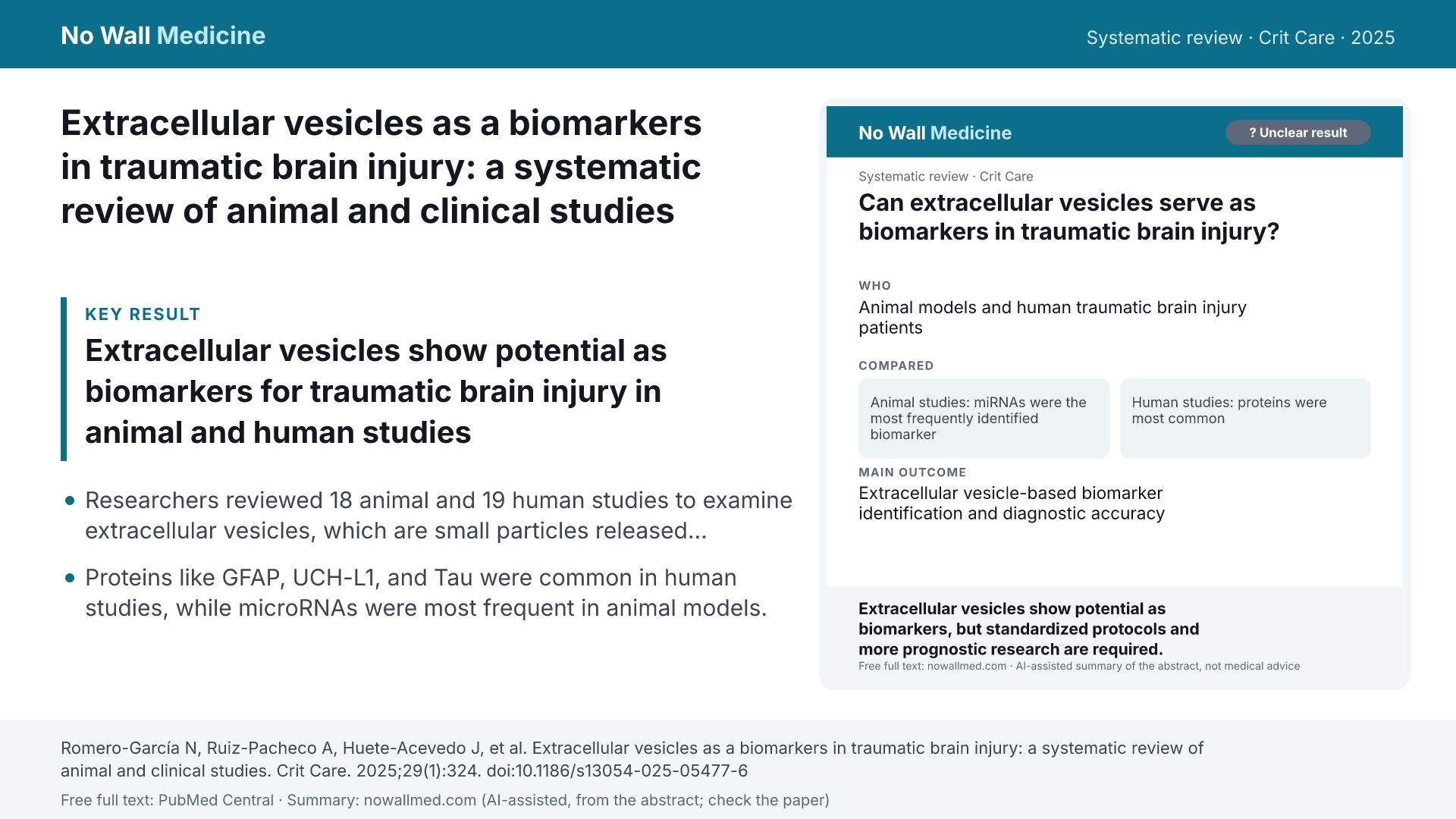
Extracellular vesicles show potential as biomarkers for traumatic brain injury in animal and human studies
Extracellular vesicles as a biomarkers in traumatic brain injury: a systematic review of animal and clinical studies
Systematic reviewUnclear result
Can extracellular vesicles serve as biomarkers in traumatic brain injury?
Who
Animal models and human traumatic brain injury patients
Compared
Animal studies: miRNAs were the most frequently identified biomarker
Human studies: proteins were most common
Main outcome
Extracellular vesicle-based biomarker identification and diagnostic accuracy
Bottom line: Extracellular vesicles show potential as biomarkers, but standardized protocols and more prognostic research are required.
Limitation: Significant heterogeneity in experimental design, isolation methods, and study populations.
Crit Care · 2025-07-24 · Save PNG

Clinical question: Can extracellular vesicles serve as biomarkers in traumatic brain injury?
Why it matters: Current clinical and imaging scales used to measure traumatic brain injury severity show limited correlation with clinical prognosis.
Key points
- Researchers reviewed 18 animal and 19 human studies to examine extracellular vesicles, which are small particles released by cells, as potential biomarkers for traumatic brain injury.
- Proteins like GFAP, UCH-L1, and Tau were common in human studies, while microRNAs were most frequent in animal models.
- The highest diagnostic performance was achieved using panels of microRNAs found within neural extracellular vesicles.
Limitation the authors note: The review notes significant heterogeneity in experimental design, exosome isolation methods, and study populations.
Headline and key points written with AI from the paper’s abstract, with every number checked against it. Read the paper before relying on them.
Was this summary helpful?
Subject terms
Headline, design, result, key points, caveat and citation as plain text.
Cite this article
Romero-García N, Ruiz-Pacheco A, Huete-Acevedo J, et al. Extracellular vesicles as a biomarkers in traumatic brain injury: a systematic review of animal and clinical studies. Crit Care. 2025;29(1):324. doi:10.1186/s13054-025-05477-6
Spotted a mistake? Suggest a correction