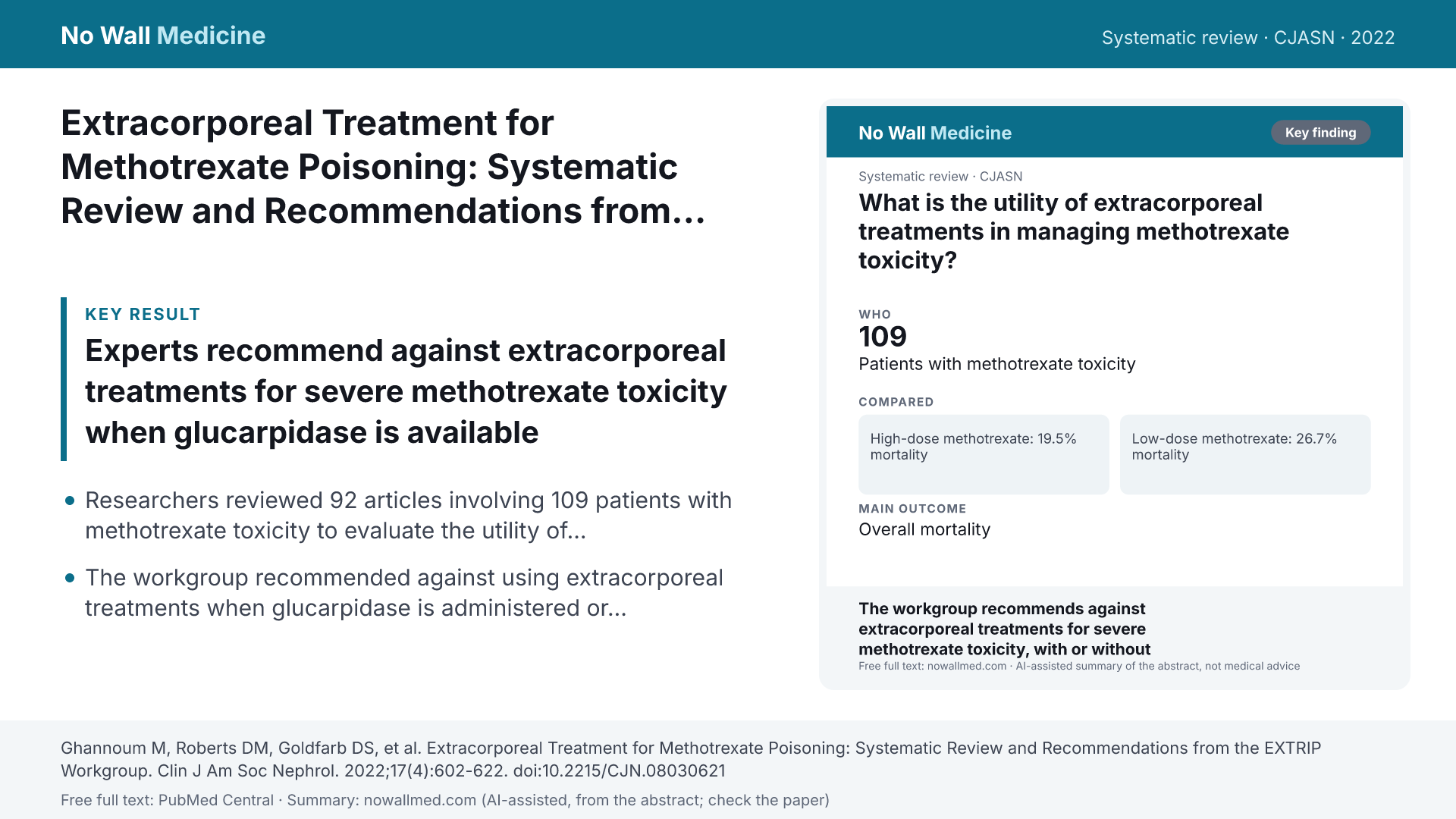
Experts recommend against extracorporeal treatments for severe methotrexate toxicity when glucarpidase is available
Extracorporeal Treatment for Methotrexate Poisoning: Systematic Review and Recommendations from the EXTRIP Workgroup
Systematic reviewKey finding
What is the utility of extracorporeal treatments in managing methotrexate toxicity?
Who
109
Patients with methotrexate toxicity
Compared
High-dose methotrexate: 19.5% mortality
Low-dose methotrexate: 26.7% mortality
Main outcome
Overall mortality
Bottom line: The workgroup recommends against extracorporeal treatments for severe methotrexate toxicity, with or without glucarpidase administration.
Limitation: The quality of evidence for these recommendations was very low.
CJASN · 2022-03-02 · Save PNG
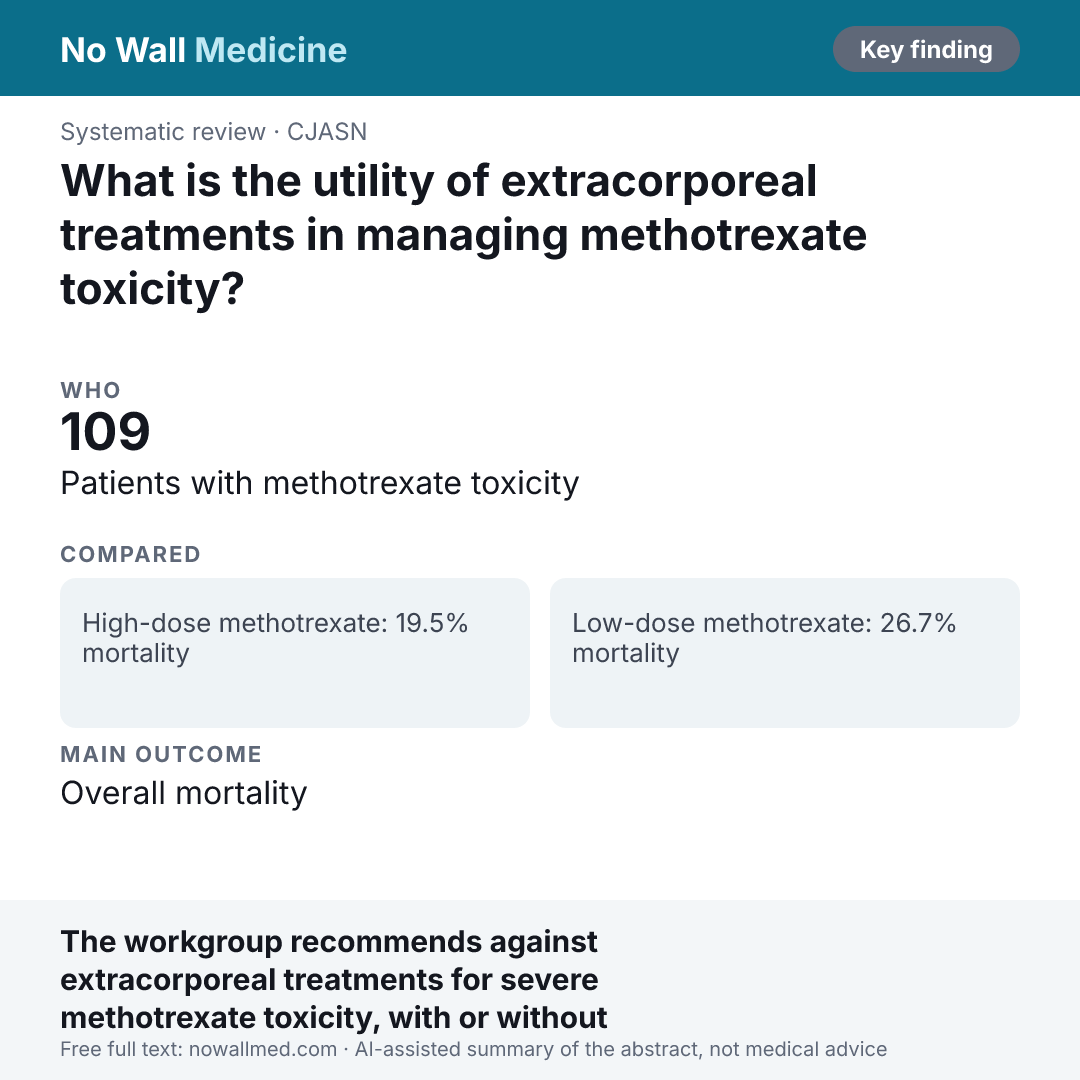
Clinical question: What is the utility of extracorporeal treatments in managing methotrexate toxicity?
Key points
- Researchers reviewed 92 articles involving 109 patients with methotrexate toxicity to evaluate the utility of extracorporeal treatments like hemodialysis, which is a process of filtering blood through a machine.
- The workgroup recommended against using extracorporeal treatments when glucarpidase is administered or when glucarpidase is not administered, noting that overall mortality was 26.7% for low-dose and 19.5% for high-dose toxicity.
- The quality of evidence for these recommendations was very low, as extracorporeal treatments mainly remove drugs from the blood vessels rather than from inside cells.
Limitation the authors note: The quality of evidence for these recommendations was very low.
Headline and key points written with AI from the paper’s abstract, with every number checked against it. Read the paper before relying on them.
Was this summary helpful?
Subject terms
Headline, design, result, key points, caveat and citation as plain text.
Cite this article
Ghannoum M, Roberts DM, Goldfarb DS, et al. Extracorporeal Treatment for Methotrexate Poisoning: Systematic Review and Recommendations from the EXTRIP Workgroup. CJASN. 2022. doi:10.2215/CJN.08030621
Spotted a mistake? Suggest a correction