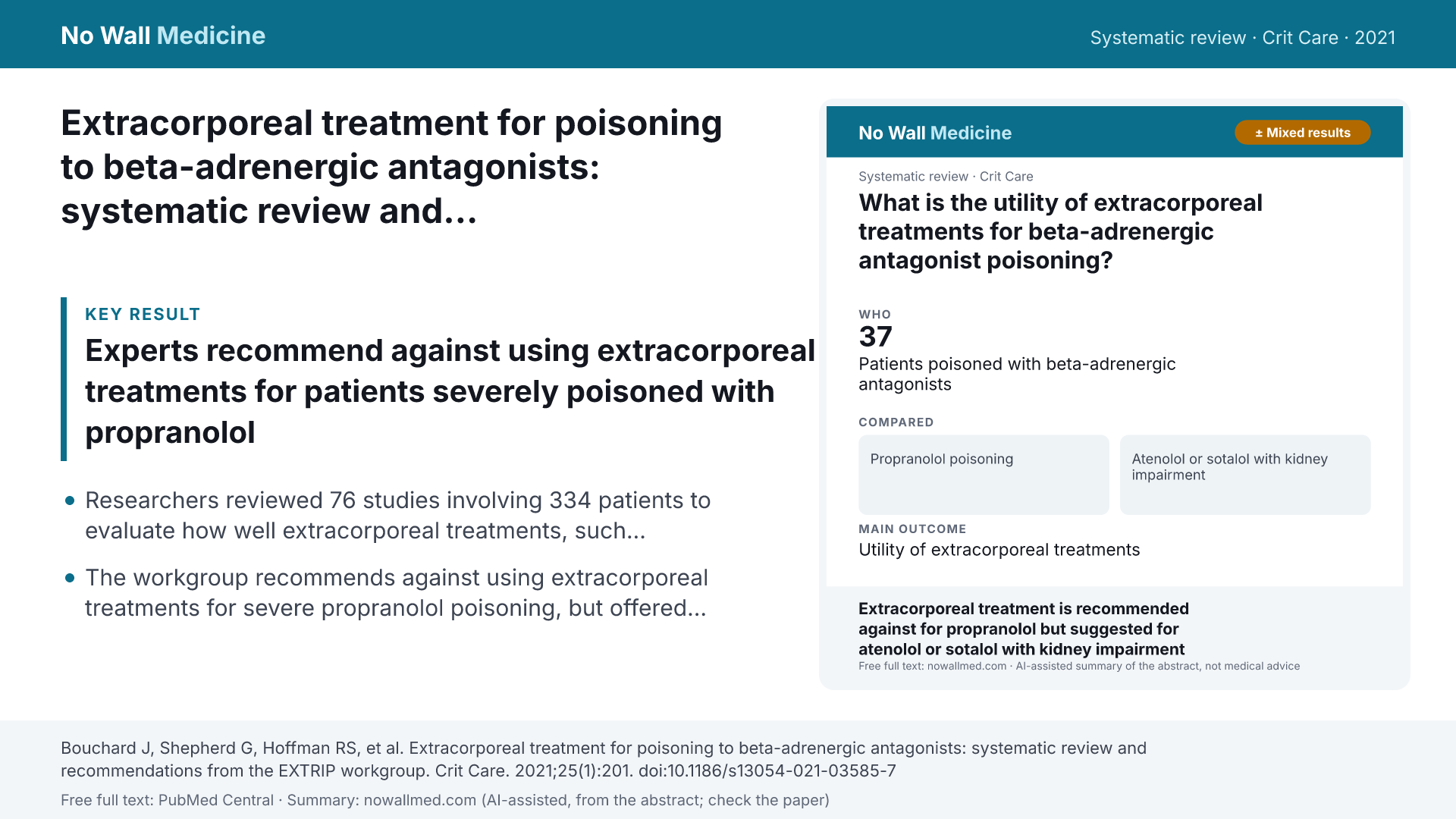
Experts recommend against using extracorporeal treatments for patients severely poisoned with propranolol
Extracorporeal treatment for poisoning to beta-adrenergic antagonists: systematic review and recommendations from the EXTRIP workgroup
Systematic reviewMixed results
What is the utility of extracorporeal treatments for beta-adrenergic antagonist poisoning?
Who
37
Patients poisoned with beta-adrenergic antagonists
Compared
Propranolol poisoning
Atenolol or sotalol with kidney impairment
Main outcome
Utility of extracorporeal treatments
Bottom line: Extracorporeal treatment is recommended against for propranolol but suggested for atenolol or sotalol with kidney impairment and specific indications.
Limitation: No reliable comparison between extracorporeal treatment cohort and historical controls treated with standard care alone could be performed.
Crit Care · 2021-06-10 · Save PNG
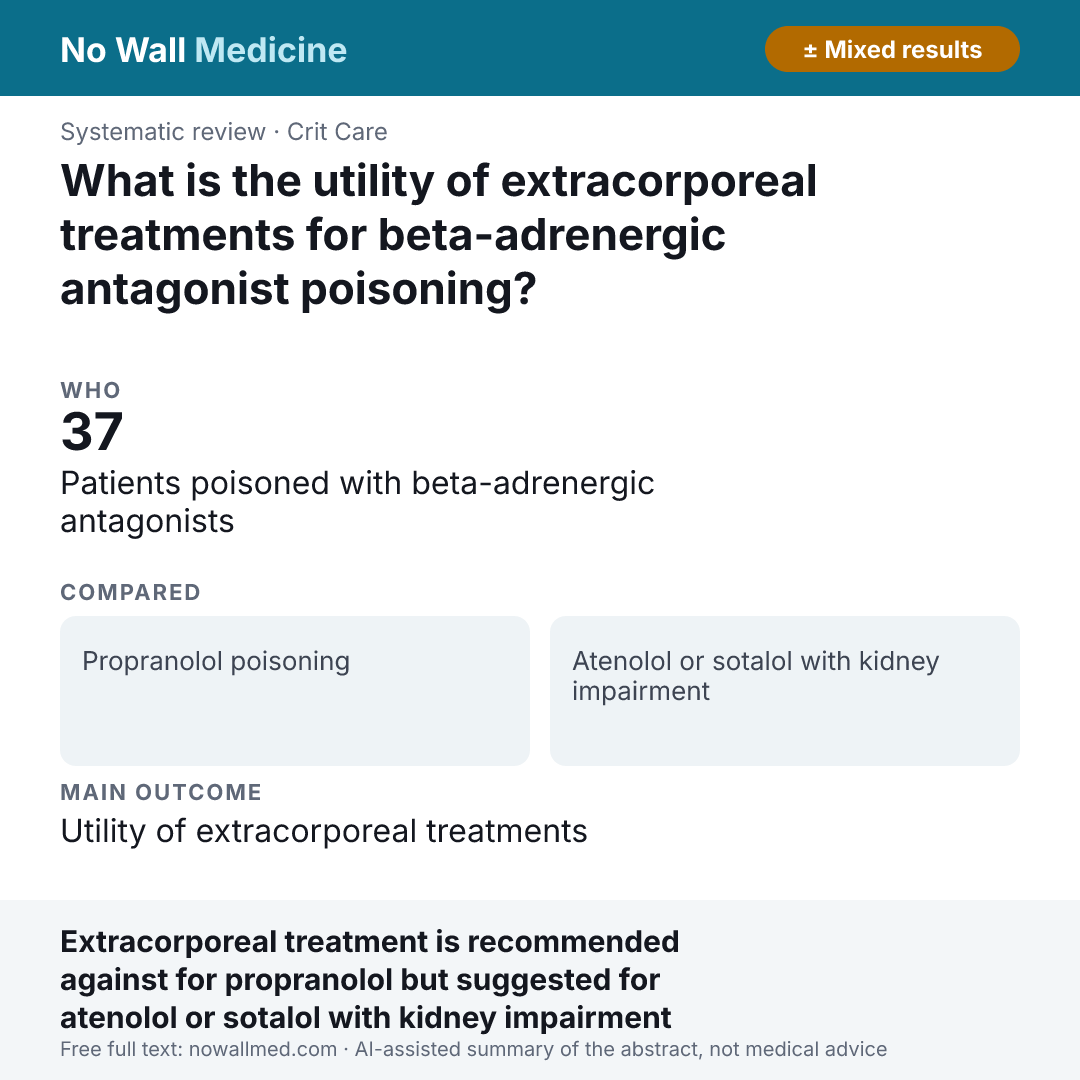
Clinical question: What is the utility of extracorporeal treatments for beta-adrenergic antagonist poisoning?
Key points
- Researchers reviewed 76 studies involving 334 patients to evaluate how well extracorporeal treatments, such as hemodialysis, remove beta-adrenergic antagonists from the body.
- The workgroup recommends against using extracorporeal treatments for severe propranolol poisoning, but offered no recommendation for severe atenolol or sotalol poisoning due to limited data.
- For patients with impaired kidney function, extracorporeal treatments are suggested for atenolol or sotalol poisoning when presenting with refractory bradycardia, hypotension, or recurrent torsade de pointes.
Limitation the authors note: No reliable comparison between the extracorporeal treatment cohort and historical controls treated with standard care alone could be performed.
Headline and key points written with AI from the paper’s abstract, with every number checked against it. Read the paper before relying on them.
Was this summary helpful?
Abstract
Background
β-adrenergic antagonists (BAAs) are used to treat cardiovascular disease such as ischemic heart disease, congestive heart failure, dysrhythmias, and hypertension. Poisoning from BAAs can lead to severe morbidity and mortality. We aimed to determine the utility of extracorporeal treatments (ECTRs) in BAAs poisoning. Methods
We conducted systematic reviews of the literature, screened studies, extracted data, and summarized findings following published EXTRIP methods. Results
A total of 76 studies (4 in vitro and 2 animal experiments, 1 pharmacokinetic simulation study, 37 pharmacokinetic studies on patients with end-stage kidney disease, and 32 case reports or case series) met inclusion criteria. Toxicokinetic or pharmacokinetic data were available on 334 patients (including 73 for atenolol, 54 for propranolol, and 17 for sotalol). For intermittent hemodialysis, atenolol, nadolol, practolol, and sotalol were assessed as dialyzable; acebutolol, bisoprolol, and metipranolol were assessed as moderately dialyzable; metoprolol and talinolol were considered slightly dialyzable; and betaxolol, carvedilol, labetalol, mepindolol, propranolol, and timolol were considered not dialyzable. Data were available for clinical analysis on 37 BAA poisoned patients (including 9 patients for atenolol, 9 for propranolol, and 9 for sotalol), and no reliable comparison between the ECTR cohort and historical controls treated with standard care alone could be performed. The EXTRIP workgroup recommends against using ECTR for patients severely poisoned with propranolol (strong recommendation, very low quality evidence). The workgroup offered no recommendation for ECTR in patients severely poisoned with atenolol or sotalol because of apparent balance of risks and benefits, except for impaired kidney function in which ECTR is suggested (weak recommendation, very low quality of evidence). Indications for ECTR in patients with impaired kidney function include refractory bradycardia and hypotension for atenolol or sotalol poisoning, and recurrent torsade de pointes for sotalol. Although other BAAs were considered dialyzable, clinical data were too limited to develop recommendations. Conclusions
BAAs have different properties affecting their removal by ECTR. The EXTRIP workgroup assessed propranolol as non-dialyzable. Atenolol and sotalol were assessed as dialyzable in patients with kidney impairment, and the workgroup suggests ECTR in patients severely poisoned with these drugs when aforementioned indications are present.
Abstract reproduced under the article’s CC BY licence.
Subject terms
Headline, design, result, key points, caveat and citation as plain text.
Cite this article
Bouchard J, Shepherd G, Hoffman RS, et al. Extracorporeal treatment for poisoning to beta-adrenergic antagonists: systematic review and recommendations from the EXTRIP workgroup. Crit Care. 2021;25(1):201. doi:10.1186/s13054-021-03585-7
Spotted a mistake? Suggest a correction