Carotid artery plaque calcification is linked to different stroke risks depending on artery narrowing
Extracranial Carotid Plaque Calcification and Cerebrovascular Ischemia: A Systematic Review and Meta-Analysis
Systematic review and meta-analysisMixed results
Does extracranial carotid artery plaque calcification associate with ipsilateral cerebrovascular ischemic events?
Who
2239
Patients with carotid artery plaque
Compared
Presence of calcification
Absence of calcification
Main outcome
Ipsilateral stroke or transient ischemic attack
Result: relative risk of 0.75 (95% CI, 0.44-1.28)
Bottom line: Calcification shows reduced risk in significant stenosis but increased risk in nonstenotic plaques.
Limitation: Results require more reproducible, standardized methods and prospective studies.
Stroke · 2023-08-28Download image
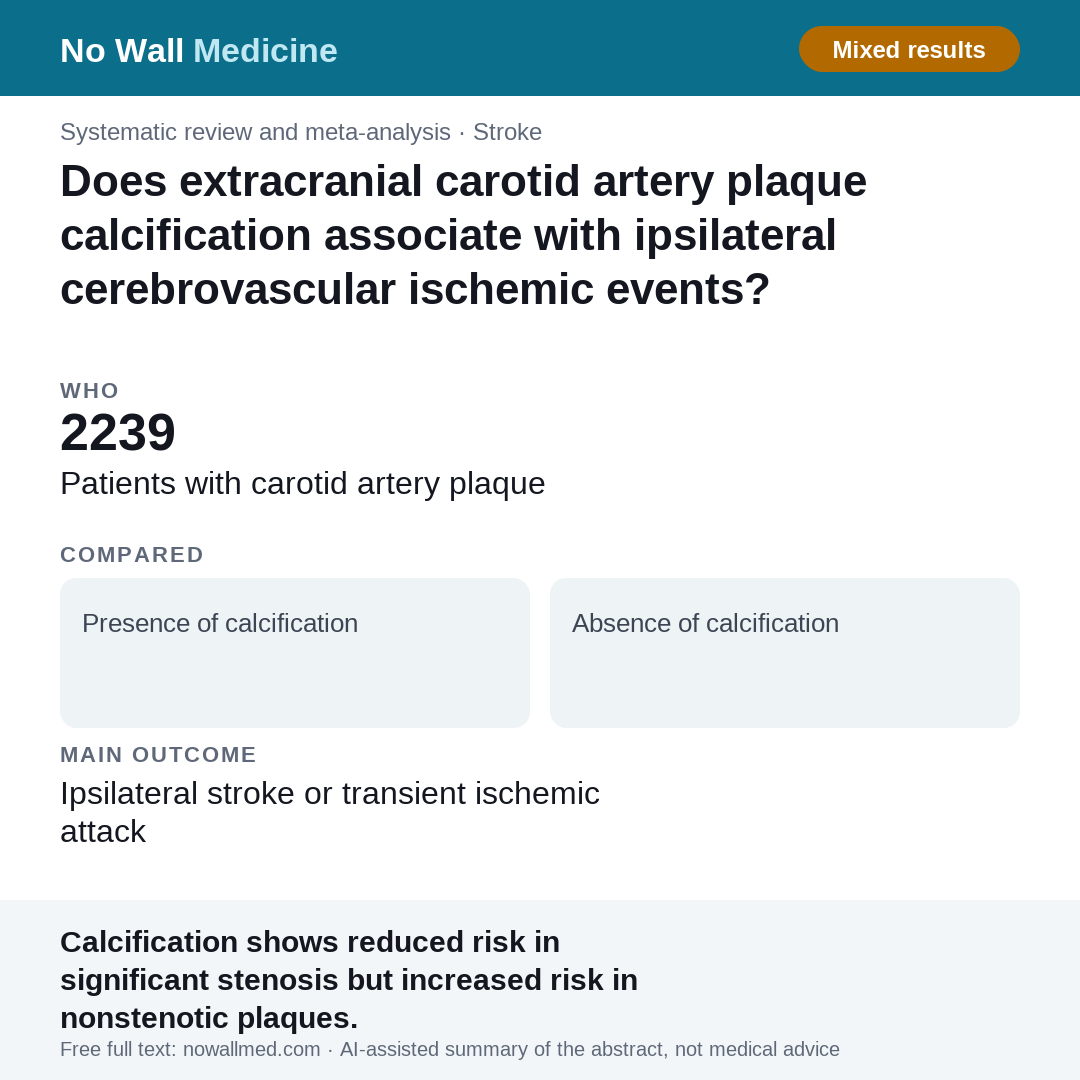
Clinical question: Does extracranial carotid artery plaque calcification associate with ipsilateral cerebrovascular ischemic events?
Why it matters: The value of quantifying calcium in carotid artery plaques for assessing the risk of cerebrovascular ischemic events is unclear.
Key points
- Researchers analyzed 9 studies involving 2239 carotid arteries to examine the link between calcium in artery plaques and strokes on the same side of the body.
- In patients with carotid artery stenosis greater than 50%, calcification was associated with a relative risk of 0.56 (95% CI, 0.38-0.85; P=0.006) for ischemic stroke.
- In patients with mainly nonstenotic plaques, calcification was associated with an increased relative risk of 1.72 (95% CI, 1.01-2.91; P=0.04) for ipsilateral ischemic stroke.
Limitation the authors note: The authors state that additional studies are needed to provide more reproducible and standardized methods of calcium characterization and testing.
Headline and key points written with AI from the paper’s abstract, with every number checked against it. Read the paper before relying on them.
Was this summary helpful?
Subject terms
Cite this article
Homssi M, Saha A, Delgado D, RoyChoudhury A, Thomas C, Lin M. Extracranial Carotid Plaque Calcification and Cerebrovascular Ischemia: A Systematic Review and Meta-Analysis. Stroke. 2023. doi:10.1161/STROKEAHA.123.042807
Spotted a mistake? Suggest a correction
Top studies every Monday
The week’s key trials and guidelines in your specialties, plus any topics you follow. By email, free.
Get the weekly digest