Dapagliflozin was associated with longer event-free survival and life expectancy in heart failure patients
Extrapolating Long-term Event-Free and Overall Survival With Dapagliflozin in Patients With Heart Failure and Reduced Ejection Fraction: An Exploratory Analysis of a Phase 3 Randomized Clinical Trial
Exploratory analysis of a phase 3 randomized, placebo-controlled trialBenefit found
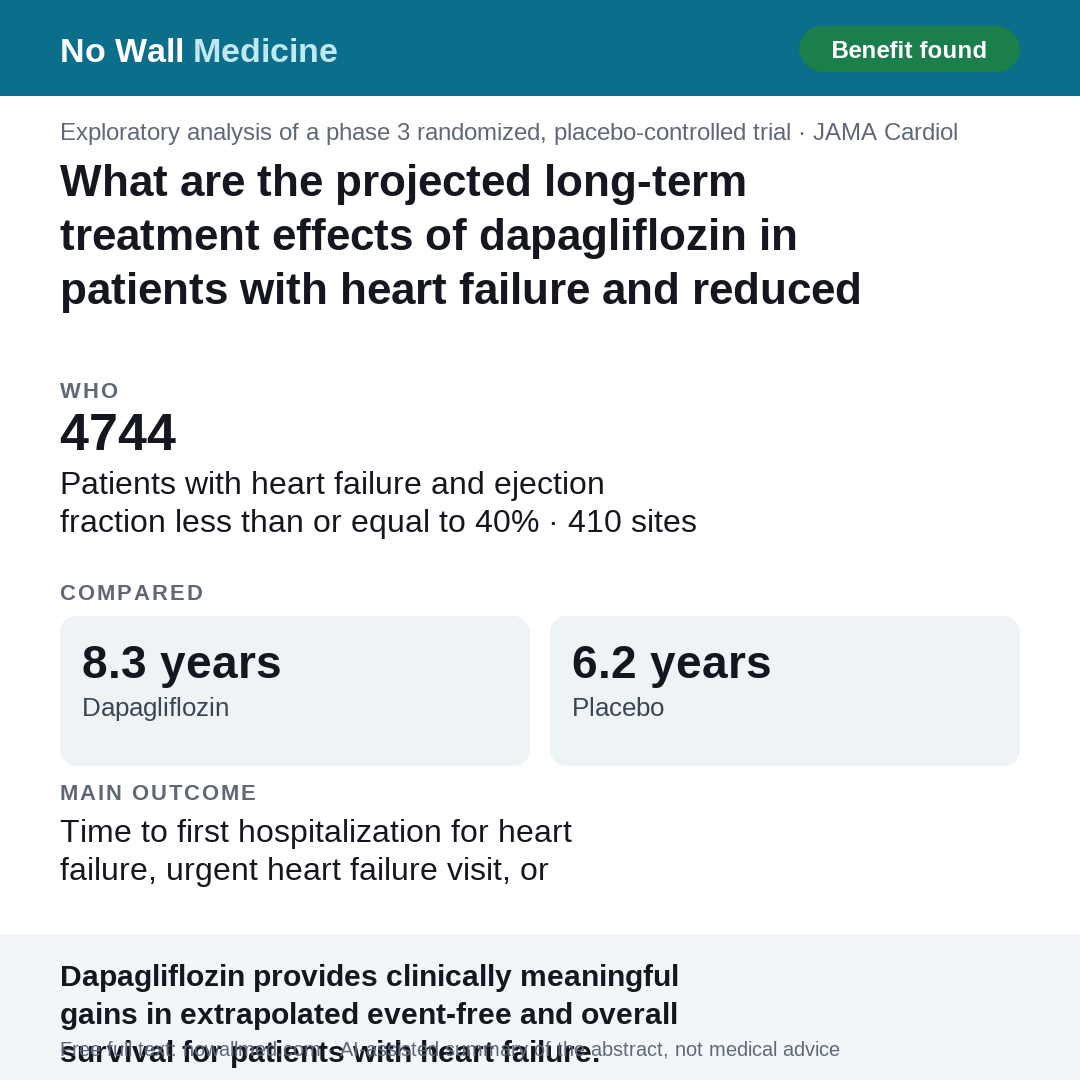
What are the projected long-term treatment effects of dapagliflozin in patients with heart failure and reduced ejection fraction?
Who
4744
Patients with heart failure and ejection fraction less than or equal to 40% · 410 sites in 20 countries
Compared
8.3 yearsDapagliflozin
6.2 yearsPlacebo
Main outcome
Time to first hospitalization for heart failure, urgent heart failure visit, or cardiovascular death
Result: event-free survival time gain of 2.1 years (95% CI, 0.8-3.3 years)
Bottom line: Dapagliflozin provides clinically meaningful gains in extrapolated event-free and overall survival for patients with heart failure.
JAMA Cardiol · 2021-07-29Download image
Clinical question: What are the projected long-term treatment effects of dapagliflozin in patients with heart failure and reduced ejection fraction?
Why it matters: Clinicians lack estimates of the projected long-term benefits of sodium glucose cotransporter 2 inhibitors over a patient's lifetime to help communicate risks and benefits.
Key points
- Researchers analyzed 4744 patients with heart failure and reduced ejection fraction who were randomized to receive either 10 mg of dapagliflozin or a placebo.
- For a 65-year-old, extrapolated results showed a mean event-free survival gain of 2.1 years with dapagliflozin compared to placebo.
- The extrapolated mean life expectancy for a 65-year-old was 10.8 years with dapagliflozin compared to 9.1 years with placebo.
Headline and key points written with AI from the paper’s abstract, with every number checked against it. Read the paper before relying on them.
Was this summary helpful?
Subject terms
Cite this article
Docherty KF, Jhund PS, Claggett B, Ferreira JP, Bengtsson O, Inzucchi SE. Extrapolating Long-term Event-Free and Overall Survival With Dapagliflozin in Patients With Heart Failure and Reduced Ejection Fraction: An Exploratory Analysis of a Phase 3 Randomized Clinical Trial. JAMA Cardiol. 2021. doi:10.1001/jamacardio.2021.2632
Spotted a mistake? Suggest a correction
Top studies every Monday
The week’s key trials and guidelines in your specialties, plus any topics you follow. By email, free.
Get the weekly digest