Clinical characteristics and recovery of facial nerve paralysis following acute COVID-19 infection
Facial Nerve Paralysis and COVID-19: A Systematic Review
Systematic reviewMixed results
What are the clinical characteristics and recovery outcomes of facial nerve paralysis after COVID-19?
Who
72
Patients with facial nerve paralysis following acute COVID-19 infection
Compared
Non-Guillain-Barré Syndrome patients: 67% complete recovery within a median of 11 [IQR 24] days
Guillain-Barré Syndrome patients
Main outcome
Clinical characteristics and recovery outcomes of facial nerve paralysis
Bottom line: Facial nerve paralysis post-COVID-19 may present uniquely with higher bilateral rates and shorter recovery than Bell's palsy.
Laryngoscope · 2022-08-08Download image
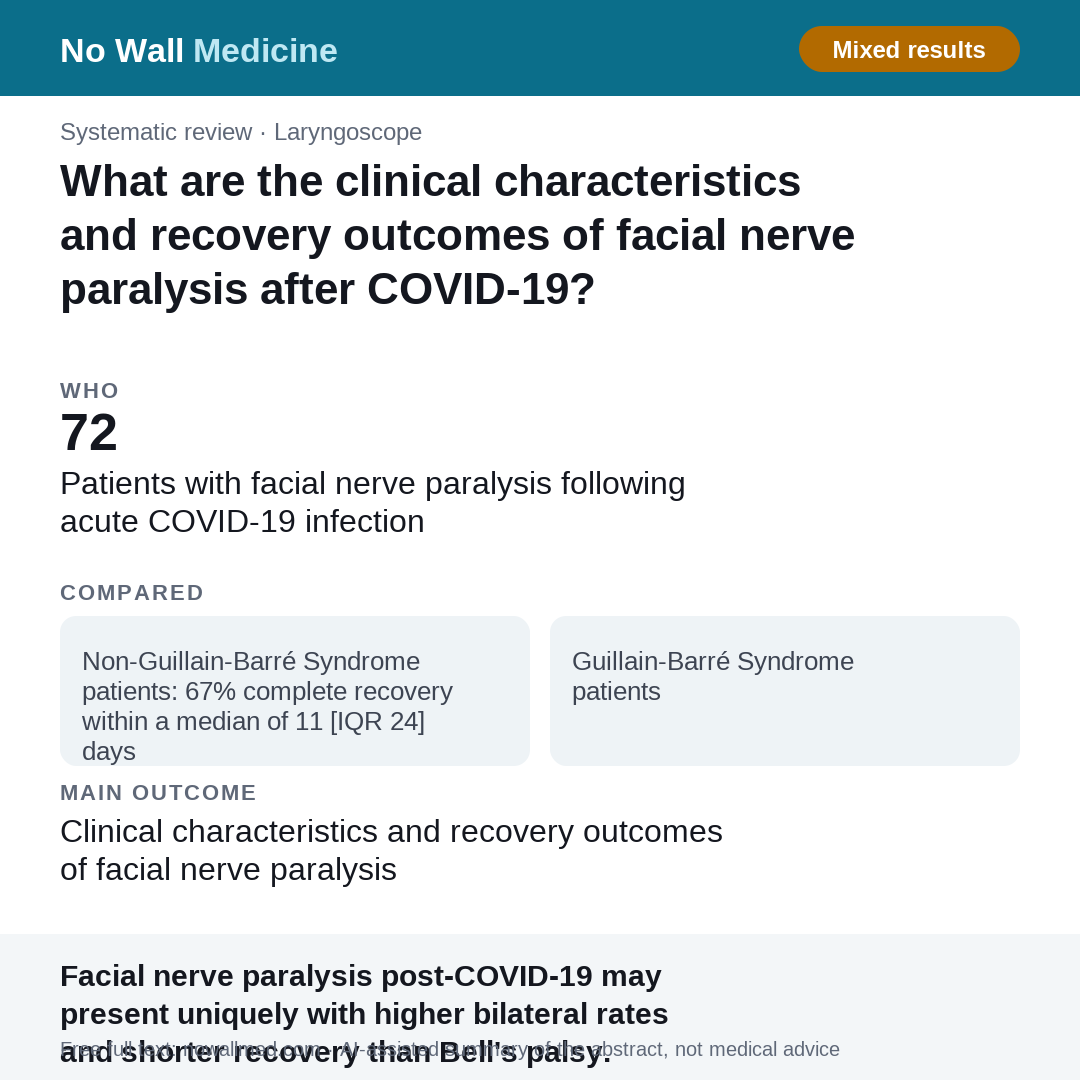
Clinical question: What are the clinical characteristics and recovery outcomes of facial nerve paralysis after COVID-19?
Why it matters: The clinical characteristics and recovery outcomes of facial nerve paralysis in patients acutely infected with COVID-19 were not clearly identified.
Key points
- Researchers reviewed 53 studies involving 72 patients to examine facial nerve paralysis, which is weakness or paralysis of the facial muscles, following COVID-19.
- Among non-Guillain-Barré Syndrome patients, 67% achieved complete recovery within a median of 11 [IQR 24] days.
- Non-Guillain-Barré Syndrome patients were on average younger at 36 years compared to 53 years for those with Guillain-Barré Syndrome.
Headline and key points written with AI from the paper’s abstract, with every number checked against it. Read the paper before relying on them.
Was this summary helpful?
Subject terms
Cite this article
Namavarian A, Eid A, Ziai H, Cheng EY, Enepekides D. Facial Nerve Paralysis and COVID-19: A Systematic Review. Laryngoscope. 2022. doi:10.1002/lary.30333
Spotted a mistake? Suggest a correction
Top studies every Monday
The week’s key trials and guidelines in your specialties, plus any topics you follow. By email, free.
Get the weekly digest