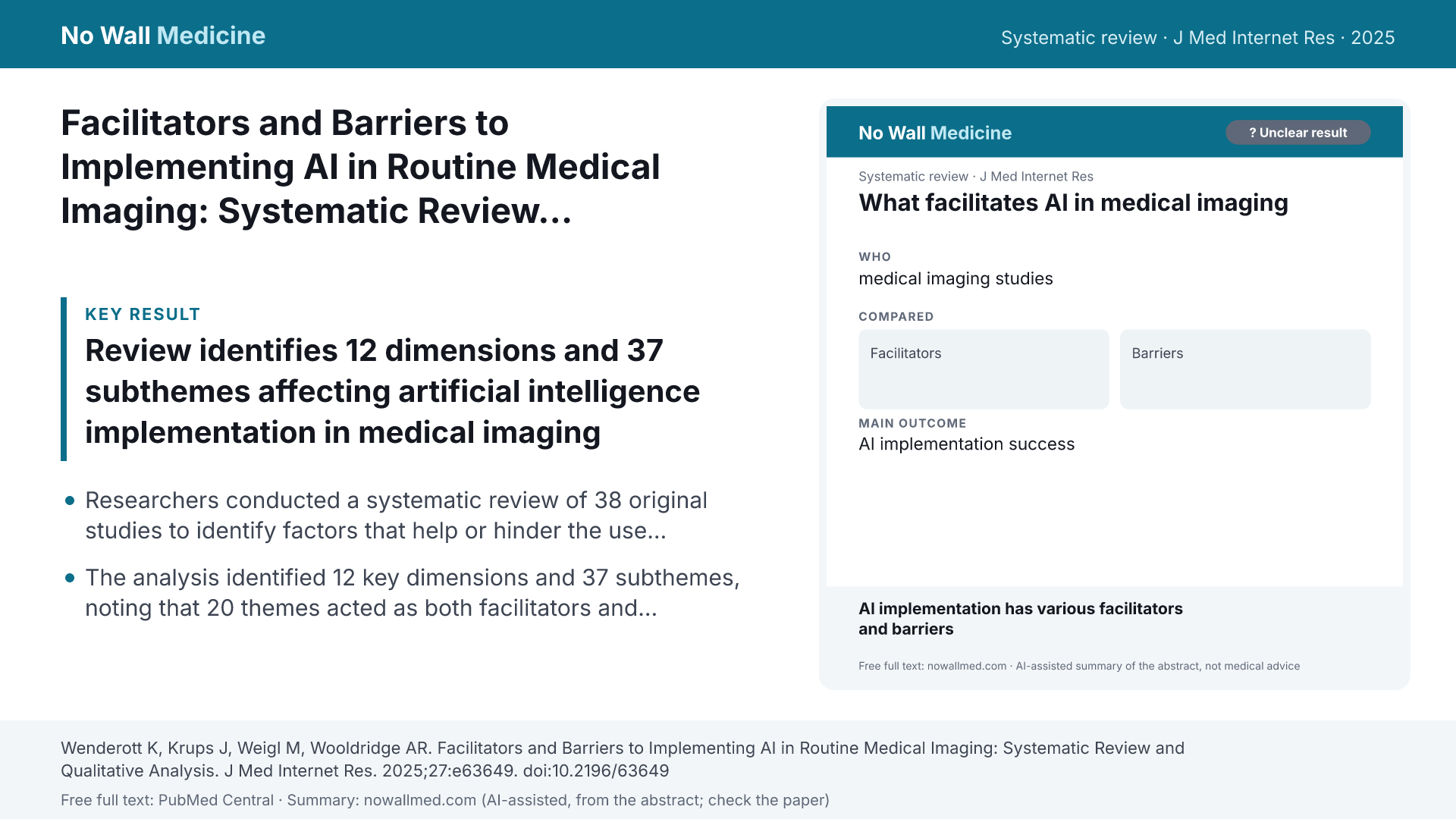
Review identifies 12 dimensions and 37 subthemes affecting artificial intelligence implementation in medical imaging
Facilitators and Barriers to Implementing AI in Routine Medical Imaging: Systematic Review and Qualitative Analysis
Systematic reviewUnclear result
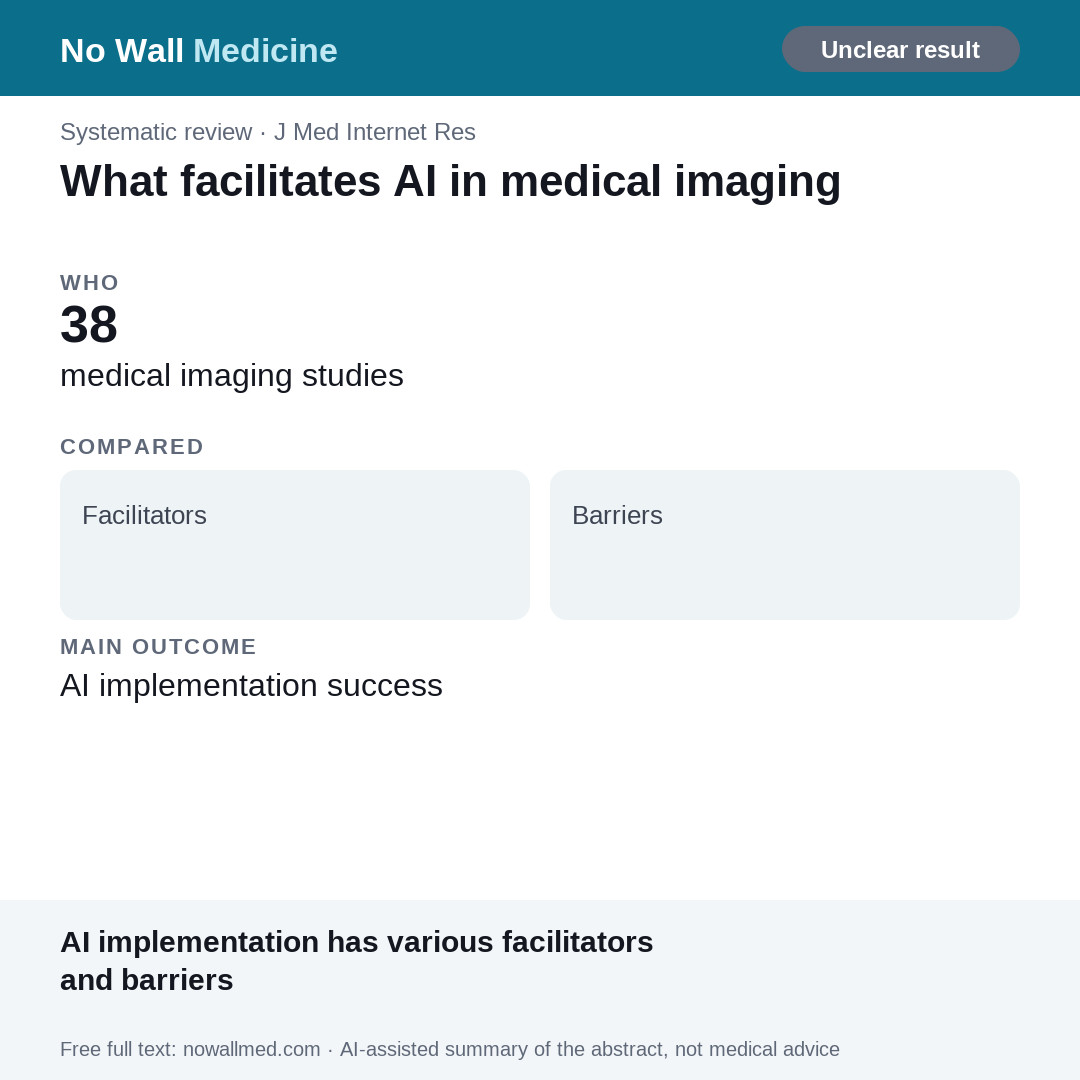
What facilitates AI in medical imaging
Who
38
medical imaging studies
Compared
Facilitators
Barriers
Main outcome
AI implementation success
Bottom line: AI implementation has various facilitators and barriers
Limitation: most studies lacked comprehensive reporting
J Med Internet Res · 2025-07-21Download image
Why it matters: There is little systematic evidence regarding the specific process factors required for successful artificial intelligence technology implementation into clinical workflows.
Key points
- Researchers conducted a systematic review of 38 original studies to identify factors that help or hinder the use of artificial intelligence in medical imaging workflows.
- The analysis identified 12 key dimensions and 37 subthemes, noting that 20 themes acted as both facilitators and barriers to implementation.
- Most studies focused on how well the technology performed rather than the experiences or outcomes of the clinicians using it.
Headline and key points written with AI from the paper’s abstract, with every number checked against it. Read the paper before relying on them.
Was this summary helpful?
Subject terms
Cite this article
Wenderott K, Krups J, Weigl M, Wooldridge AR. Facilitators and Barriers to Implementing AI in Routine Medical Imaging: Systematic Review and Qualitative Analysis. J Med Internet Res. 2025. doi:10.2196/63649
Spotted a mistake? Suggest a correction