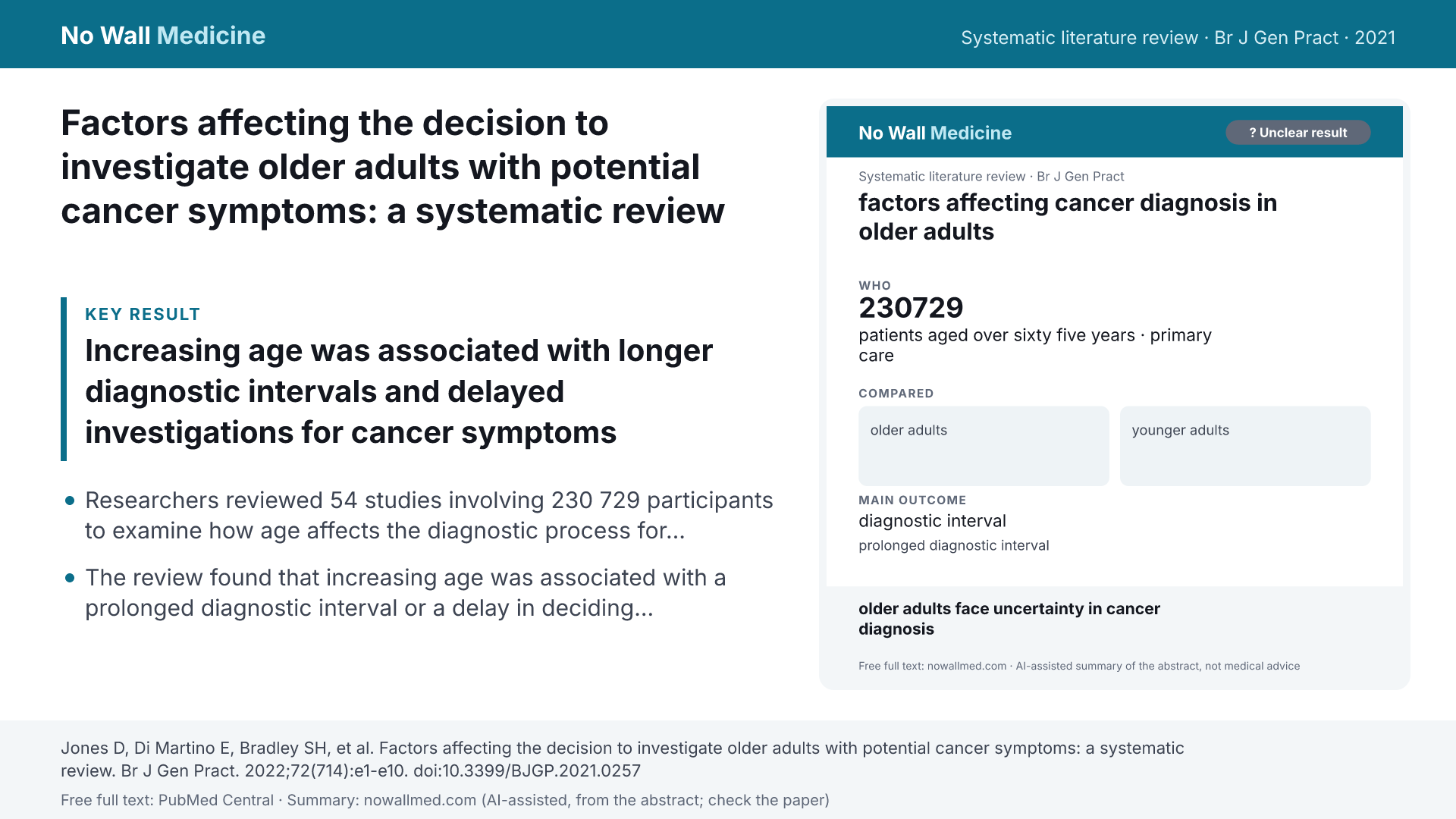
Increasing age was associated with longer diagnostic intervals and delayed investigations for cancer symptoms
Factors affecting the decision to investigate older adults with potential cancer symptoms: a systematic review
Systematic literature reviewUnclear result
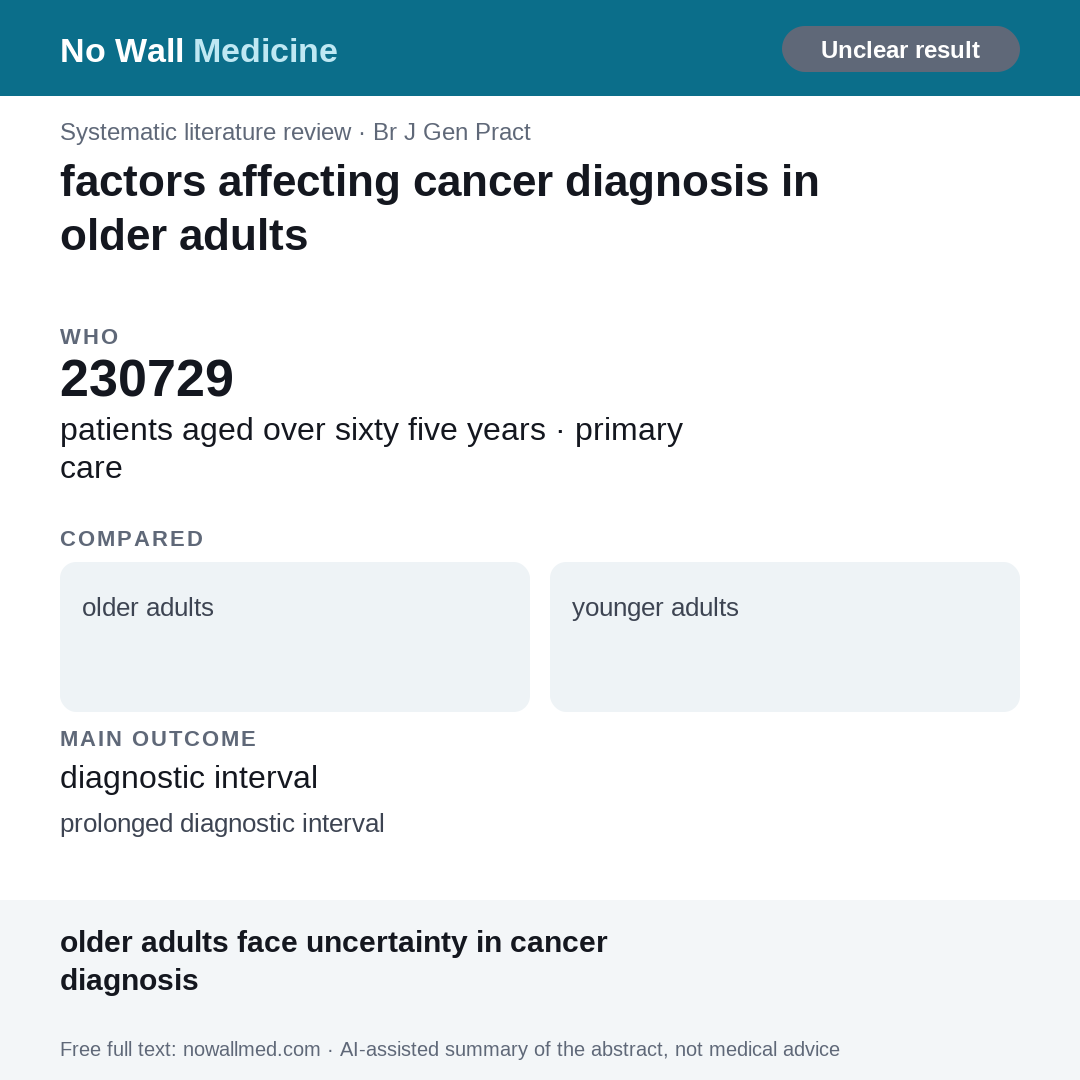
factors affecting cancer diagnosis in older adults
Who
230729
patients aged over sixty five years · primary care
Compared
older adults
younger adults
Main outcome
diagnostic interval
Result: prolonged diagnostic interval
Bottom line: older adults face uncertainty in cancer diagnosis
Limitation: uncertainty regarding optimum management
Br J Gen Pract · 2021-12-31Download image
Why it matters: It is unknown how older age affects the time it takes to diagnose cancer and which specific factors influence these diagnostic decisions.
Key points
- Researchers reviewed 54 studies involving 230 729 participants to examine how age affects the diagnostic process for cancer symptoms in people over 65 years old.
- The review found that increasing age was associated with a prolonged diagnostic interval or a delay in deciding to investigate cancer symptoms.
- Frailty, other medical conditions, and cognitive impairment were identified as factors that created uncertainty in diagnostic decisions for older adults.
Headline and key points written with AI from the paper’s abstract, with every number checked against it. Read the paper before relying on them.
Was this summary helpful?
Subject terms
Cite this article
Jones D, Di Martino E, Bradley SH, et al. Factors affecting the decision to investigate older adults with potential cancer symptoms: a systematic review. Br J Gen Pract. 2021. doi:10.3399/BJGP.2021.0257
Spotted a mistake? Suggest a correction