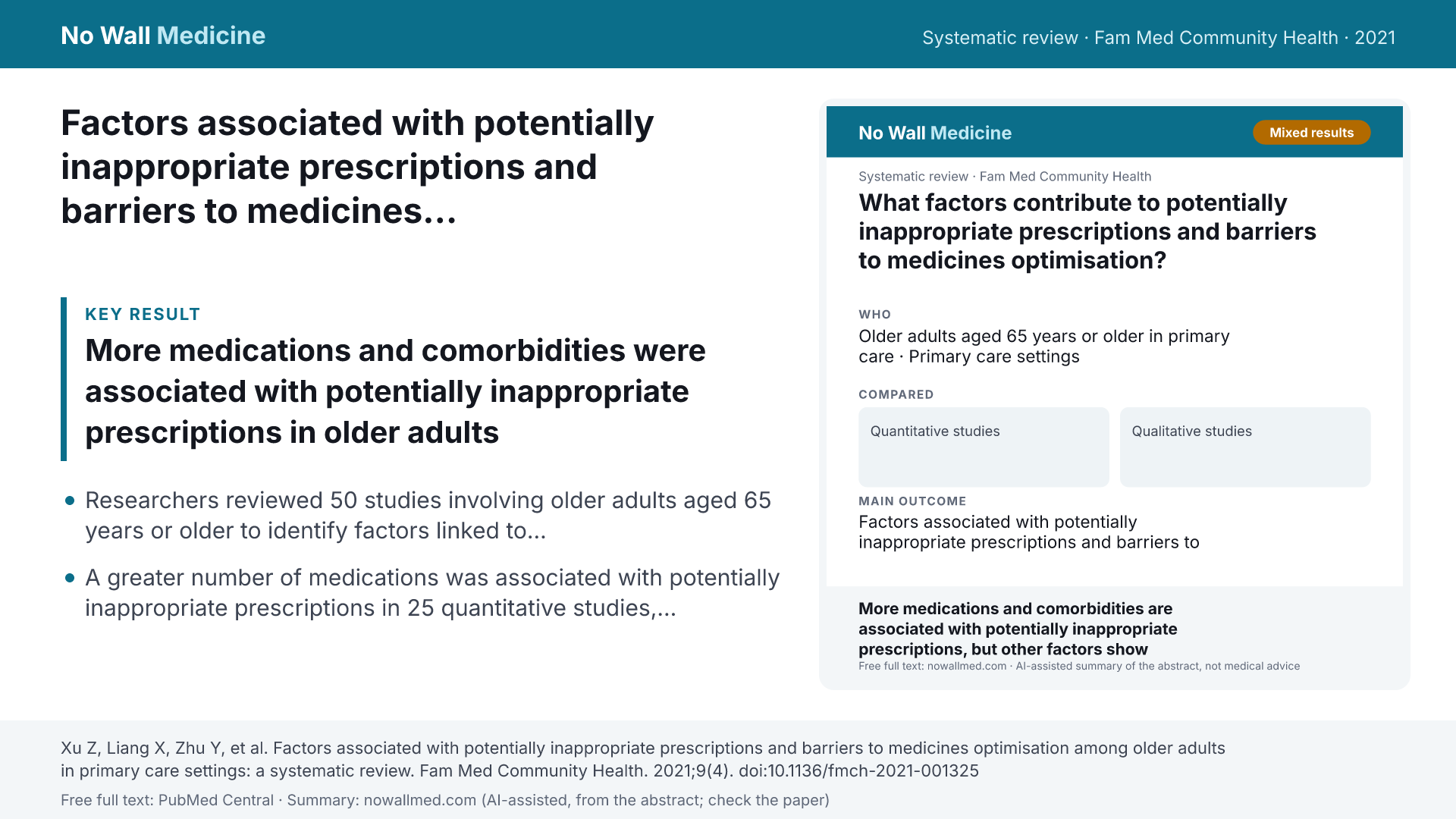
More medications and comorbidities were associated with potentially inappropriate prescriptions in older adults
Factors associated with potentially inappropriate prescriptions and barriers to medicines optimisation among older adults in primary care settings: a systematic review
Systematic reviewMixed results
What factors contribute to potentially inappropriate prescriptions and barriers to medicines optimisation?
Who
Older adults aged 65 years or older in primary care · Primary care settings
Compared
Quantitative studies
Qualitative studies
Main outcome
Factors associated with potentially inappropriate prescriptions and barriers to medicines optimisation
Bottom line: More medications and comorbidities are associated with potentially inappropriate prescriptions, but other factors show inconsistent associations.
Fam Med Community Health · 2021-11-19Download image
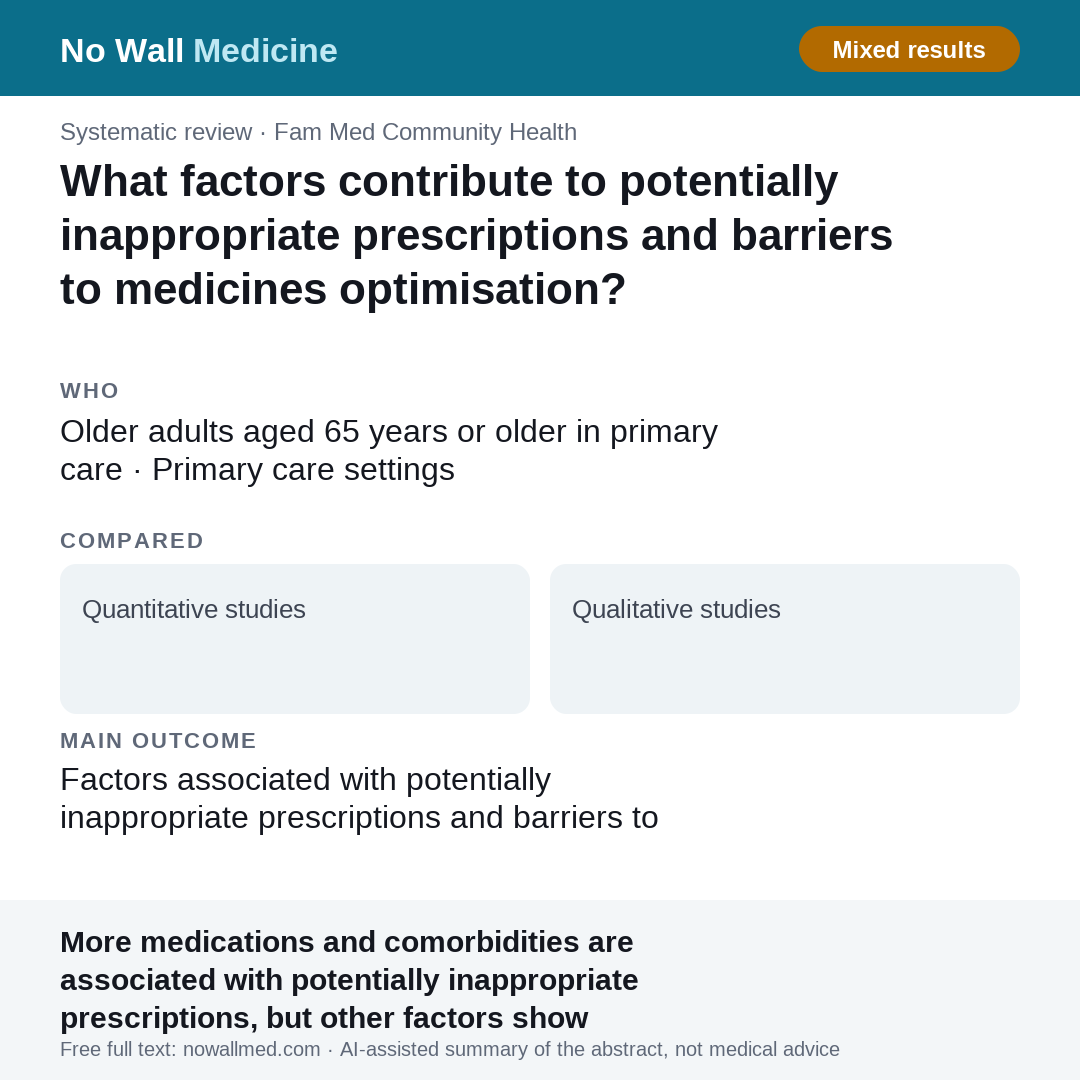
Clinical question: What factors contribute to potentially inappropriate prescriptions and barriers to medicines optimisation?
Key points
- Researchers reviewed 50 studies involving older adults aged 65 years or older to identify factors linked to potentially inappropriate prescriptions and barriers to medicines optimization.
- A greater number of medications was associated with potentially inappropriate prescriptions in 25 quantitative studies, along with higher numbers of physical and psychiatric comorbidities.
- Barriers to optimizing medicine use included prescriber knowledge, patient understanding, environmental constraints like time, and technology implementation complexity.
Headline and key points written with AI from the paper’s abstract, with every number checked against it. Read the paper before relying on them.
Was this summary helpful?
Abstract
Objective
To identify factors that likely contribute to potentially inappropriate prescriptions (PIPs) among older adults in primary care settings, as well as barriers to medicines optimisation and recommended potential solutions. Design
Systematic review. Eligibility criteria
Quantitative studies that analysed the factors associated with PIPs among older adults (≥65 years) in primary care settings, and qualitative studies that explored perceived barriers and potential solutions to medicines optimisation for this population. Information sources
PubMed, EMBASE, Scopus, CINAHL, PsycINFO, Web of Science, CNKI and Wanfang. Results
Of the 13 167 studies identified, 50 were included (14 qualitative, 34 cross-sectional and 2 cohort). Nearly all quantitative studies examined patient-related non-clinical factors (eg, age) and clinical factors (eg, number of medications) and nine studies examined prescriber-related factors (eg, physician age). A greater number of medications were identified as positively associated with PIPs in 25 quantitative studies, and a higher number of comorbidities, physical comorbidities and psychiatric comorbidities were identified as patient-related clinical risk factors for PIPs. However, other factors showed inconsistent associations with the PIPs. Barriers to medicines optimisation emerged within four analytical themes: prescriber related (eg, inadequate knowledge, concerns of adverse consequences, clinical inertia, lack of communication), patient related (eg, limited understanding, patient non-adherence, drug dependency), environment related (eg, lack of integrated care, insufficient investment, time constraints) and technology related (eg, complexity of implementation and inapplicable guidance). Recommended potential solutions were based on each theme of the barriers identified accordingly (eg, prescriber-related factors: incorporating training courses into continuing medical education). Conclusions
Older adults with more drugs prescribed and comorbidities may have a greater risk of receiving PIPs in the primary care setting, but it remains unclear whether other factors are related. Barriers to medicines optimisation among primary care older adults comprise multiple factors, and evidence-based and targeted interventions are needed to address these difficulties. Prospero registration number
CRD42020216258.
Abstract reproduced under the article’s CC BY NC licence.
Subject terms
Cite this article
Xu Z, Liang X, Zhu Y, et al. Factors associated with potentially inappropriate prescriptions and barriers to medicines optimisation among older adults in primary care settings: a systematic review. Fam Med Community Health. 2021. doi:10.1136/fmch-2021-001325
Spotted a mistake? Suggest a correction