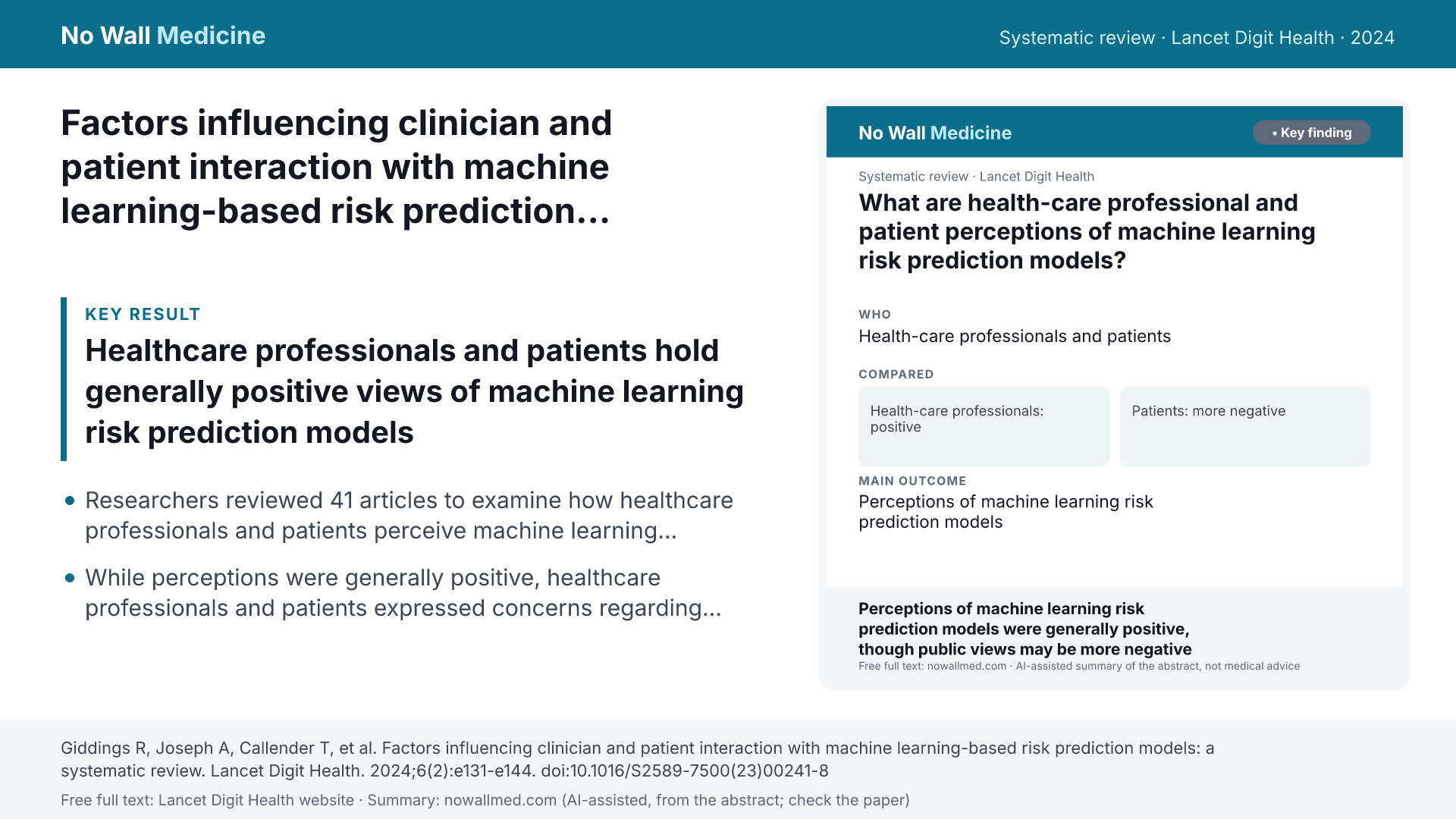
Healthcare professionals and patients hold generally positive views of machine learning risk prediction models
Factors influencing clinician and patient interaction with machine learning-based risk prediction models: a systematic review
Systematic reviewKey finding
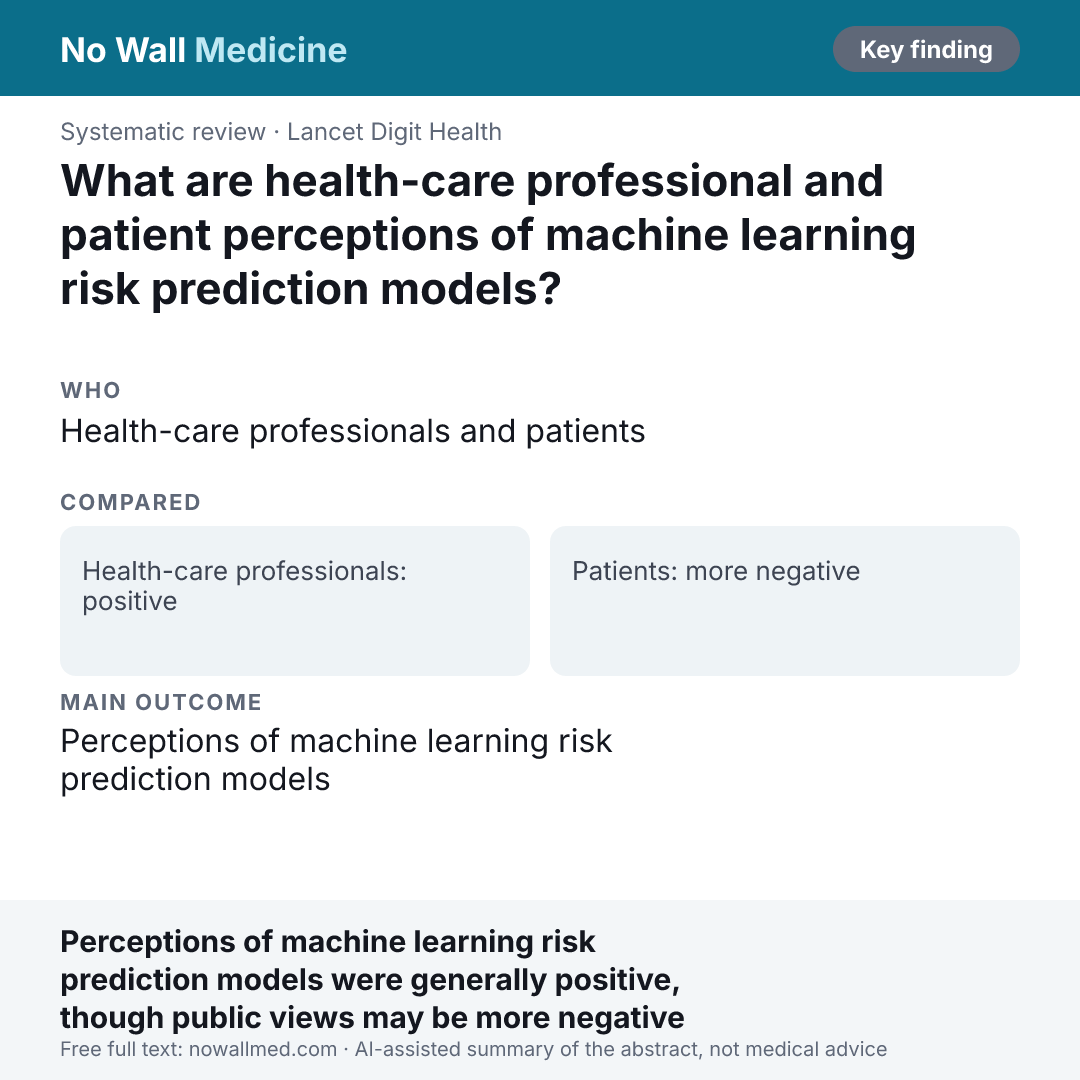
What are health-care professional and patient perceptions of machine learning risk prediction models?
Who
Health-care professionals and patients
Compared
Health-care professionals: positive
Patients: more negative
Main outcome
Perceptions of machine learning risk prediction models
Bottom line: Perceptions of machine learning risk prediction models were generally positive, though public views may be more negative than professionals.
Limitation: Low number of patient studies, absence of ethnic diversity, and variation in article quality.
Lancet Digit Health · 2024-01-27 · Save PNG
Clinical question: What are health-care professional and patient perceptions of machine learning risk prediction models?
Key points
- Researchers reviewed 41 articles to examine how healthcare professionals and patients perceive machine learning risk prediction models.
- While perceptions were generally positive, healthcare professionals and patients expressed concerns regarding data quality and unintended consequences.
- Public views were identified as potentially more negative than those of healthcare professionals.
Headline and key points written with AI from the paper’s abstract, with every number checked against it. Read the paper before relying on them.
Was this summary helpful?
Abstract
Machine learning (ML)-based risk prediction models hold the potential to support the health-care setting in several ways; however, use of such models is scarce. We aimed to review health-care professional (HCP) and patient perceptions of ML risk prediction models in published literature, to inform future risk prediction model development. Following database and citation searches, we identified 41 articles suitable for inclusion. Article quality varied with qualitative studies performing strongest. Overall, perceptions of ML risk prediction models were positive. HCPs and patients considered that models have the potential to add benefit in the health-care setting. However, reservations remain; for example, concerns regarding data quality for model development and fears of unintended consequences following ML model use. We identified that public views regarding these models might be more negative than HCPs and that concerns (eg, extra demands on workload) were not always borne out in practice. Conclusions are tempered by the low number of patient and public studies, the absence of participant ethnic diversity, and variation in article quality. We identified gaps in knowledge (particularly views from under-represented groups) and optimum methods for model explanation and alerts, which require future research.
Abstract reproduced under the article’s CC BY licence.
Subject terms
Headline, design, result, key points, caveat and citation as plain text.
Cite this article
Giddings R, Joseph A, Callender T, et al. Factors influencing clinician and patient interaction with machine learning-based risk prediction models: a systematic review. Lancet Digit Health. 2024;6(2):e131-e144. doi:10.1016/S2589-7500(23)00241-8
Spotted a mistake? Suggest a correction