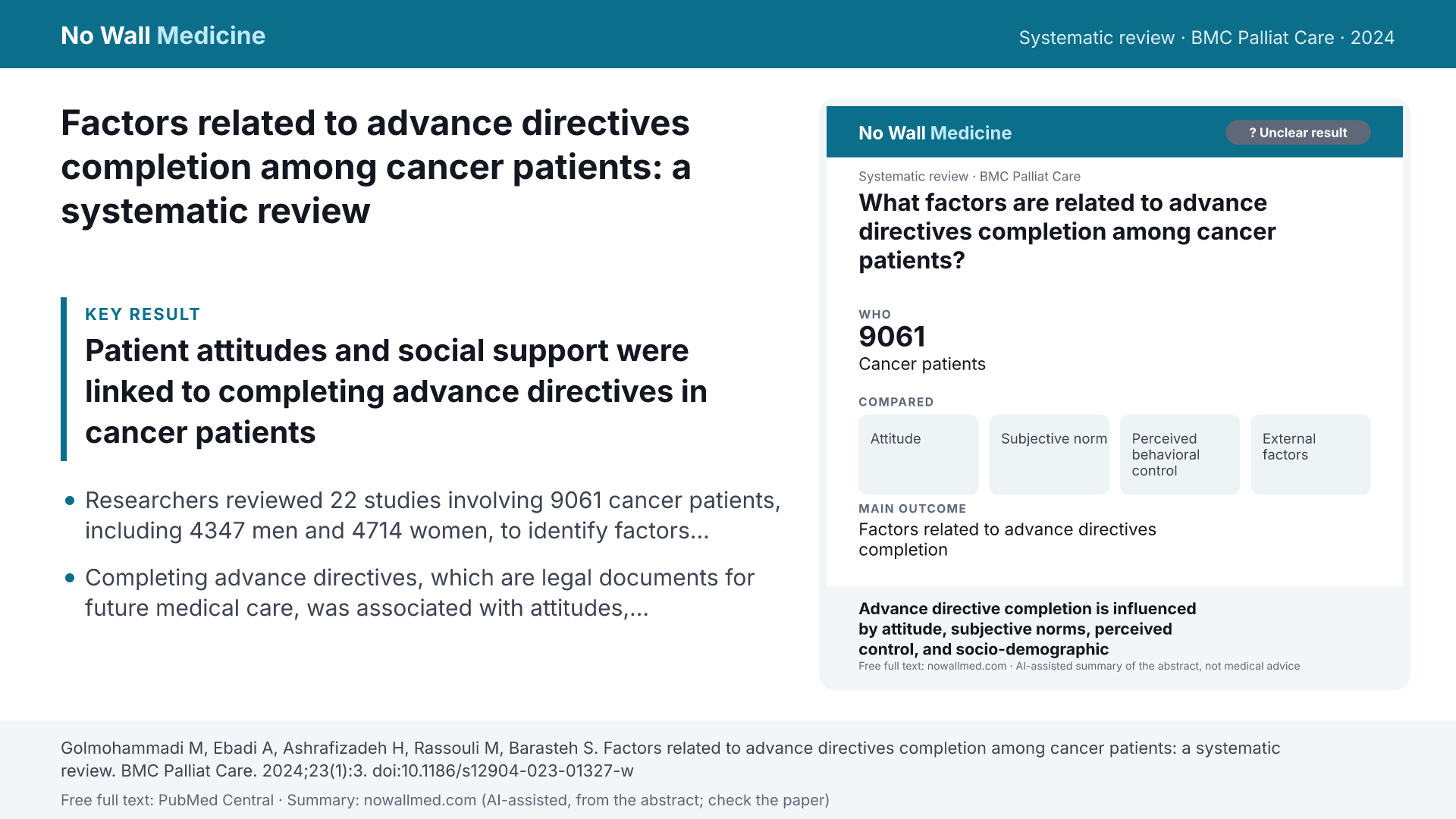
Patient attitudes and social support were linked to completing advance directives in cancer patients
Factors related to advance directives completion among cancer patients: a systematic review
Systematic reviewUnclear result
What factors are related to advance directives completion among cancer patients?
Who
9061
Cancer patients
Compared
Attitude
Subjective norm
Perceived behavioral control
External factors
Main outcome
Factors related to advance directives completion
Bottom line: Advance directive completion is influenced by attitude, subjective norms, perceived control, and socio-demographic characteristics.
BMC Palliat Care · 2024-01-03Download image
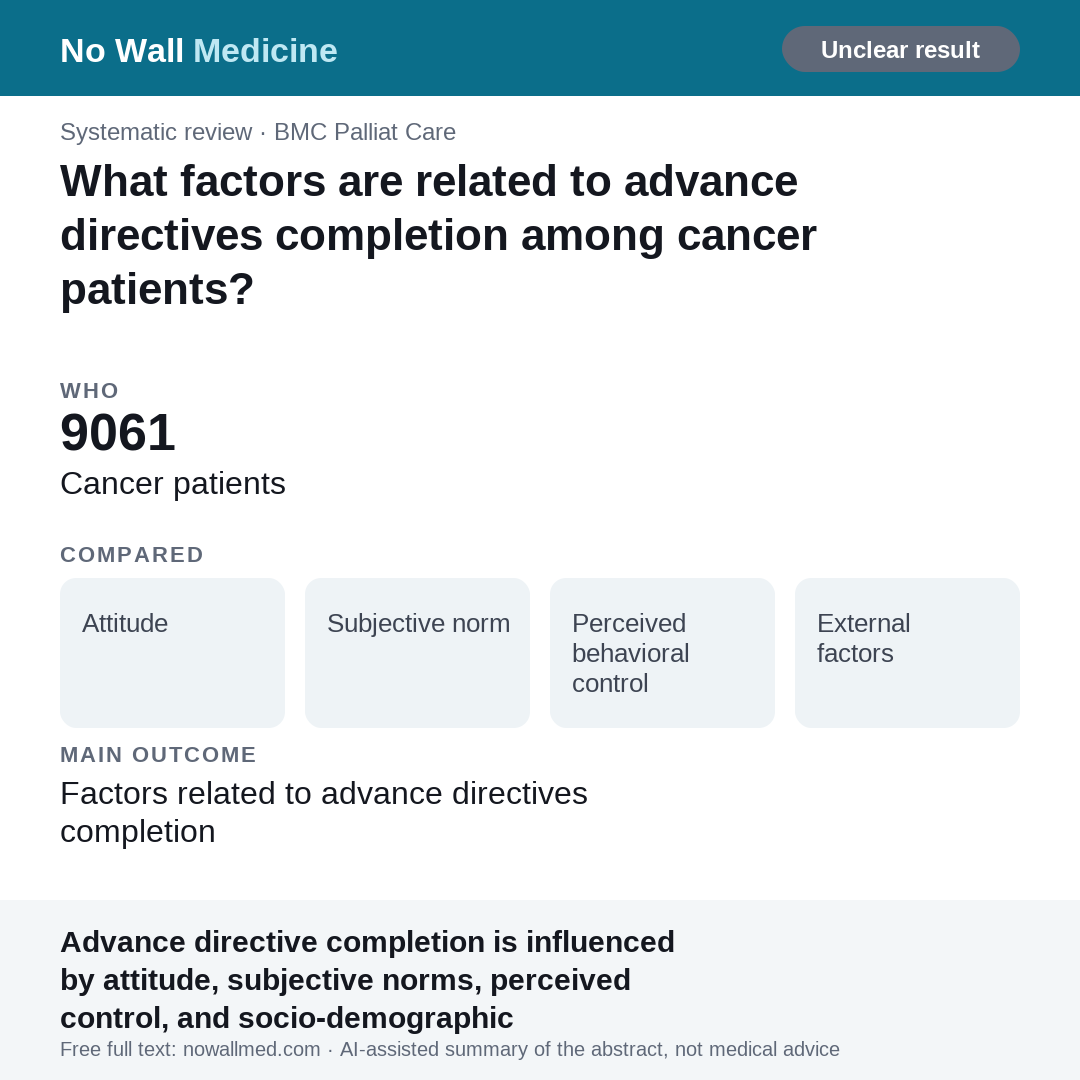
Clinical question: What factors are related to advance directives completion among cancer patients?
Key points
- Researchers reviewed 22 studies involving 9061 cancer patients, including 4347 men and 4714 women, to identify factors related to advance directives.
- Completing advance directives, which are legal documents for future medical care, was associated with attitudes, social support, perceived control, and socio-demographic characteristics.
- Factors included knowledge of advance directives, family interaction, decision-making, and access to the healthcare system.
Headline and key points written with AI from the paper’s abstract, with every number checked against it. Read the paper before relying on them.
Was this summary helpful?
Subject terms
Headline, design, result, key points, caveat and citation as plain text.
Cite this article
Golmohammadi M, Ebadi A, Ashrafizadeh H, Rassouli M, Barasteh S. Factors related to advance directives completion among cancer patients: a systematic review. BMC Palliat Care. 2024. doi:10.1186/s12904-023-01327-w
Spotted a mistake? Suggest a correction