Group antenatal care increases healthcare visits and birth weight in sub-Saharan Africa
Feasibility, acceptability and effectiveness of group antenatal care on maternal health continuum of care and perinatal outcomes in sub-Saharan Africa: a systematic review and meta-analysis
Systematic review and meta-analysisBenefit found
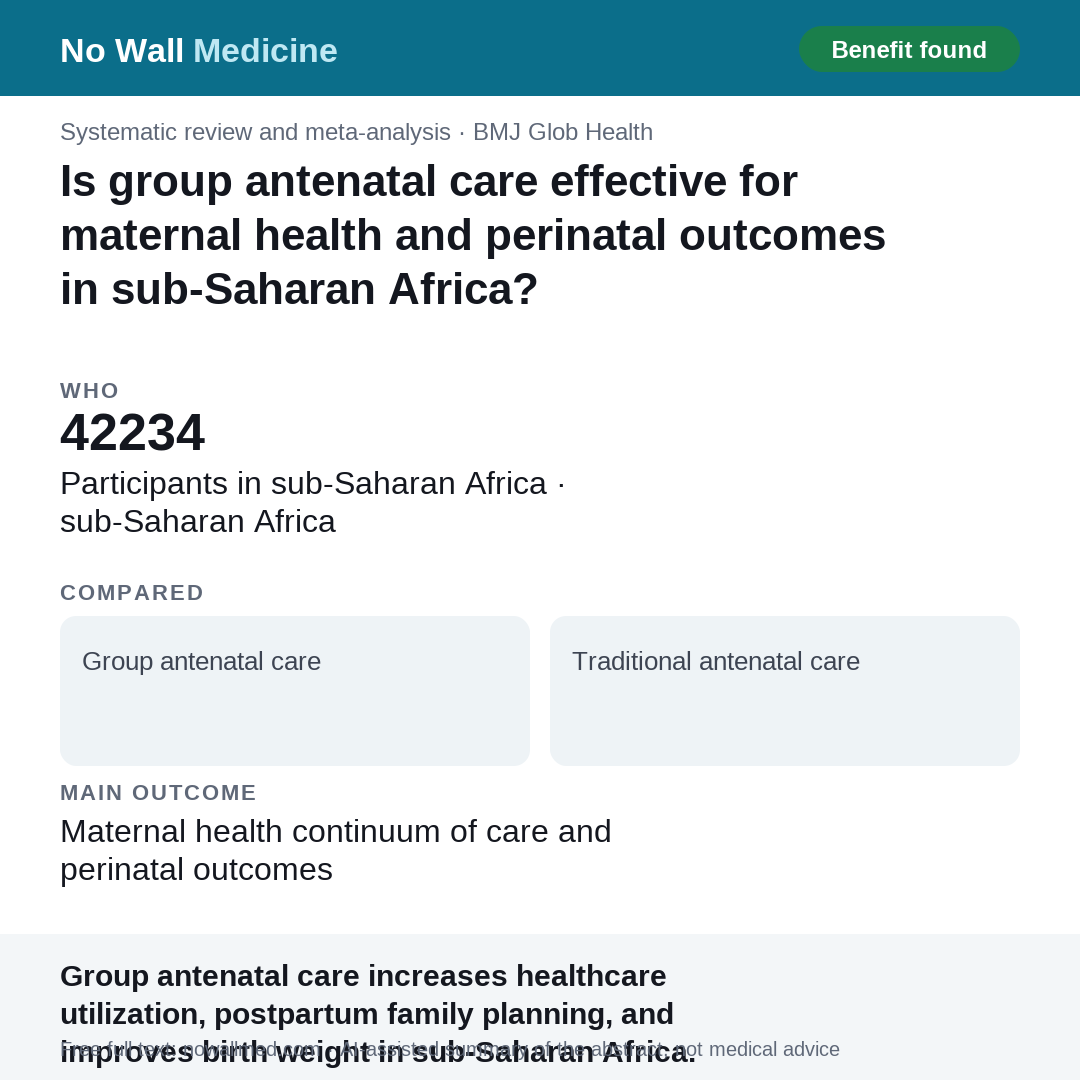
Is group antenatal care effective for maternal health and perinatal outcomes in sub-Saharan Africa?
Who
42234
Participants in sub-Saharan Africa · sub-Saharan Africa
Compared
Group antenatal care
Traditional antenatal care
Main outcome
Maternal health continuum of care and perinatal outcomes
Result: risk ratio 1.45 (95% CI 1.22 to 2.82) for four or more visits
Bottom line: Group antenatal care increases healthcare utilization, postpartum family planning, and improves birth weight in sub-Saharan Africa.
Limitation: No cost-effectiveness studies of group antenatal care were identified in sub-Saharan Africa.
BMJ Glob Health · 2026-06-09Download image
Clinical question: Is group antenatal care effective for maternal health and perinatal outcomes in sub-Saharan Africa?
Why it matters: Existing research on group antenatal care in sub-Saharan Africa needed systematic synthesis to guide policy and implementation for reducing maternal and perinatal mortality.
Key points
- Researchers analyzed 34 studies involving 42,234 participants to evaluate group antenatal care, which combines medical visits with education.
- Group care increased the likelihood of attending four or more antenatal visits (RR=1.45; 95% CI 1.22 to 2.82) and postpartum family planning (RR=1.85; 95% CI 1.26 to 2.73).
- The intervention was associated with improved birth weight (RR=1.53; 95% CI 1.09 to 2.14) but showed no significant difference in the likelihood of giving birth at health facilities.
Limitation the authors note: No cost-effectiveness studies of group antenatal care were identified in sub-Saharan Africa.
Headline and key points written with AI from the paper’s abstract, with every number checked against it. Read the paper before relying on them.
Abstract
Background
Group antenatal care (G-ANC), integrating medical care with education, has demonstrated positive effects on maternal and newborn health. Individual studies have shown promising evidence in sub-Saharan Africa, but systematically synthesising the existing research would facilitate implementation and identify gaps for further research. This systematic review aimed, therefore, to review the existing evidence on feasibility, acceptability and effectiveness of G-ANC in resource-limited settings to guide policy and support implementing G-ANC to reduce maternal and perinatal mortality. Methods
A systematic and comprehensive literature search was conducted in the PubMed/MEDLINE, Web of Science, Cumulative Index to Nursing and Allied Health Literature (CINAHL), Excerpta Medica Database (Embase) and Google Scholar electronic databases. The Preferred Reporting Items for Systematic Reviews and Meta-Analyses (PRISMA) guidelines for systematic reviews and meta-analyses of healthcare interventions were followed. Data were extracted using a prespecified protocol and quality was assessed using the Joanna Briggs Institute appraisal tool. Random-effects meta-analyses were used to pool estimates. The review is registered on the International Prospective Register of Systematic Reviews (PROSPERO: CRD42024565501). Results
Of the 576 articles identified, 34 articles with 42 234 participants were included. G-ANC increased the likelihood of attending four or more ANC visits (pooled risk ratio (RR)=1.45; 95% CI 1.22 to 2.82), was associated with the likelihood of attending postnatal care visits (RR=1.23; 95% CI 1.03 to 1.47), increased uptake of postpartum family planning methods (RR=1.85; 95% CI 1.26 to 2.73) and was associated with improved birth weight (RR=1.53; 95% CI 1.09 to 2.14). It was also associated with improved quality of care, health literacy, psychosocial gains, empowerment and facilitating culturally sensitive discussions. There was, however, no significant difference found between groups regarding likelihood of giving birth at health facilities compared with the traditional ANC. Also, no cost-effectiveness studies of G-ANC were identified in sub-Saharan Africa, highlighting a key evidence gap for guiding future implementation and scale-up. Conclusions
Exposure to G-ANC enhances utilisation of maternal healthcare such as ANC attendance, postnatal care, family planning uptake and improves birth weight. It also improves maternal engagement, health literacy and empowerment through a highly participatory learning approach and peer support. Nevertheless, no notable difference was observed between the groups in terms of likelihood of giving birth in health facilities. Prospero registration number
CRD42024565501.
Abstract reproduced under the article’s CC BY NC licence.
Topics
Cite this article
Mengesha MB, Chekole TT, Abraha HE, Tsegay EW, Kinyina A, Atsbaha AH. Feasibility, acceptability and effectiveness of group antenatal care on maternal health continuum of care and perinatal outcomes in sub-Saharan Africa: a systematic review and meta-analysis. BMJ Glob Health. 2026. doi:10.1136/bmjgh-2025-020883
Spotted a mistake? Suggest a correction