Remote technologies for trauma-related disorders showed higher feasibility when they included clinician interaction
Feasibility and acceptability of remote technologies for the treatment of trauma- and stressor-related disorders in adults: mixed-methods systematic review
Mixed-methods systematic reviewMixed results
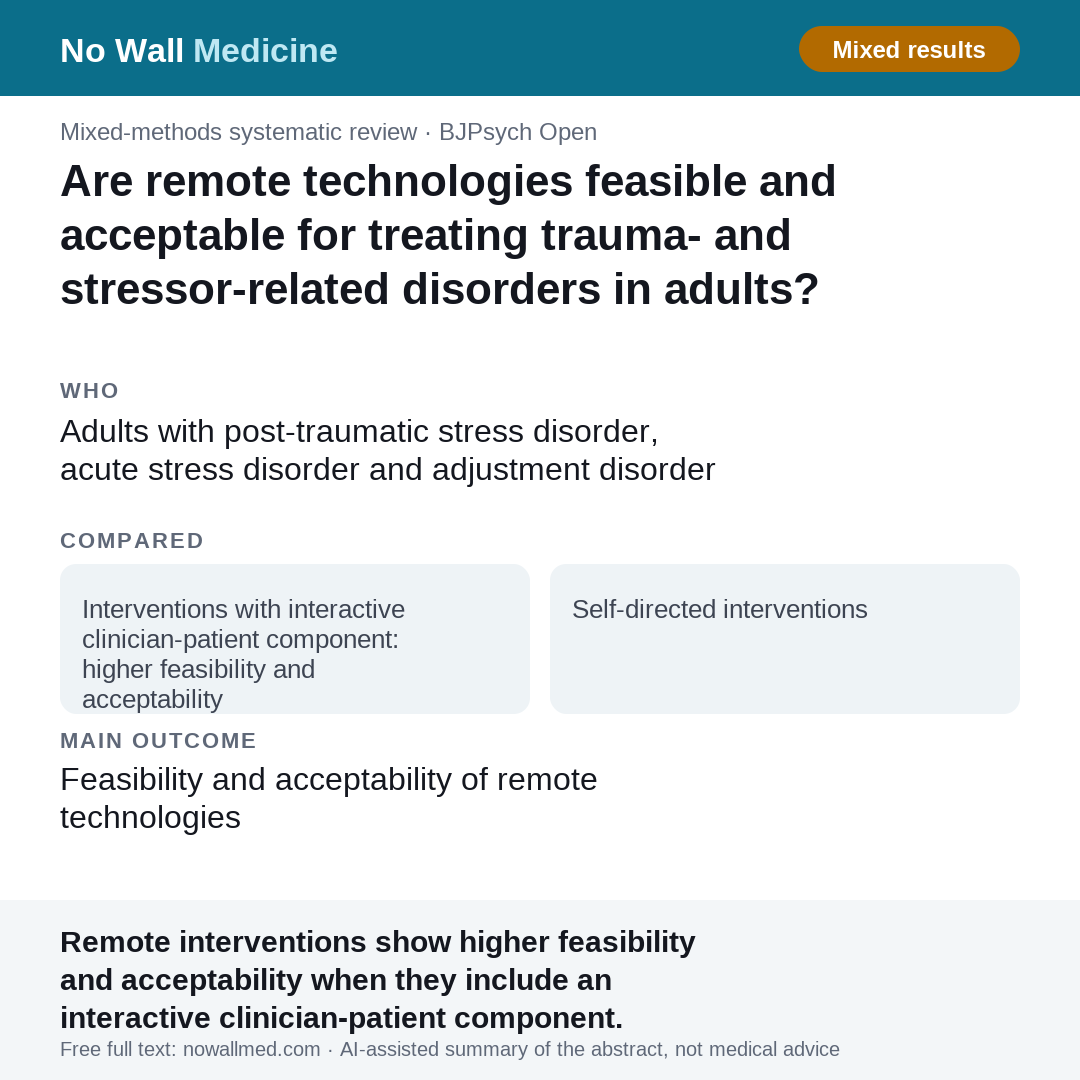
Are remote technologies feasible and acceptable for treating trauma- and stressor-related disorders in adults?
Who
Adults with post-traumatic stress disorder, acute stress disorder and adjustment disorder
Compared
Interventions with interactive clinician-patient component: higher feasibility and acceptability
Self-directed interventions
Main outcome
Feasibility and acceptability of remote technologies
Bottom line: Remote interventions show higher feasibility and acceptability when they include an interactive clinician-patient component.
BJPsych Open · 2025-10-22Download image
Clinical question: Are remote technologies feasible and acceptable for treating trauma- and stressor-related disorders in adults?
Why it matters: Barriers to traditional services have increased the use of remote technologies for treating trauma- and stressor-related disorders.
Key points
- Researchers reviewed 74 studies involving 27 remote interventions for adults with post-traumatic stress disorder, acute stress disorder, and adjustment disorder.
- Interventions that included an interactive clinician-patient component were associated with higher feasibility and acceptability.
- The reviewed interventions included online programs (63.51%), mobile applications (22.97%), video conferencing (12.16%), and message-based systems (1.35%).
Headline and key points written with AI from the paper’s abstract, with every number checked against it. Read the paper before relying on them.
Cite this article
Rivest-Beauregard M, Fortin J, Gauthier É, Lonergan M, Brunet A, Ferrari M. Feasibility and acceptability of remote technologies for the treatment of trauma- and stressor-related disorders in adults: mixed-methods systematic review. BJPsych Open. 2025. doi:10.1192/bjo.2025.10832
Spotted a mistake? Suggest a correction