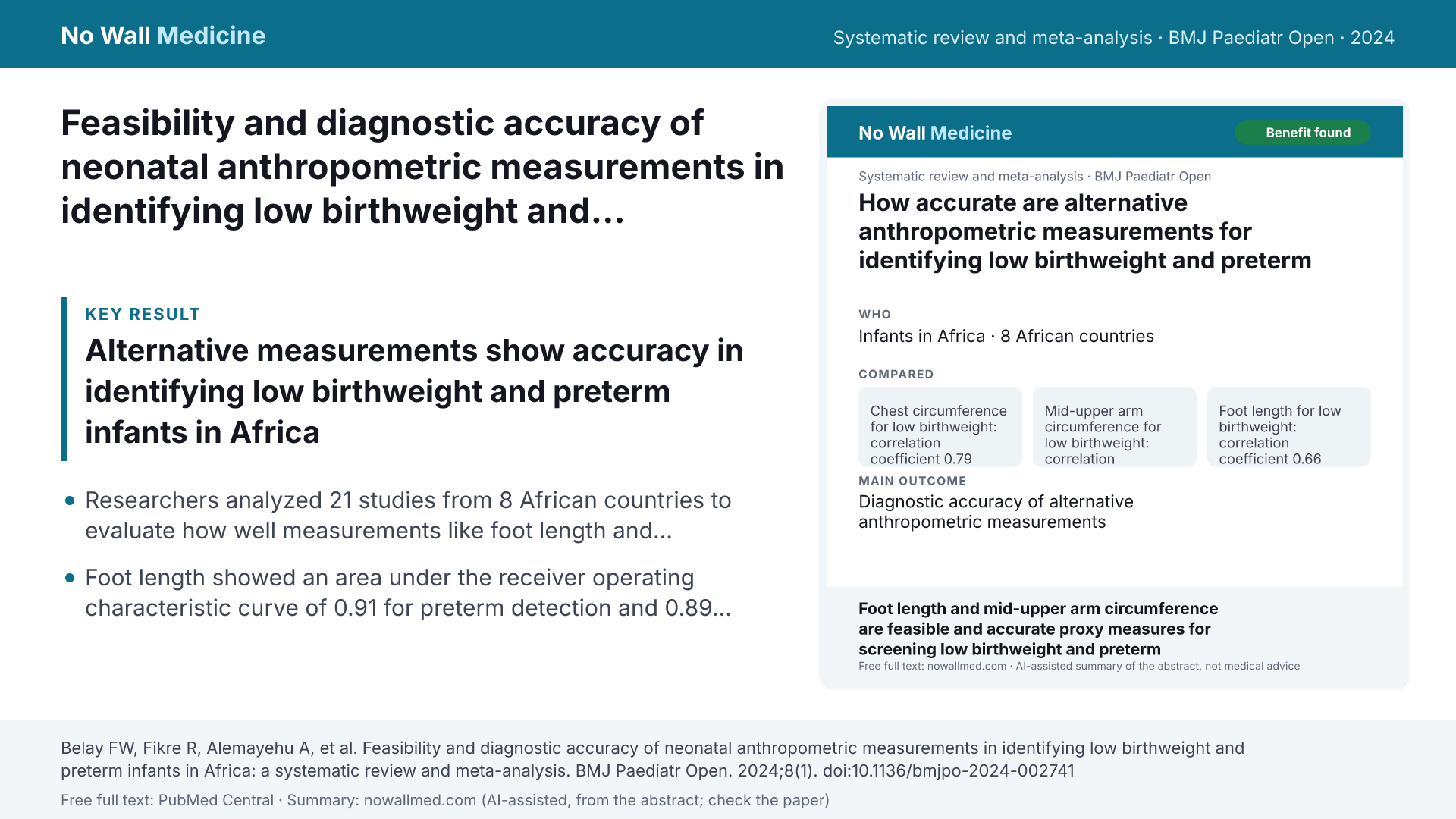
Alternative measurements show accuracy in identifying low birthweight and preterm infants in Africa
Feasibility and diagnostic accuracy of neonatal anthropometric measurements in identifying low birthweight and preterm infants in Africa: a systematic review and meta-analysis
Systematic review and meta-analysisBenefit found
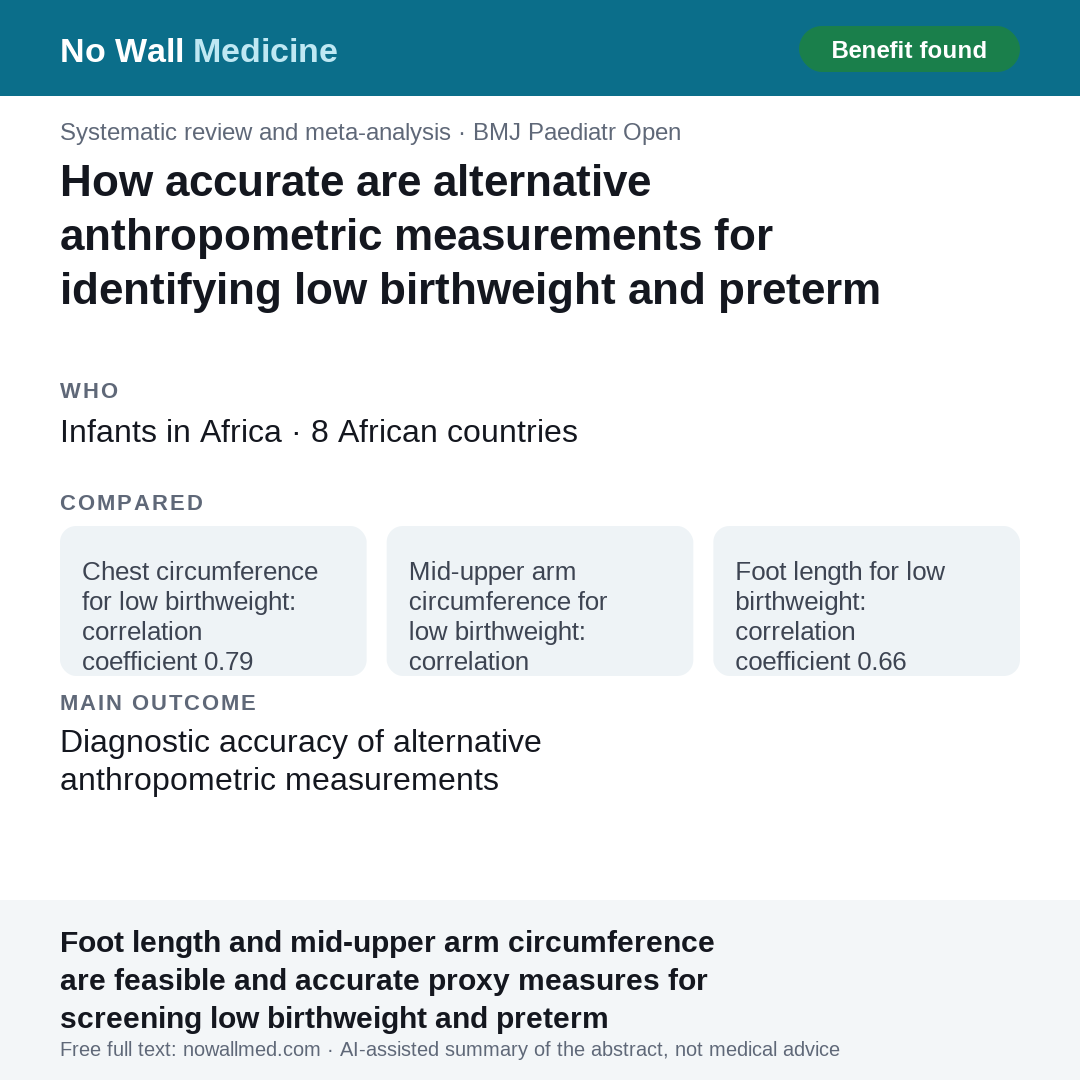
How accurate are alternative anthropometric measurements for identifying low birthweight and preterm infants in Africa?
Who
Infants in Africa · 8 African countries
Compared
Chest circumference for low birthweight: correlation coefficient 0.79 (95% CI 0.70 to 0.85)
Mid-upper arm circumference for low birthweight: correlation coefficient 0.71 (95% CI 0.62 to 0.78)
Foot length for low birthweight: correlation coefficient 0.66 (95% CI 0.59 to 0.73)
Main outcome
Diagnostic accuracy of alternative anthropometric measurements
Bottom line: Foot length and mid-upper arm circumference are feasible and accurate proxy measures for screening low birthweight and preterm infants.
BMJ Paediatr Open · 2024-10-01Download image
Clinical question: How accurate are alternative anthropometric measurements for identifying low birthweight and preterm infants in Africa?
Why it matters: It is unknown if alternative measurements like foot length or mid-upper arm circumference can accurately identify low birthweight and preterm infants in low-resource settings.
Key points
- Researchers analyzed 21 studies from 8 African countries to evaluate how well measurements like foot length and mid-upper arm circumference identify low birthweight and preterm infants.
- Foot length showed an area under the receiver operating characteristic curve of 0.91 for preterm detection and 0.89 for low birthweight identification.
- Chest circumference had a correlation coefficient of 0.79 with birth weight, while mid-upper arm circumference had a correlation of 0.71.
Headline and key points written with AI from the paper’s abstract, with every number checked against it. Read the paper before relying on them.
Was this summary helpful?
Abstract
Background
Complications of prematurity are the leading cause of under-5 mortality globally and 80% of newborn deaths are of low birth weight (LBW) babies. Early identification of LBW and preterm infants is crucial to initiate timely interventions. Objective
To evaluate the feasibility and diagnostic accuracy of alternative neonatal anthropometric measurements in identifying LBW and preterm infants in Africa. Methods
In this systematic review and meta-analysis, we evaluated the diagnostic performance of infant foot length, mid-upper arm circumference (MUAC), head and chest circumferences against birth weight and gestational age. Pooled correlation between the index and the reference methods was estimated. Multiple anthropometric thresholds were considered in estimating the pooled sensitivity, specificity and area under receiver operating characteristic curve (AUC). Results
21 studies from 8 African countries met the inclusion criteria. Correlation coefficients with birth weight were 0.79 (95% CI 0.70 to 0.85) for chest circumference, 0.71 (95% CI 0.62 to 0.78) for MUAC and 0.66 (95% CI 0.59 to 0.73) for foot length. Foot length measured by rigid ruler showed a higher correlation than tape measurement. Chest circumference with 28.8 cm cut-off detects LBW babies with AUC value of 0.92 (95% CI 0.71 to 0.97). Foot length identified preterm infants, with 82% sensitivity, 89% specificity and AUC of 0.91 (95% CI 0.69 to 0.98) at a 7.2 cm optimal cut-off point. MUAC had an AUC of 0.83 (95% CI 0.47 to 0.95) for preterm detection. In identifying LBW babies, foot length and MUAC have AUC values of 0.89 (95% CI 0.70 to 0.96) and 0.91 (95% CI 0.73 to 0.97) at 7.3 cm and 9.8 cm optimal cut-off points, respectively. Foot length and MUAC are relatively simple and minimise the risk of exposing infants to cold. Conclusion
Newborn foot length, MUAC, head and chest circumferences have comparable diagnostic accuracy in identifying LBW and preterm babies. Using foot length and MUAC in low-resource settings are the most feasible proxy measures for screening where weighing scales are not available. Prospero registration number
CRD42023454497.
Abstract reproduced under the article’s CC BY NC licence.
Subject terms
Cite this article
Belay FW, Fikre R, Alemayehu A, et al. Feasibility and diagnostic accuracy of neonatal anthropometric measurements in identifying low birthweight and preterm infants in Africa: a systematic review and meta-analysis. BMJ Paediatr Open. 2024. doi:10.1136/bmjpo-2024-002741
Spotted a mistake? Suggest a correction