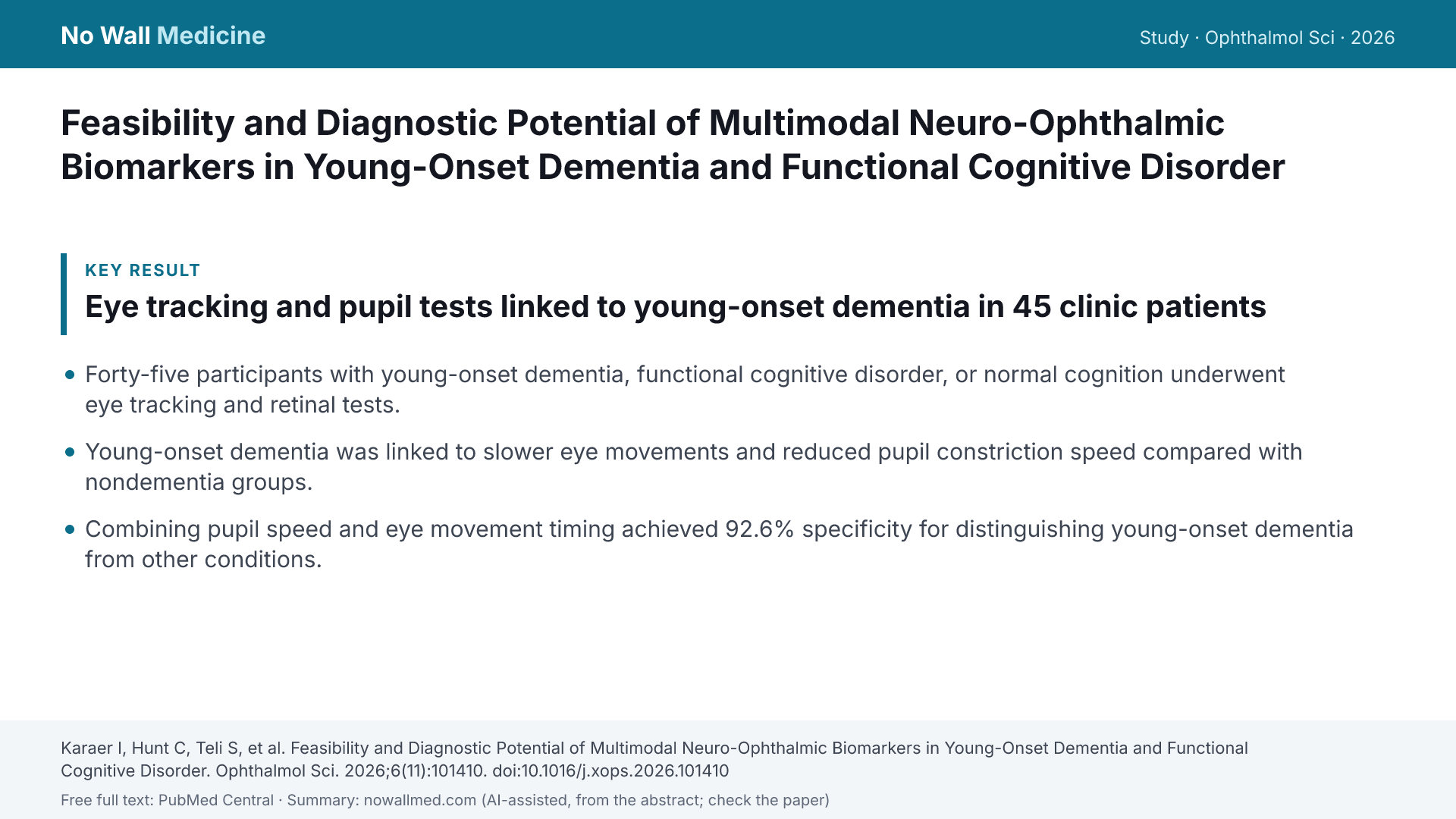
Eye tracking and pupil tests linked to young-onset dementia in 45 clinic patients
Feasibility and Diagnostic Potential of Multimodal Neuro-Ophthalmic Biomarkers in Young-Onset Dementia and Functional Cognitive Disorder
Why it matters: Clinicians lack objective, culture-fair tools to distinguish young-onset dementia from functional cognitive disorder in memory clinics.
Key points
- Forty-five participants with young-onset dementia, functional cognitive disorder, or normal cognition underwent eye tracking and retinal tests.
- Young-onset dementia was linked to slower eye movements and reduced pupil constriction speed compared with nondementia groups.
- Combining pupil speed and eye movement timing achieved 92.6% specificity for distinguishing young-onset dementia from other conditions.
Limitation the authors note: The study was cross-sectional and observational, requiring larger longitudinal studies to validate diagnostic thresholds.
Study type: Observational study: it can show a link, but not prove that one thing causes another.
Headline and key points written with AI from the paper’s abstract, with every number checked against it. Read the paper before relying on them.
Was this summary helpful?
Headline, design, result, key points, caveat and citation as plain text.
Cite this article
Karaer I, Hunt C, Teli S, et al. Feasibility and Diagnostic Potential of Multimodal Neuro-Ophthalmic Biomarkers in Young-Onset Dementia and Functional Cognitive Disorder. Ophthalmol Sci. 2026;6(11):101410. doi:10.1016/j.xops.2026.101410
Spotted a mistake? Suggest a correction