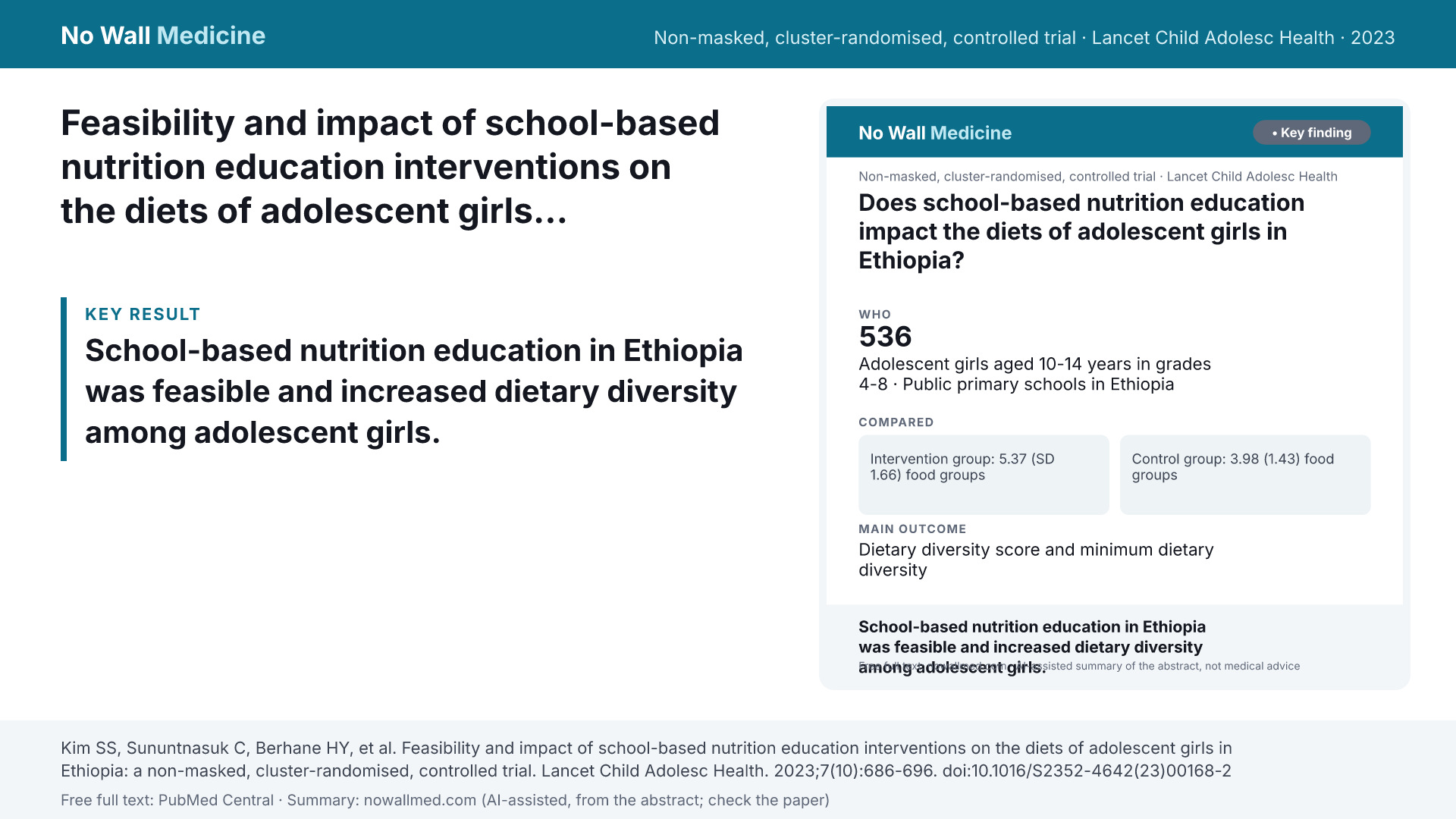
Feasibility and impact of school-based nutrition education interventions on the diets of adolescent girls in Ethiopia: a non-masked, cluster-randomised, controlled trial
Non-masked, cluster-randomised, controlled trialKey finding
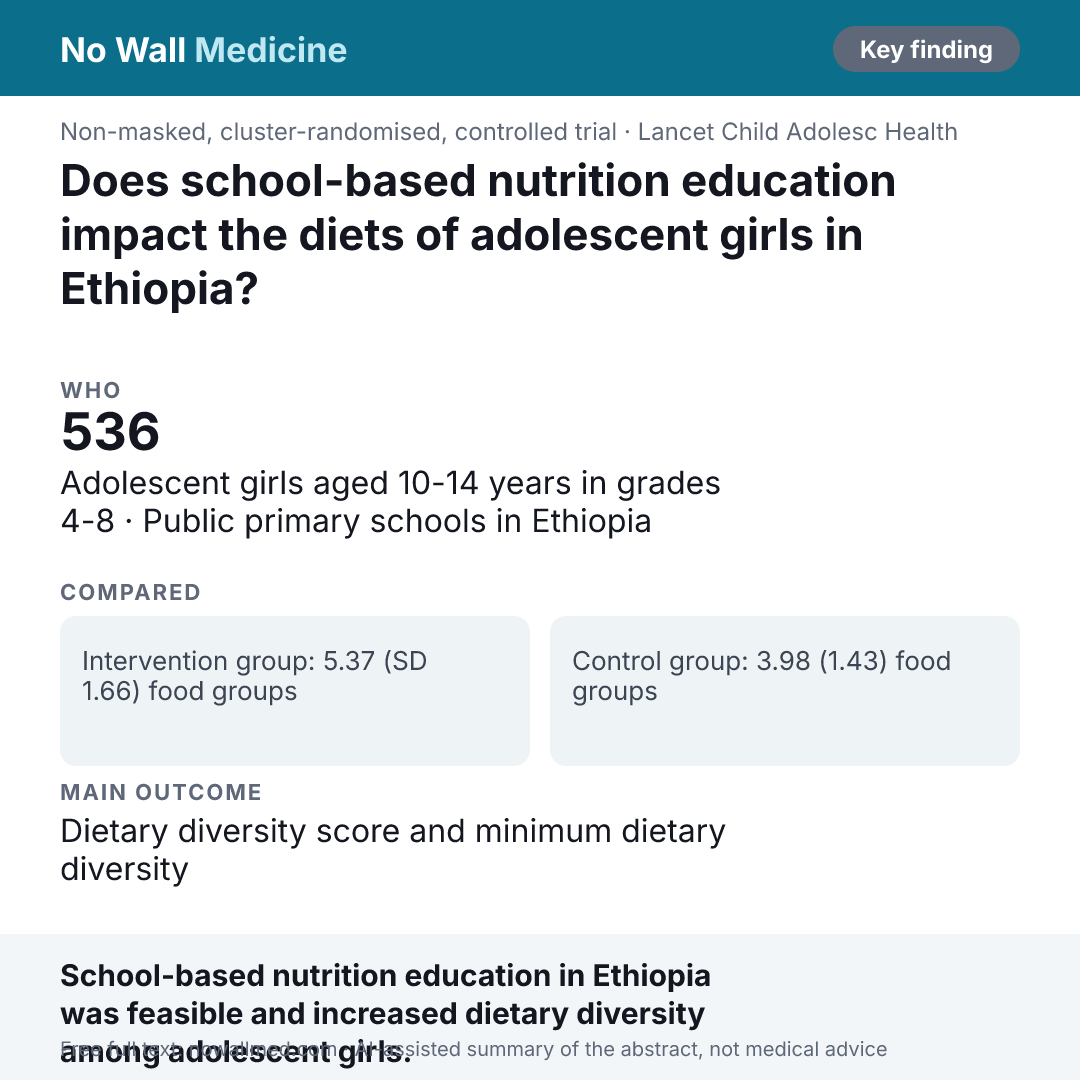
Does school-based nutrition education impact the diets of adolescent girls in Ethiopia?
Who
536
Adolescent girls aged 10-14 years in grades 4-8 · Public primary schools in Ethiopia
Compared
Intervention group: 5.37 (SD 1.66) food groups
Control group: 3.98 (1.43) food groups
Main outcome
Dietary diversity score and minimum dietary diversity
Result: adjusted mean difference 1.33, 95% CI 0.90-1.75
Bottom line: School-based nutrition education in Ethiopia was feasible and increased dietary diversity among adolescent girls.
Limitation: Could be limited in changing other food choice behaviours, such as junk food consumption.
Funded by: Bill & Melinda Gates Foundation
Lancet Child Adolesc Health · 2023-09-01 · Save PNG
Clinical question: Does school-based nutrition education impact the diets of adolescent girls in Ethiopia?
Abstract
Background
Adolescence is a critical period of physical and psychological development, especially for girls, because poor nutrition can affect their wellbeing as well as that of their children. We aimed to assess the feasibility and impact of a package of nutrition education interventions delivered through public primary schools on the diets of adolescent girls in Ethiopia. Methods
In this non-masked, cluster-randomised, controlled trial, primary schools (clusters) in the Southern Nations, Nationalities, and People's Region and Somali region of Ethiopia were randomly allocated to the intervention group (nutrition information provided during flag ceremonies, classroom lessons, school club meetings, peer group mentoring, BMI measurement and counselling, and parent-teacher meetings) or the control group (standard academic curriculum on health and nutrition) by use of computer-generated pseudo-random numbers. Duration of the school-based interventions was 4 months, and the key messages were related to dietary diversity (eating a variety of foods), energy adequacy (eating breakfast and healthy snacks), and healthy food choices (avoiding junk foods). Adolescent girls were eligible for participation if aged 10-14 years and enrolled in grades 4-8 in a study school. Data were collected with two independent cross-sectional surveys: baseline before the start of implementation and endline 1·5 years later. The primary outcome of impact was dietary diversity score, defined as the number of food groups (out of ten) consumed over the previous 24 h using a list-based method, and minimum dietary diversity, defined as the proportion of girls who consumed foods from at least five of the ten food groups, in the intention-to-treat population. We also assessed intervention exposure as a measure of feasibility. We estimated intervention effects using linear regression models for mean differences at endline, with SEs clustered at the school level, and controlled for adolescent age, region, household food security, and wealth. The trial is registered with ClinicalTrials.Gov, NCT04121559, and is complete. Findings
27 primary schools were randomly allocated to the intervention group and 27 to the control group. Between March 22 and April 29, 2021, 536 adolescent girls participated in the endline survey (270 in the intervention group and 266 in the control group), with median age of 13·3 years (IQR 12·1-14·0). At endline, the dietary diversity score was 5·37 (SD 1·66) food groups in the intervention group and 3·98 (1·43) food groups in the control group (adjusted mean difference 1·33, 95% CI 0·90-1·75, p<0·0001). Increased minimum dietary diversity was also associated with the intervention (182 [67%] of 270 in the intervention group vs 76 [29%] of 266 in the control group; adjusted odds ratio 5·37 [95% CI 3·04-9·50], p<0·0001). 256 (95%) of 270 adolescent girls in the intervention group were exposed to at least one of the five in-school intervention components. Interpretation
Integrating nutrition interventions into primary schools in Ethiopia was feasible and increased dietary diversity incrementally among adolescent girls, but could be limited in changing other food choice behaviours, such as junk food consumption, based on nutrition education alone. Funding
Bill & Melinda Gates Foundation.
Abstract reproduced under the article’s CC BY licence.
Subject terms
Headline, design, result, key points, caveat and citation as plain text.
Cite this article
Kim SS, Sununtnasuk C, Berhane HY, et al. Feasibility and impact of school-based nutrition education interventions on the diets of adolescent girls in Ethiopia: a non-masked, cluster-randomised, controlled trial. Lancet Child Adolesc Health. 2023;7(10):686-696. doi:10.1016/S2352-4642(23)00168-2
Spotted a mistake? Suggest a correction