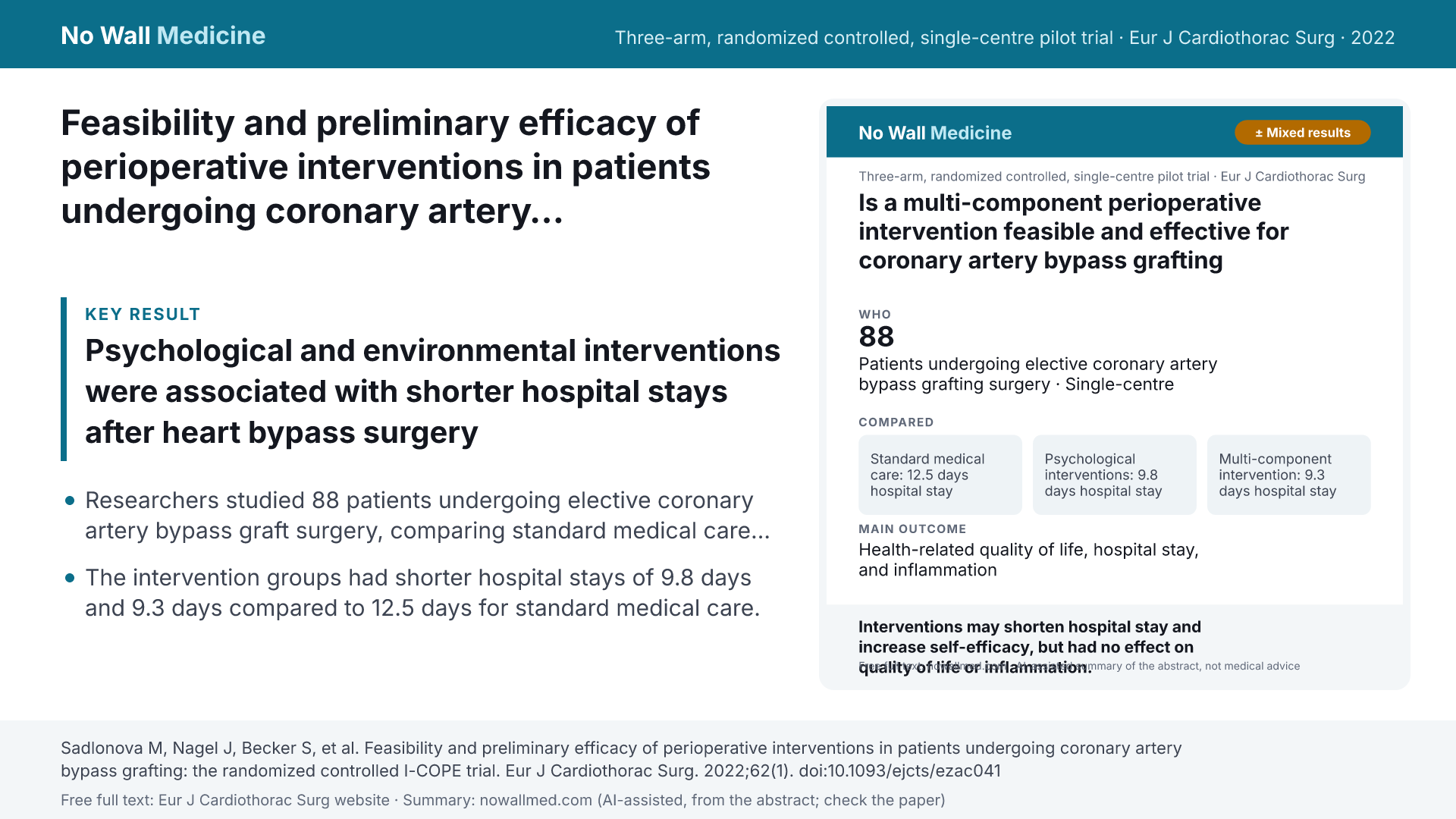
Psychological and environmental interventions were associated with shorter hospital stays after heart bypass surgery
Feasibility and preliminary efficacy of perioperative interventions in patients undergoing coronary artery bypass grafting: the randomized controlled I-COPE trial
Three-arm, randomized controlled, single-centre pilot trialMixed results
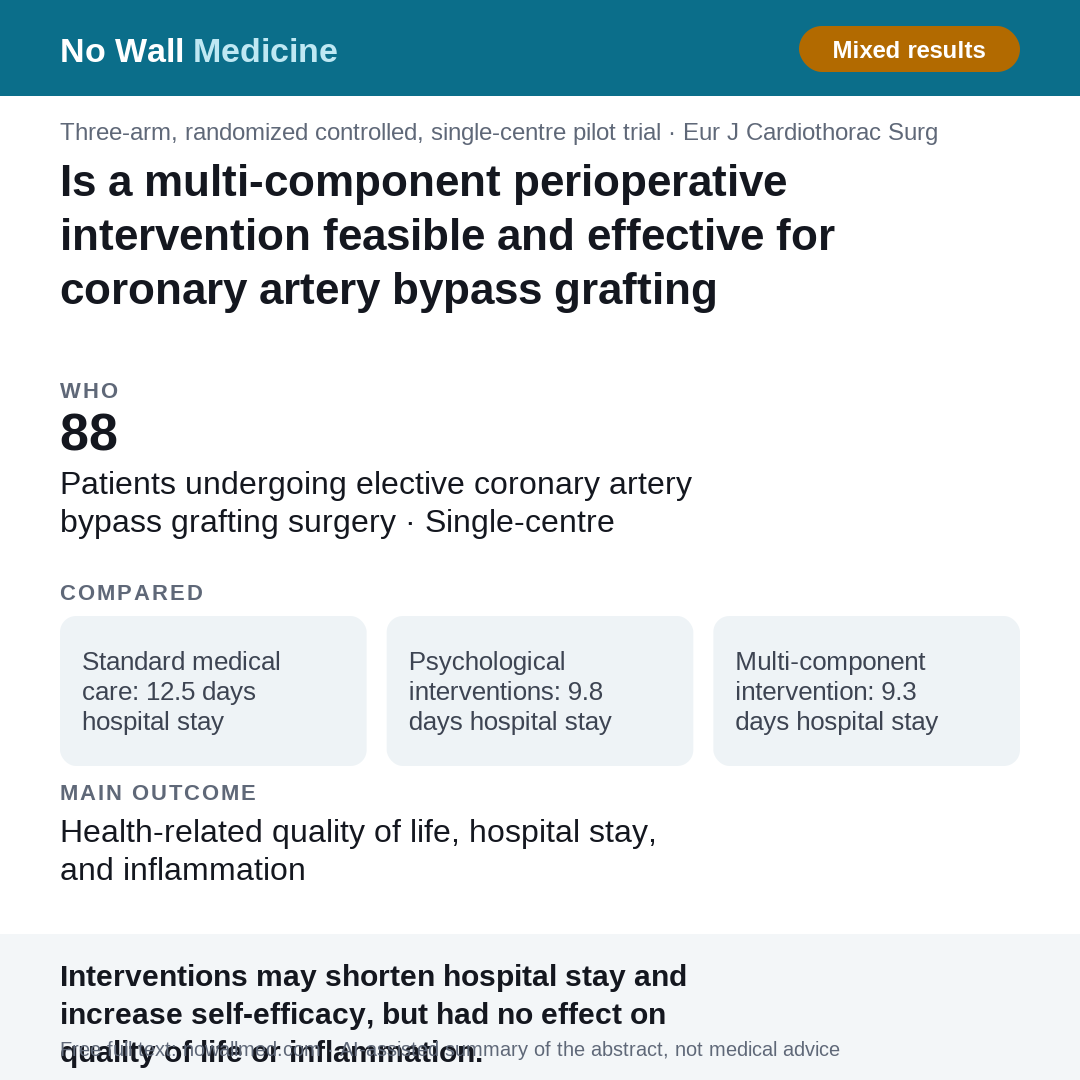
Is a multi-component perioperative intervention feasible and effective for coronary artery bypass grafting patients?
Who
88
Patients undergoing elective coronary artery bypass grafting surgery · Single-centre
Compared
Standard medical care: 12.5 days hospital stay
Psychological interventions: 9.8 days hospital stay
Multi-component intervention: 9.3 days hospital stay
Main outcome
Health-related quality of life, hospital stay, and inflammation
Bottom line: Interventions may shorten hospital stay and increase self-efficacy, but had no effect on quality of life or inflammation.
Limitation: This was a pilot trial; further studies are needed to determine impact on quality of life and inflammation.
Eur J Cardiothorac Surg · 2022-02-10Download image
Clinical question: Is a multi-component perioperative intervention feasible and effective for coronary artery bypass grafting patients?
Why it matters: It is unknown if combining psychological support with reduced hospital stressors can improve health-related quality of life and recovery after heart bypass surgery.
Key points
- Researchers studied 88 patients undergoing elective coronary artery bypass graft surgery, comparing standard medical care to psychological support or a multi-component intervention.
- The intervention groups had shorter hospital stays of 9.8 days and 9.3 days compared to 12.5 days for standard medical care.
- The interventions were not associated with changes in health-related quality of life or plasma levels of interleukin-6 and interleukin-8.
Limitation the authors note: This was a single-centre pilot trial.
Headline and key points written with AI from the paper’s abstract, with every number checked against it. Read the paper before relying on them.
Was this summary helpful?
Subject terms
Cite this article
Sadlonova M, Nagel J, Becker S, et al. Feasibility and preliminary efficacy of perioperative interventions in patients undergoing coronary artery bypass grafting: the randomized controlled I-COPE trial. Eur J Cardiothorac Surg. 2022. doi:10.1093/ejcts/ezac041
Spotted a mistake? Suggest a correction