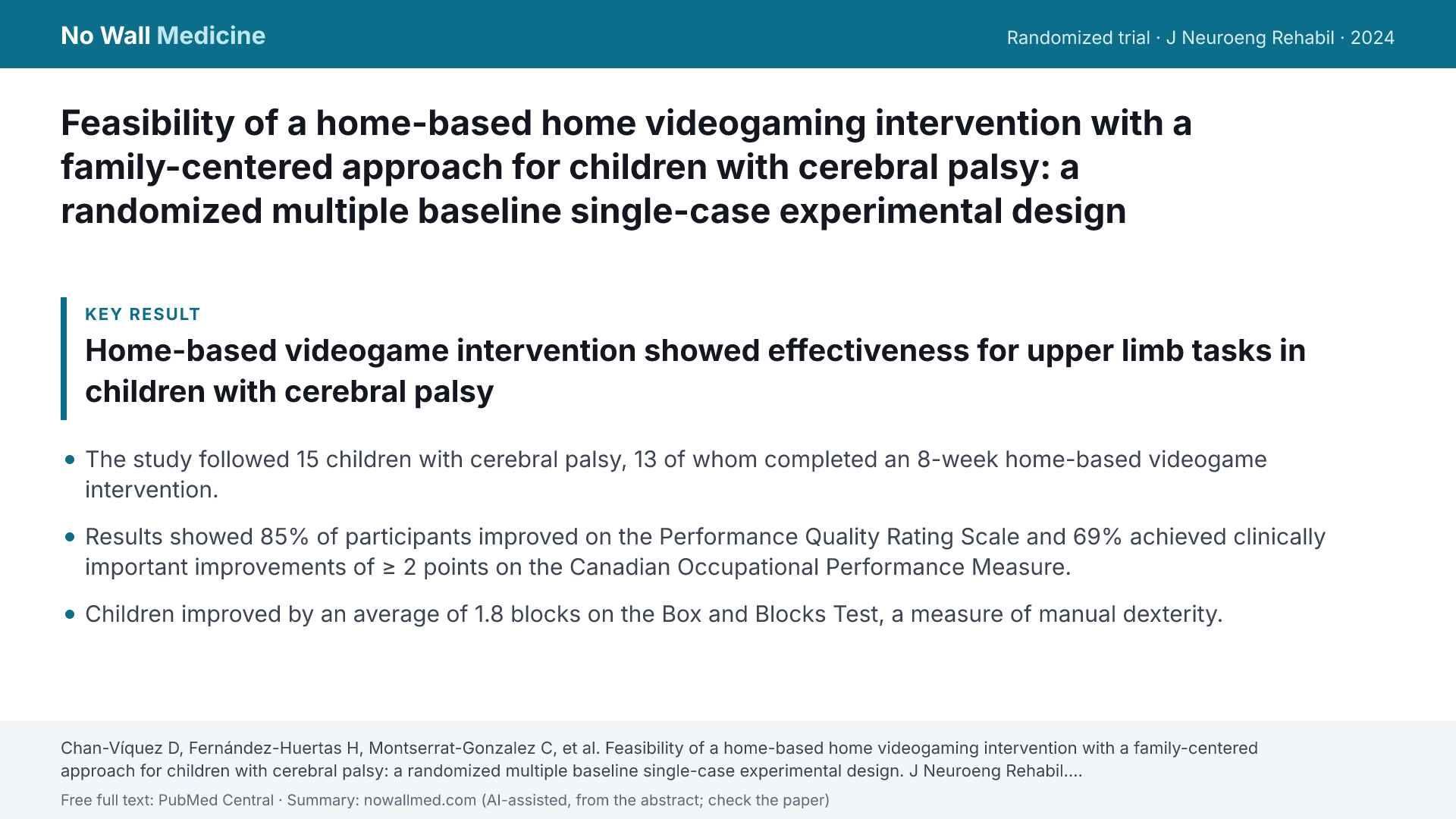
Feasibility of a home-based home videogaming intervention with a family-centered approach for children with cerebral palsy: a randomized multiple baseline single-case experimental design
Key result: Home-based videogame intervention showed effectiveness for upper limb tasks in children with cerebral palsy
Key points
- The study followed 15 children with cerebral palsy, 13 of whom completed an 8-week home-based videogame intervention.
- Results showed 85% of participants improved on the Performance Quality Rating Scale and 69% achieved clinically important improvements of ≥ 2 points on the Canadian Occupational Performance Measure.
- Children improved by an average of 1.8 blocks on the Box and Blocks Test, a measure of manual dexterity.
Why it matters: Children with cerebral palsy in underserved communities face barriers to accessing motor therapy services for upper limb function.
Discussion prompts
- Would these patients look like yours? Who was left out?
- Is the main outcome one that matters to patients?
- Is the difference large enough to change what you do?
Cite: Chan-Víquez D, Fernández-Huertas H, Montserrat-Gonzalez C, et al. Feasibility of a home-based home videogaming intervention with a family-centered approach for children with cerebral palsy: a randomized multiple baseline single-case experimental design. J Neuroeng Rehabil. 2024;21(1):151. doi:10.1186/s12984-024-01446-2
Free full text: PubMed Central · Summary and visual abstract: nowallmed.com/a/feasibility-of-a-home-based-home-videogaming-intervention-with-a-abq6eo/ (AI-assisted from the abstract; check the paper before relying on it).