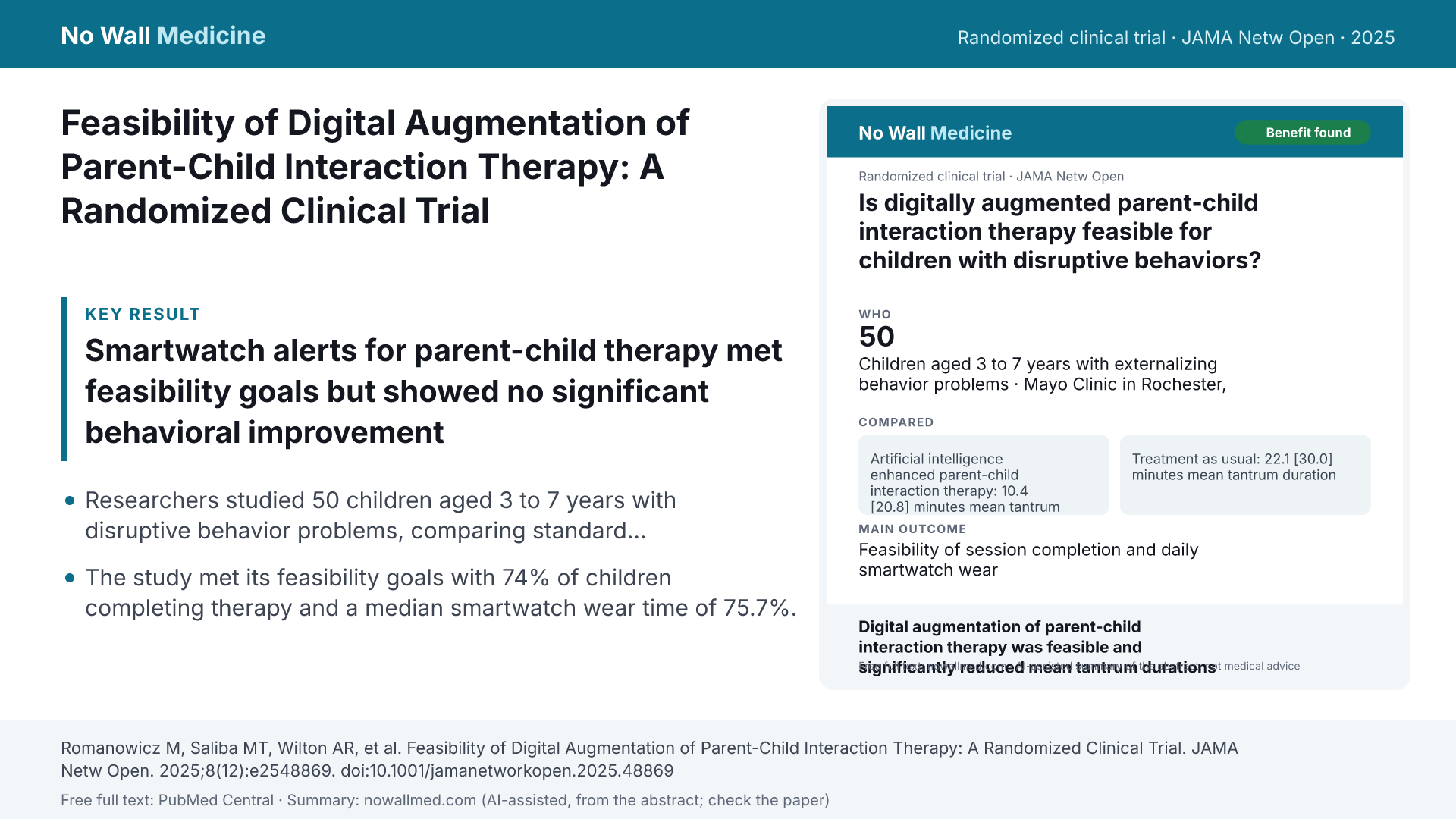
Smartwatch alerts for parent-child therapy met feasibility goals but showed no significant behavioral improvement
Feasibility of Digital Augmentation of Parent-Child Interaction Therapy: A Randomized Clinical Trial
Randomized clinical trialBenefit found
Is digitally augmented parent-child interaction therapy feasible for children with disruptive behaviors?
Who
50
Children aged 3 to 7 years with externalizing behavior problems · Mayo Clinic in Rochester, Minnesota
Compared
Artificial intelligence enhanced parent-child interaction therapy: 10.4 [20.8] minutes mean tantrum duration
Treatment as usual: 22.1 [30.0] minutes mean tantrum duration
Main outcome
Feasibility of session completion and daily smartwatch wear
Result: odds ratio 3.66 (95% CI 2.72-4.95) for tantrums lasting 15 minutes or more
Bottom line: Digital augmentation of parent-child interaction therapy was feasible and significantly reduced mean tantrum durations in children.
JAMA Netw Open · 2025-12-01 · Save PNG
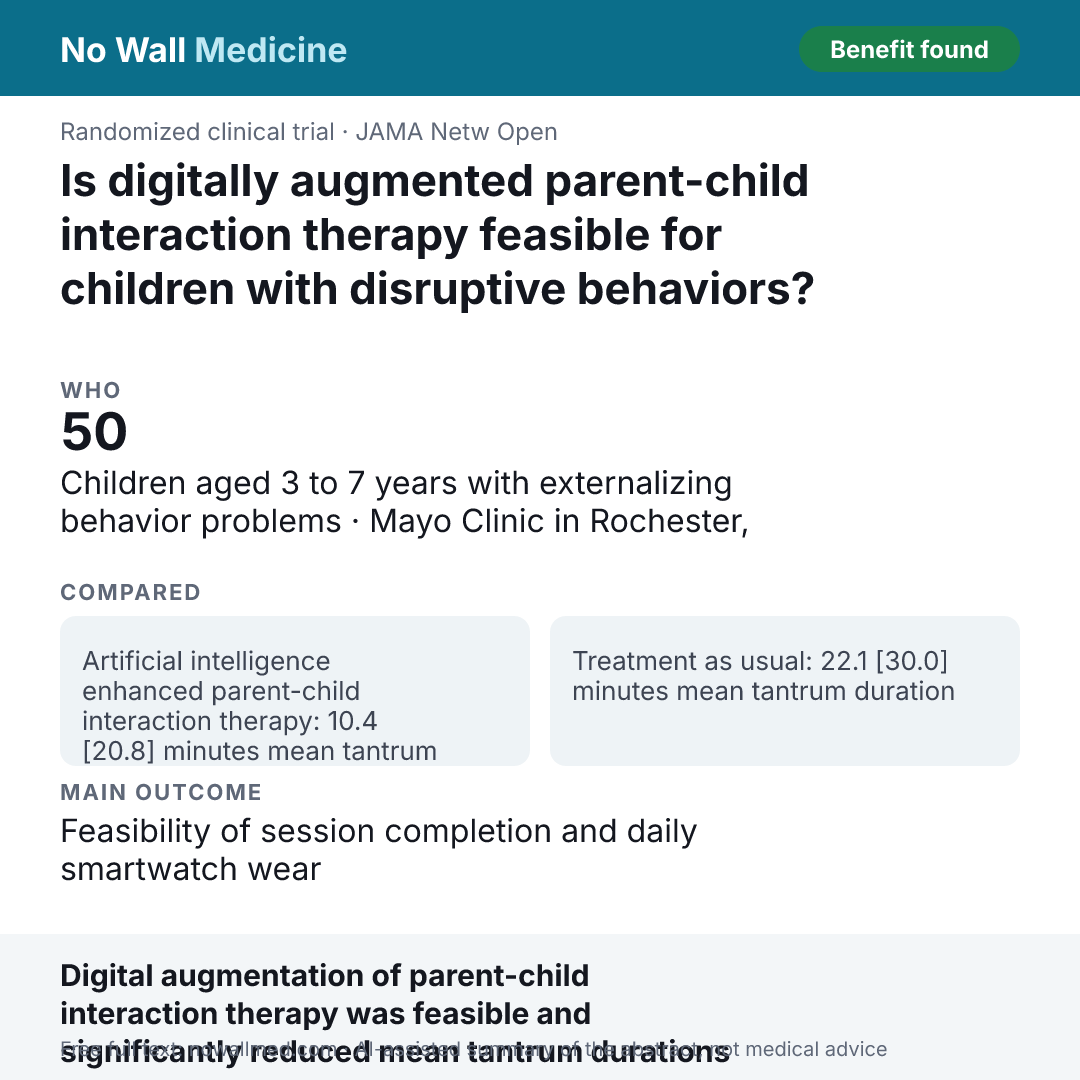
Clinical question: Is digitally augmented parent-child interaction therapy feasible for children with disruptive behaviors?
Why it matters: The potential utility of real-time digital therapeutics that identify impending behavioral outbursts to proactively apply interventions for children with disruptive behavior disorder has not been tested.
Key points
- Researchers studied 50 children aged 3 to 7 years with disruptive behavior problems, comparing standard parent-child interaction therapy to therapy enhanced with artificial intelligence smartwatch alerts.
- The study met its feasibility goals with 74% of children completing therapy and a median smartwatch wear time of 75.7%.
- The artificial intelligence arm was not linked to significantly greater improvements in behavior or sleep scores, though it was associated with shorter mean tantrum durations.
Headline and key points written with AI from the paper’s abstract, with every number checked against it. Read the paper before relying on them.
Was this summary helpful?
Subject terms
Headline, design, result, key points, caveat and citation as plain text.
Cite this article
Romanowicz M, Saliba MT, Wilton AR, et al. Feasibility of Digital Augmentation of Parent-Child Interaction Therapy: A Randomized Clinical Trial. JAMA Netw Open. 2025;8(12):e2548869. doi:10.1001/jamanetworkopen.2025.48869
Spotted a mistake? Suggest a correction